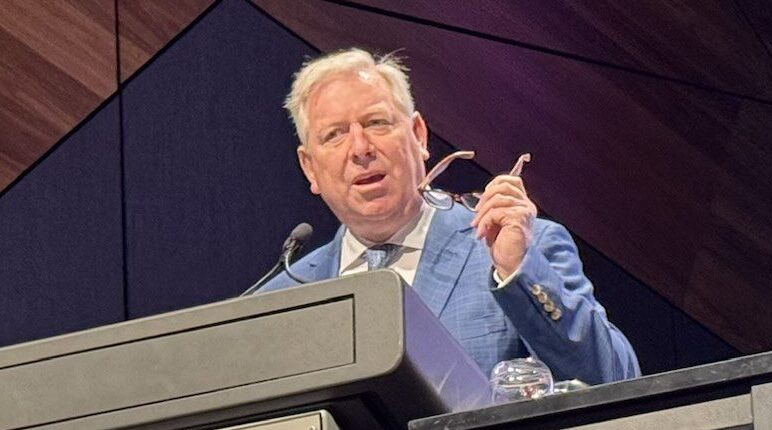
David Davis, potentially Victoria’s next energy minister if the Liberal-Nationals coalition wins November’s state election, says he would demand a “short, sharp and independent” review of the state’s multi-billion dollar transmission plan but admits renewable energy would provide “the single biggest component” of generation.
In an address to the All Energy 2026 conference in Melbourne on Wednesday, Davis did not provide new policy announcements but offered generally conciliatory comments to an audience made up largely by firms supporting the energy transition off fossil fuels.
“The electrification agenda is a very important one,” Davis said, adding that “the energy security agenda is incredibly important” as well.
In a nod to the 12 years of Labor government in Victoria, Davis said that “much has been achieved: the rollout of solar on a huge scale, additional wind capacity, additional battery and storage capacity has transformed much of our grid”.
However, most of this speech and in brief comments to Renew Economy afterwards, Davis criticised the pace and scope of the transition in Victoria, and emphasised the need for more gas.
He did not, though, explain how adding more of the expensive fossil fuel would lower prices and did not mention climate or emissions save for his closing lines.
The state’s looming energy issues include the planned closure of the 1.48 gigawatts Yallourn coal-fired power station by mid-2028, placing a priority on new generation capacity coming on line.
“We want living standards to rise. We want to manage energy prices and their impact on families,” Davis concluded. “At the same time, we are deeply, deeply aware of the need to focus on the reliability – reliability of the power supply – and on reducing emissions.
“The people in this room are central to our job … to make it easier, faster, and more affordable.”
Asked when a Liberal-led government would complete the transmission review, Davis said he hadn’t “put an exact time on it”, adding that he didn’t “intend to let the grass grow” in what would be a months’-long process.
“I’ve just pointed to [the All Energy conference] many of the projects that are some of them eight years behind time,” he said. “I’m just very heavy to push back on people who say, ‘Oh, a delay,’ but [the Labor government] were eight years behind time, and they’ve said nothing.”
In his speech, Davis cited at length an article in Monday’s Herald Sun that tapped into what it dubbed as a leaked “confidential briefing paper” on energy perpared for government department secretaries, no matter which party wins the 28 November elections.
Headlined “Dire gas shortage warning”, the article cited the leaked document as noting Victoria’s gas demand is forecast to exceed annual production by 2029. “If shortfalls are not addressed, the implications for households and the Victorian economy are significant,” the newspaper cited the report as saying.
That projection, though, is not greatly different from the latest gas statement of opportunities released by the Australian Energy Market Operator.
“From 2030, projected supply gaps under most weather conditions indicate a need [in eastern Australia] for new supply in addition to that now classified as committed and anticipated, or more investment in demand-side opportunities to lower gas needs,” the gas report said.
Indeed, “[g]as consumption across the residential and small commercial sectors is forecast to decline steadily, reflecting fewer active connections and the impact of projected electrification in response to market and policy drivers,” the AEMO report states.
“Bans on new gas connections in Victoria and the Australian Capital Territory contribute to lower forecast gas use, despite growth in new dwellings and economic activity, with 65% of the decline projected to take place in Victoria,” it states.
The Liberals have stated that reversing the gas connection ban would be a top priority in its first 100 days, should it win government. “Reverse Labor’s gas appliance bans and invite gas producers to propose conventional gas exploration opportunities to bring down power bills for Victorian homes and businesses,” is the stated policy.
Gas, though, would be expensive to extract, with few fields offering much promise, and insiders noting the absence of big companies bidding for drilling rights.
On Thursday, Labor Premier Ben Carroll announced the government had approved a production licence to restart the Patricia-Baleen gas fields off Victoria’s Gippsland coast.
“We know Victoria’s gas supplies are declining. That’s why Labor is focused on securing the supply we do have and backing new sources of gas,” Carroll said in the statement. The licence was granted to Cooper Energy, a subsidiary of Amplitude Energy.
“The project is expected to deliver up to 15 petajoules of gas over its lifetime – equivalent to 7% of all gas used in Victoria last year,” the premier said.
To support independent media, and help combat the spread of deliberate misinformation and disinformation about the energy transition, you can click here to make a one off donation or become a regular supporter of Renew Economy.
To join more than 29,000 others and get the latest clean energy news delivered straight to your inbox, for free, click here to subscribe to our free daily newsletter.
rnewables that they they they’re going to have to do a lot of this.
In closing, I want to say a few things. The electrification agenda is a very important one. The energy security agenda is incredibly important. Much has been achieved: the rollout of solar on a huge scale, additional wind capacity, additional battery and storage capacity has transformed much of our grid. More, in my view, needs to be focused on supporting businesses. Businesses have been left without the support they need, and we will say more about that. I’m conscious also, and I know the minister’s announcement on renewable gas, and we strongly support the place of renewable gasses in our system, and see that there is significant gas to be got through those particular approaches. And you know, perhaps I can draw one out.
The Liberals and Nationals have announced that we will not proceed with VNI West, and we will undertake a short, sharp, and independent review of the Victorian Transmission Plan, associated connections, and the renewable energy zones. In the light of the leaked paper, my key focus has always been on finding ways to build capacity within the system through new build and new connections, growing demand from population growth, data centers, and the retirement of other assets will mean a very significant need for new energy, and renewable energy is the single biggest component of that. The proponents and enablers in this room will be central to meeting it.
d
Peter Hannam
Peter Hannam is a veteran journalist whose work spans almost four decades and includes stints outside Australia, including time in China, Japan, Singapore and Mongolia. He has lately reported extensively on energy, climate and environmental issues in Australia, and also worked for the federal Climate Change Authority as a special media advisor.
Share this:
Facebook
X
LinkedIn
Reddit
Email
Print