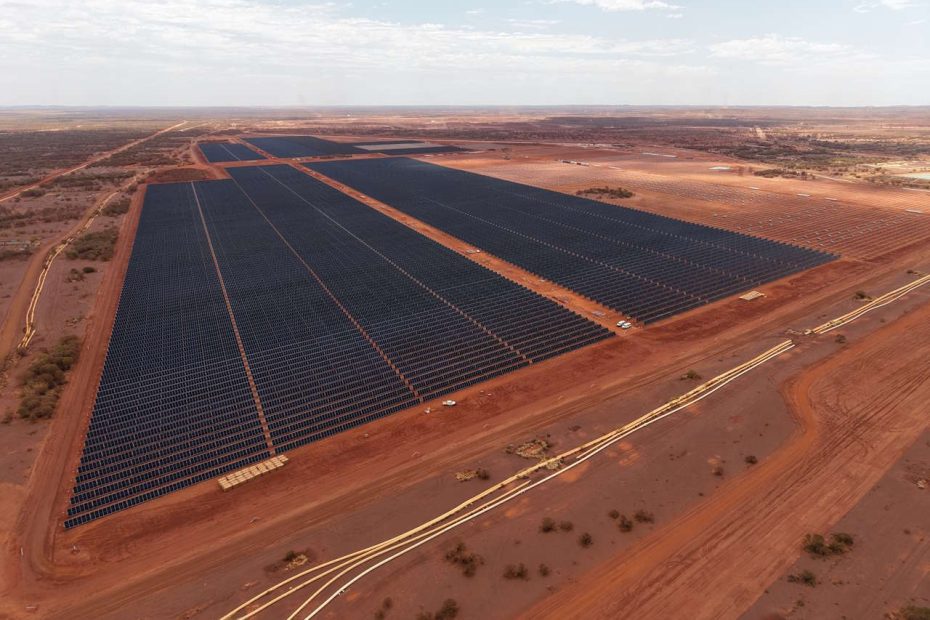
Australian mining giant Fortescue has signed its first power purchase agreement to supply clean electricity from its massive new Green Grid in the Pilbara, the first step towards establishing itself as a major energy supplier to industry.
Fortescue, the world’s fourth-largest iron ore producer, is building multiple gigawatts of wind, solar and battery storage to eliminate fossil fuels in its own mining operations, and is also building excess capacity to sell firm green electricity to outside customers, such as miners, data centres and green steel.
On Wednesday, it announced it had signed a long term power purchase agreement (PPA) with lithium producer PLS Group for a minimum of 325 gigawatt-hours (GWh) of power annually, equivalent to around 100 MW of wind and solar, depending on the mix.
Fortescue is building 2.4 gigawatts of wind and solar, backed up to to 5 GWh of battery storage, to meet the 800 MW average demand needs of what will be its full electric mines, and have 200 MW of spare capacity left over.
The deal with PLS will power its lithium hard rock Pilgangoora mine in the Pilbara, currently being expanded at a cost of $1.9 billion, with supply expected to commence some time in 2029, by which time the green grid will be complete.
To supply the mine, Fortescue will build an approximately 25-kilometre, 220kV transmission line to connect its Green Grid with the Pilgangoora Operation, while PLS will fund the entire transmission line and own 20 kilometres of it. Fortescue owning the remainder.
This new transmission line builds on Fortescue’s existing rollout of transmission lines across the Pilbara, having already built 550 kilometres-worth of the planned 660km network.
Fortescue flagged earlier this year that its Green Grid would be the “world’s first” replicable green grid capable of eliminating diesel and other fossil fuels for large-scale industry.
More than 1.3 gigawatts (GW) of solar and wind capacity, and over 1 GWh of battery storage, is already operational or under construction in the Pilbara.
Image Credit: Fortescue
“We started building the Green Grid for our own operations, but we could see strong demand for cheap, green, reliable power across the Pilbara and an opportunity to supply other customers too,” said Dino Otranto, Fortescue Metals CEO, adding that there is a strong pipeline of other users looking to source power from its Green Grid.
“Cost. Climate. Control. That’s the case for the Green Grid. We used 680 million litres of diesel last year, and every 10-cent rise in diesel prices adds almost US$70 million to our annual costs,” he said.
“Replacing diesel with renewable power improves our competitiveness, cuts emissions, reduces our exposure to volatile fossil fuel prices, and gives us greater control over when and where we use energy.”
“We commend Fortescue’s leadership in developing the Green Grid and are pleased to partner with them as their first external customer,” said Dale Henderson, PLS managing director and CEO.
PLS says the deal will deliver significantly lower emissions and big savings on costs, estimated at around $20/tonne.
“This agreement will deliver lower-cost, lower-emissions power to our long-life Pilgangoora operation, further strengthening our competitiveness in the global lithium industry,” said Dale Henderson, PLS managing director and CEO.
To support independent media, and help combat the spread of deliberate misinformation and disinformation about the energy transition, you can click here to make a one off donation or become a regular supporter of Renew Economy.
To join more than 29,000 others and get the latest clean energy news delivered straight to your inbox, for free, click here to subscribe to our free daily newsletter.
Joshua S Hill
Joshua S. Hill is a Melbourne-based journalist who has been writing about climate change, clean technology, and electric vehicles for over 15 years. He has been reporting on electric vehicles and clean technologies for Renew Economy and The Driven since 2012. His preferred mode of transport is his feet.
Share this:
Facebook
X
LinkedIn
Reddit
Email
Print