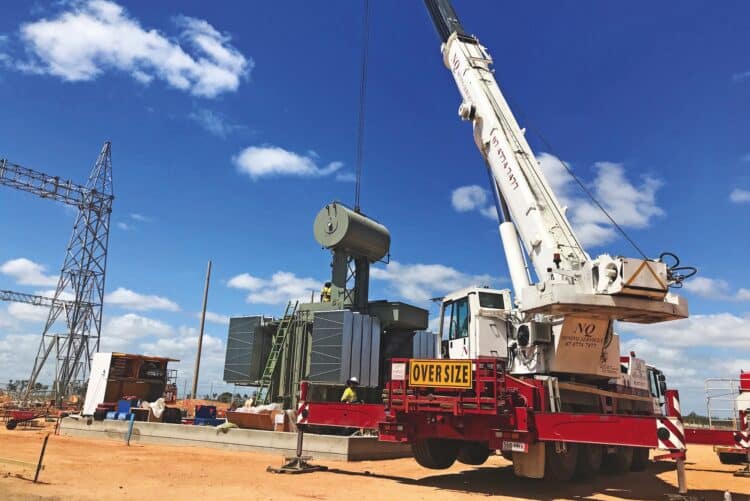
Early civil engineering decisions can prevent costly redesigns and keep battery and solar projects on track from concept to construction.
CivEng Consulting intimately understands the civil and structural engineering considerations that underpin renewable energy projects.
As a consultant on Australian substation, battery energy storage systems (BESS) and solar farm projects, the company sees how civil engineering parameters are being tested as developers push to get their projects installed.
CivEng sheds light on five lessons learned from decades in the field.
Don’t lock in megawatts too early
In CivEng’s experience, BESS developers will often fix the site boundary and megawatt capacity early in the piece, then pack in as many batteries as possible to support the financial model.
A civil review might then reveal that there’s not enough room for access roads, turning paths, drainage, batters and other earthworks.
If not identified and addressed early in the process, costly workarounds such as retaining walls, underground drainage or longer cable runs may then be required to ensure the project is compliant.
“On a past project, the battery layout was arranged to maximise the megawatts, but did not consider the site topography,” CivEng Consulting co-founder Vincent Kelly told Energy.
“We had to implement a tiered site with extended retaining walls in order to make this work.”
By strategising civil works early in the design phase, developers will have clear sight of their topographical advantages, empowering them to shape layouts and platforms around the existing ground.
They can also co‑optimise civil and electrical layouts, reserving direct cable corridors and placing electrical hubs strategically to avoid re-routes that could add hundreds of metres of cable runs.
CivEng repeatedly sees projects follow a 3D design file too literally without reconciling it with real ground conditions. Image: Steve/shutterstock.com
Use ECI to anchor design
In CivEng’s experience, optimising the construction methodology of a project depends heavily on who is going to build it.
Different contractors might have different cost profiles and construction processes for the same design concept. Early contractor involvement (ECI) ensures the right civil contractor is chosen for the job.
“If you talk to different civil contractors, one might recommend driven steel piles, while another might prefer concrete,” CivEng Consulting co-founder Dave Jones told Energy. “It comes down to their equipment, experience and supply chains.”
CivEng was recently engaged early to model the earthworks and firefighting ponds of a BESS project, which set the asset up for success.
“CivEng could determine how the developer intended to build the project and designed around that,” Jones said. “The developer then took those quantities to market, got ballpark pricing from civil contractors, and clearly understood their preferences before anything was fixed.”
In many projects, by contrast, contractors only see the job at the 70–80 per cent design phase, when foundation types and layouts are essentially locked in. If they wanted to make any changes to the construction methodology, this could be difficult and expensive.
Design vs. reality
CivEng repeatedly sees issues where construction follows a 3D design file too literally without reconciling it with real ground conditions.
“More and more earthworks are being built straight off CAD (computer-aided design) files,” Kelly said. “If no one considers how design translates on the ground, this often creates a mismatch with the actual site requirements.
“On one job, we found surveys hadn’t accurately captured how overland flow crossed a site. The road was built to the model, but excess water ran straight across it and washed part of it out.
“This had to be rectified after construction rather than designing for it up front, creating a headache and additional cost for the asset owner.”
As Kelly highlighted, solutions need to be determined “through conversations”.
“There will always be mismatches between design models and the actual topography,” he said. “The best way to resolve this is through conversations on-site, where we can explain the design intent and determine the right adjustment with the contractor.”
The right footings for the job
For CivEng, one of the most important – and misunderstood – decisions on battery and solar projects is how the equipment is founded: piles, pads, slabs on ground, bored piers, and beyond.
The ‘right’ footing is not just a structural question, but a practical construction choice.
“We always ask up-front, ‘What is your preference for the footings?’,” Kelly said. “We can make most options work, but the real answer can be region-dependent and rely on things like concrete availability, fabrication and the contractor building it.”
Developers also tend to default to whatever is shown in OEM drawings, even when those details are generic and not tailored to site.
“We’ve seen plenty of OEM manuals where the footings are just square blocks on a page,” Kelly said. “Many of these are produced overseas and not written with a specific Australian site, contractor or supply chain in mind.”
This can direct the whole footing strategy in the wrong direction. Developers are instead advised to agree on a footing strategy early, explicitly and in context – factoring in local supply chains, contractor methodology, and conduit routing.
BESS developers will often fix the site boundary and megawatt capacity early, before a civil review reveals constraints. Image: Harley Kingston/stock.adobe.com
Bring civil input in early
For a battery or solar project, the most valuable work happens at concept or around the 30 per cent design stage, when layouts, foundation strategies, access and drainage are still flexible.
Without an early civil voice, key decisions on these priorities are either pushed back or made by default. Jones recalled a BESS project where CivEng tried to recommend optimising footings early on – and got little traction.
“The developer was focused on project planning and power purchase agreements, so the civil detail wasn’t prioritised,” Jones said. “This isn’t detrimental initially, but the longer these decisions are ignored, the more problematic it can become.”
Ignored for too long and this can trigger a chain of late – and costly – changes.
By bringing civil in early, developers can prevent expensive re‑work when projects hit tender or construction, and ensure their layout actually works on site and within the local context.
Early civil input acts as risk insurance on three fronts – cost, constructability and schedule – at a stage when adjustments are practical and affordable.
Backed by 80 years of combined industry experience, CivEng Consulting has worked on enough renewable energy and power projects to understand the common mistakes made in design and construction phases.
The company is putting this wisdom to good use, setting Australian BESS, solar and substation assets up for long-term success.
This feature appeared in the September edition of Energy.