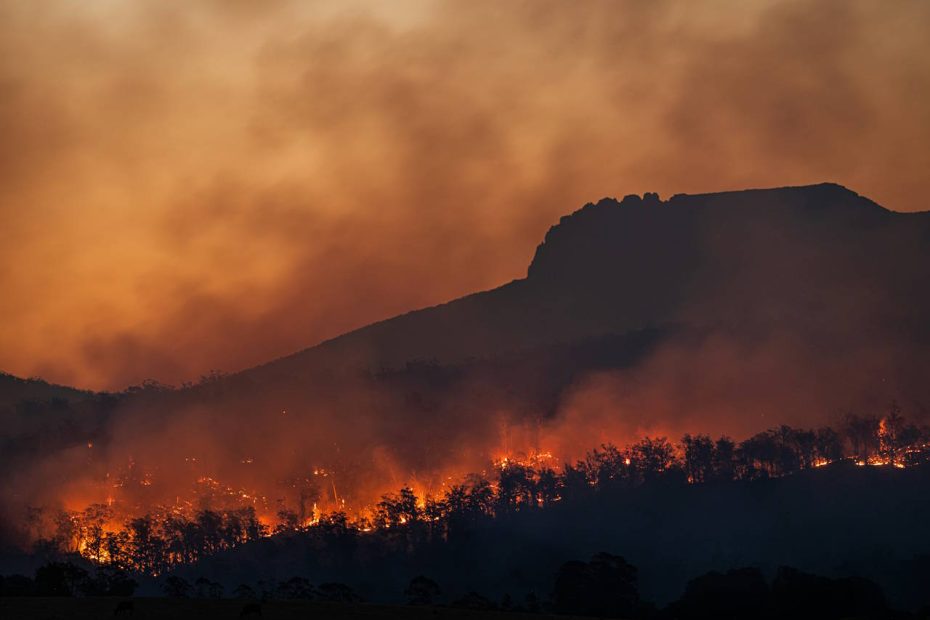
Solar farm operators across Australia are being warned to prepare for the effects of bushfires, beyond the obvious direct fire risk, with smoke from major outbreaks capable of dramatically reducing electricity generation from as far away as 150 kilometres.
New research published this week by the University of New South Wales (UNSW) highlighted the need for better forecasting of smoke movements, more frequent panel inspections and cleaning, and changes to how solar panels operate.
The new research from the UNSW, which examined the effects of the 2019-2020 Black Summer fires and Victoria’s 2009 Black Saturday fires, shows the need to look beyond solar farms immediately surrounding a fire and consider where smoke is likely to travel.
The analysis used historical weather and satellite data to model how smoke and airborne particles affected solar electricity generation and panel temperatures across south-eastern Australia. The results are therefore not specific measurements from individual solar farms, but modelled estimates.
For example, during the Black Summer bushfire, the researchers estimated that energy generation from solar farms would have fallen by up to 70 per cent within 50 km of bushfire hotspots, and around 40 per cent in regions more than 150km away.
Similarly, though less dramatically considering the comparatively reduced scale, the Black Saturday fires in Victoria would have resulted in 18 per cent reductions in energy generation from solar farms near bushfire hotspots, and between 4 to 10 per cent for solar installations over 100km away.
This was due not only to the smoke plumes and atmospheric haze which “significantly reduce incoming solar irradiance and thus limit PV output,” but also due to the buildup of smoke particles on solar panels which can reduce the sunlight reaching the panel’s surface.
“We should start looking into things like trajectory modelling of the smoke and how long and far those smoke particles can be transported,” said Dr Shukla Poddar, the report’s corresponding author and a Postdoctoral Researcher at the School of Photovoltaics and Renewable Energy Engineering, UNSW Sydney.
“Extreme bushfires are becoming more frequent and intense in several regions, including Australia, California, and southern Europe. Their impacts are not confined to the areas where fires burn: smoke from California’s 2020 wildfires reached Europe, while smoke from Spain’s 2025 fires travelled as far as the UK and northwestern Europe.
“Although this particular study is based on two extreme bushfires in Australia, the same method and analysis can be done for other parts of the world.”
The research also found that solar modules would have operated 10-20°C higher than the climatological module temperature during the Black Summer bushfire period.
This occurs not only because of “the anomalously hot” temperatures during the 2019-2020 summer, but also because of emissions from the bushfires which deposit smoke particles on solar panels, creating localised hotspots on the modules, resulting in increased module temperatures and potentially increasing thermal degradation.
Recommendations based on the research included the need to combine bushfire information, wind patterns, and smoke-trajectory modelling, in order to help predict which solar farms are likely to be affected.
Weather forecasts already help solar farm operators to anticipate conditions such as high temperatures and strong winds, but a similar system for smoke could give operators advanced warning that airborne particles are heading towards their facilities.
This would, in turn, help operators prepare, allowing them to plan inspections to identify unusually hot panels or electrical components, schedule more frequent cleaning, or adjust the position of panels before smoke arrives.
“If operators got an alert that their solar farm might be impacted, they could potentially adapt some mitigation strategies, such as adjusting the panel angle where appropriate or being aware that additional cleaning may be required,” said Poddar.
Changing the angle of solar panels away from accessing maximum sunlight could help to reduce heat exposure as well as potentially help loosen smoke particles that have gathered on panel surfaces.
The paper also recommended better remote monitoring and electrical fault detection to allow operators to more quickly identify temperature anomalies and quickly isolate affected parts of a system.
Dr Poddar and her colleagues also believe their research can help inform decisions about where to build solar farms in the future. Developers could, for example, assess the history of nearby bushfires and examine prevailing wind directions and likely smoke pathways as they investigate potential sites.
“This framework can be combined to understand the frequent bushfire hotspots and air trajectory pathways as a pre-feasibility assessment for site selection of new solar farms,” the paper says.
“This is also beneficial for understanding optimal operational and management strategies for current operational solar farms that are in proximity to bushfire hotspots or can be affected due to aerosol dispersion and travel.
To join more than 29,000 others and get the latest clean energy news delivered straight to your inbox, for free, click here to subscribe to our free daily newsletter.
Joshua S Hill
Joshua S. Hill is a Melbourne-based journalist who has been writing about climate change, clean technology, and electric vehicles for over 15 years. He has been reporting on electric vehicles and clean technologies for Renew Economy and The Driven since 2012. His preferred mode of transport is his feet.
Share this:
Facebook
X
LinkedIn
Reddit
Email
Print