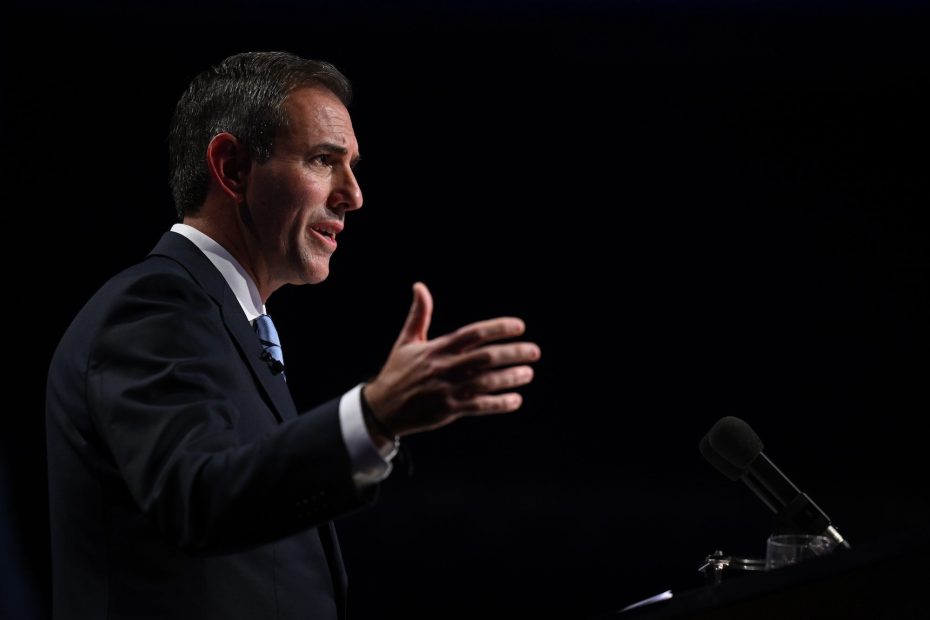
The renewable energy sector will be among the likely beneficiaries of changes introduced by Treasurer Jim Chalmers to the performance test applied to the $4.8 trillion superannuation industry that are intended to reduce “benchmark hugging” by fund managers.
The removal of investment barriers has “the potential to unlock up to $90 billion of investment in emerging assets,” Chalmers told a conference in Melbourne on Wednesday hosted by the Association of Superannuation Funds of Australia (ASFA).
The government will introduce a new benchmark “to enable capital flows into more productive, transformational investments such as innovative start‑ups, housing and energy, recognising that some opportunities are not well represented in current benchmarks,” Chalmers said.
Under the voluntary scheme, trustees can opt to use the new benchmark in new investments for as much as 5% of their portfolio. The measure will be set at a margin above the consumer price inflation rate, with different levels for growth and defensive assets.
“I know some of you would like to see a higher allocation than 5%, but this is a sensible starting point which can be assessed in future reviews,” Chalmers said, flagging the prospect of a higher allocation in the future.
Australia’s super fund assets are massive in global terms, and are already the fourth-biggest capital pool in the world. They are on track to be the second largest by the early 2030s, he noted.
However, performance mandates have tended to discourage investment in long-term assets if such allocations reduce near-term returns.
While housing has gleaned a lot of the media’s attention given governments’ struggles to lift the construction rate to meet a swelling population, the lack of superfund investment in decarbonisation and climate adaptation efforts has also been telling.
As Matt Kean, chair of the Climate Change Authority told a March conference of the Australian Council of Superannuation Investors, investment mandates are not yet aligned to the challenge of maximising members’ returns decades in the future, when climate impacts are likely to be more severe as the planet warms.
“If Australia really is to have a net-zero emissions economy by 2050, do the investments you expect to generate returns to super holders from incorporate that goal?” Kean said. “Mid-century is only 24 years away, after all.”
“By some measures, we’ll need half a trillion dollars of investment to re-tool our economy over the next couple of decades,” he said. “The Business Council of Australia estimated the investment range to hit the upper end of the 2035 emissions goal alone at between $200-$500 billion.”
Chalmers’ speech mentioned “energy” once without referring to renewables, per se.
For now, though, no private companies – nor any states – have indicated an interest to build new coal-fired power stations. Nuclear power, so far, has the backing only of One Nation nationally, and the federal Coalition.
ASFA chief executive Mary Delahunty welcomed reforms to strengthen the superannuation performance, saying they would preserve the performance test’s role in ensuring funds consistently perform well.
They also addressed unintended consequences of its original design that hampered investment “in certain opportunities that offer strong long-term returns for Australians,” ASFA said.
“The indices used in the current test represent established asset classes and do not align with the risk and return characteristics of emerging assets,” Delahunty said in a statement.
“The new emerging assets benchmark, set at a margin above inflation, will give funds a more suitable measure for these investments.
“Energy infrastructure is a good example”, of unintended consequences of the current performance test, she said.
“The [artificial intelligence] buildout depends on new generation, storage and transmission to power it, and portfolio managers are seeing strong opportunities to invest,” Delahunty said. “But the design of the test can discourage them.
“Under the current test, new infrastructure projects, which earn little during construction, are measured against a benchmark that reflects mature, established infrastructure assets with relatively high annual returns,” Delahunty said.
“That can make a sound long-term investment hard to justify in its early years, even though that investment would serve Australians’ long-term retirement savings.”
The Clean Energy Investor Group also welcomed the Treasurer’s plan.
“These changes will remove a significant barrier to super funds investing in clean energy in Australia,” a CEIG spokesperson told Renew Economy. “This comes at a crucial time, when much more investment is needed in Australia’s energy transition.”
“Up until now, the benchmark has compared investment in new clean energy assets to investments in mature assets in other sectors,” the spokesperson said.
“Investments in new renewable energy assets take longer to generate returns as it takes several years to build and commence operations, but the short-term view of the current annual super performance test creates a disincentive to holding these assets that will still deliver significant value over their operational lives,” he said.
“Creating a new class for emerging assets allows super funds to further diversify their portfolios while still requiring them to act in the best financial interests of their members,” the spokesperson said. “There is a lot of detail still to be worked through, and we look forward to engaging closely with Treasury on this.”
However, Chalmers’ plan has drawn criticism from the federal opposition.
Kevin Hogan, the coalition’s spokesperson for financial services, said earlier this week the Albanese government “wants your super invested in Net Zero 2050.”
“Super is your money. It must be invested in your best financial interests,” Hogan said in a statement. “But Labor treats your super like a piggy bank for its pet projects.
“The Coalition introduced the performance test in 2021 to protect Australians from underperforming funds,” he said. “It’s not perfect – but it’s working. Treasury’s figures show the number of members in failing funds fell from one million in 2021 to just 8,500 in 2025.
“Ultimately, I’m concerned these changes could lower the bar on your super’s performance,” Hogan said.
Chalmers, though, stressed in his speech, “we are strengthening the [performance] test not watering it down”.
“Your expectation and our expectation is that our reforms will make a positive, tangible difference to retirement balances,” he told the audience of super fund representatives.
“And on one estimate, a higher allocation in venture capital or private equity could mean around $20,000 extra in retirement for an average income earner,” Chalmers said, without stating the source of the figure.
The new benchmark would use a sector‑neutral definition for eligible assets, focused on where existing benchmarking options fall short. It would also be based on independent advice from the Australian Government Actuary and administered by the Australian Prudential Regulation Authority, Chalmers said.
If you would like to join more than 29,000 others and get the latest clean energy news delivered straight to your inbox, for free, you can click here to subscribe to our free daily newsletter.
If you wish to support independent media, and accurate information, please consider making a one off donation or becoming a regular supporter of Renew Economy. Please click here. Your support is invaluable.
Peter Hannam
Peter Hannam is a veteran journalist whose work spans almost four decades and includes stints outside Australia, including time in China, Japan, Singapore and Mongolia. He has lately reported extensively on energy, climate and environmental issues in Australia, and also worked for the federal Climate Change Authority as a special media advisor.
Share this:
Facebook
X
LinkedIn
Reddit
Email
Print