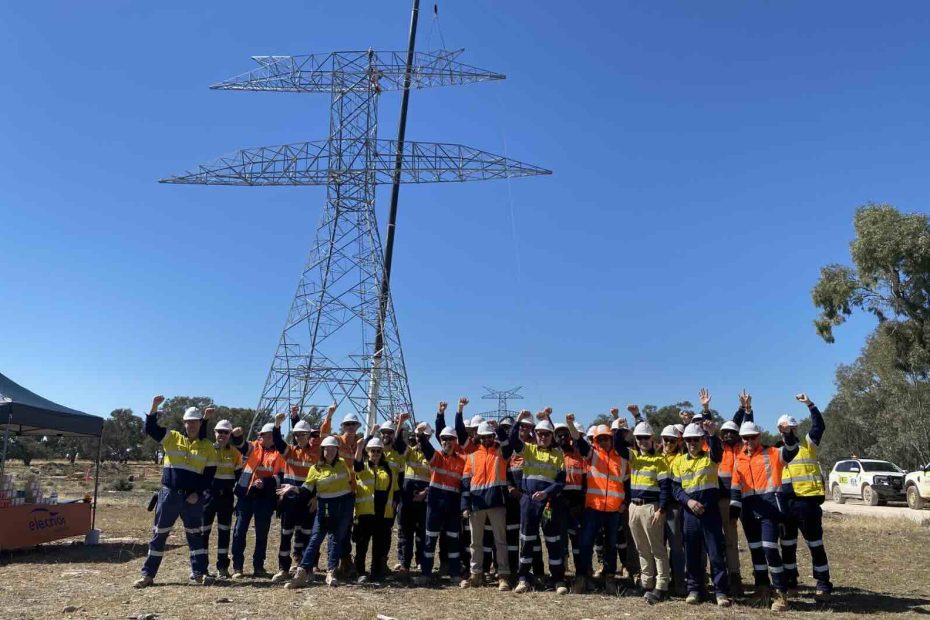
The final stage of Australia’s biggest new transmission project, a 900 km grid augmentation that will “fundamentally change” the flow of electricity between three major states, has started operational testing as it works its way towards full output at the end of next year.
The Australian Energy Market Operator (AEMO) last week announced the major milestone for the $4.1 billion Project EnergyConnect, a “first of its kind” interconnector that will create a new transmission loop linking South Australia, Victoria and New South Wales.
The two-stage project connects Robertstown in South Australia to Wagga Wagga in New South Wales, adding around 800 megawatts (MW) of new bidirectional capacity, and has been delivered by network companies ElectraNet on the SA side and Transgrid on the NSW side.
AEMO says that, starting this month, it will progressively bring into operation stage 2 of Project EnergyConnect (PEC) – the 700 km NSW section, including more than 1,500 towers – increasing energy transfers as conditions enable testing opportunities, with full commissioning expected by the end of 2027.
It’s a huge moment for the Australia’s main grid, the National Electricity Market (NEM), being the first new electricity interconnector between Australian states in 15 years.
“Integrating a new transmission line of Project EnergyConnect’s unique characteristics requires extensive preparation across power system operations, market rules and industry readiness,” said AEMO’s group manager of operations resilience, Teresa Smit, in a statement last week.
“As system and market operator for the NEM, this means AEMO must update market, settlement, dispatch and registration arrangements to recognise the new interconnector and the more complex conditions created by a looped network,” she said.
It is also a huge moment for Australia’s energy transition – the project is considered crucial to boost the security and reliability of the NEM, help South Australia reach 100 per cent “net” renewables, and support new generation essential to allow NSW to phase out the last of its coal fired generators.
“The extension of the existing 44,000 km transmission network throughout the NEM is underway to support a near doubling of electricity consumption by 2050 as homes, businesses and industry increasingly electrify and while ageing coal-fired generation progressively retires,” Smit said.
“Transmission connects new generation and storage to the grid, helping move electricity from where it is generated to where it is needed and allowing lower-cost electricity to be shared between regions.”
On LinkedIn, the new interconnector’s official launch on the NEM – AEMO is dispatching PEC as a separate interconnector NSW1-SA1 – was noted by a number of industry watchers and experts, with one describing it as the beginning of “a new era for Australia’s NEM.”
“From 1 October, Project EnergyConnect (PEC) has officially entered the NEM Dispatch Engine, with transfer capacity initially limited to ±150 MW. The full 800 MW bidirectional transfer capacity is expected to be progressively released,” said the power system and grid connection engineer.
“For South Australia, this could mark a turning point. The long-standing challenges of severe renewable curtailment and negative prices, driven by high rooftop PV and wind farm penetration and limited interchange capacity, could gradually become a thing of the past.
“Negative prices in South Australia during midday will gradually become less frequent, while evening price peaks will also weaken.
“After nearly eight years of accumulated utility-scale solar development demand, South Australia is set to see a significant surge in hybrid solar projects, positioning the state to become the energy hub in NEM.”
Over at Watt Clarity, Paul McArdle shared some snapshots of the interconnector’s first bursts of activity on the NEM.
Source: Watt Clarity
The journey
Project EnergyConnect was first included in AEMO’s 2020 Integrated System Plan (ISP) and has a somewhat bumpy journey through planning, regulatory approval and construction, at least on the NSW side of the equation, anyway.
The project was to have been up and running by now, and while the South Australian side – a 206 km line from Robertstown to the SA-NSW border – was finished on time and on budget in late 2023.
But, the NSW side – a 700 km line from the border to Wagga Wagga and two new substations at Buronga and Dinawan – has faced a series of issues that blew out total project costs from $1.8 billion to $3.6 billion and delayed delivery.
The Australian Energy Regulator has so far resisted Transgrid’s efforts to recover some $1 billion in extra costs through its 2023-28 revenue determination.
Transgrid claims the added costs have been out of its control, caused by what it describes as a “contract failure” with the project’s engineering, procurement and construction partner, Elecnor.
“Energisation of EnergyConnect marks the culmination of one of the nation’s most significant transmission builds and is a defining moment in the delivery of Australia’s clean energy future,” Transgrid CEO Brett Redman said in a statement in June, when construction was completed and the NSW line was energised.
“EnergyConnect will benefit consumers by enabling access to lower-cost sources of energy like solar and wind, also known as wholesale energy, which is the largest component of household bills,” Redman said.
“The project will also help achieve Australia’s climate change targets as we replace coal-fired power with renewable energy.”
Transmission projects – many of them considered critical to underpin Australia’s exit from coal – have been some of the most contentious in the transition to renewables, with their costs and impacts on landholders and farmers in the path of the huge new lines making them unpopular and politically divisive.
In Victoria, the future of two major transmission projects VNI West and Western Renewables Link – both of which have links with EnergyConnect – is hanging in the balance, likely to be determined by the outcome of the November state election.
In this context, the latest milestone of Project EnergyConnect becomes even more significant.
“The energy transition is not a distant ambition – it is a build that is happening now – and it is demonstrably achievable,” said Redman in June.
“Transgrid is playing our part to strengthen the critical energy backbone – EnergyConnect is done, HumeLink is well underway, and the rest of the build is moving at pace.”
To join more than 29,000 others and get the latest clean energy news delivered straight to your inbox, for free, click here to subscribe to our free daily newsletter.
To support independent media, and help combat the spread of deliberate misinformation and disinformation about the energy transition, you can click here to make a one off donation or become a regular supporter of Renew Economy.
Sophie Vorrath
Sophie is editor of Renew Economy and editor of its sister site, One Step Off The Grid . She is the co-host of the Solar Insiders Podcast. Sophie has been writing about clean energy for more than a decade.
Share this:
Facebook
X
LinkedIn
Reddit
Email
Print