The latest perovskite solar cell research out of a Sydney university comes with an intriguing headline, but it’s what the lead researchers couldn’t say about a secret molecule that might be most interesting.
The same University of New South Wales (UNSW) team that landed a $6.3 million grant last month has revealed that it can almost match silicon-based solar panels for efficiency.
The 23.5 per cent efficiency rating was for a very specific type of module, a 30 x 30 cm “submodule” that didn’t have extra layers to juice the output.
It’s a figure the research team, led by Scientia professor Xiaojing Hao, says is a world record, and beats by the slimmest of margins a Chinese team using an iron compound.
What Hao won’t talk about is the detail of how they got there – patents are pending as they push to get the technology out of the lab and into the real world.
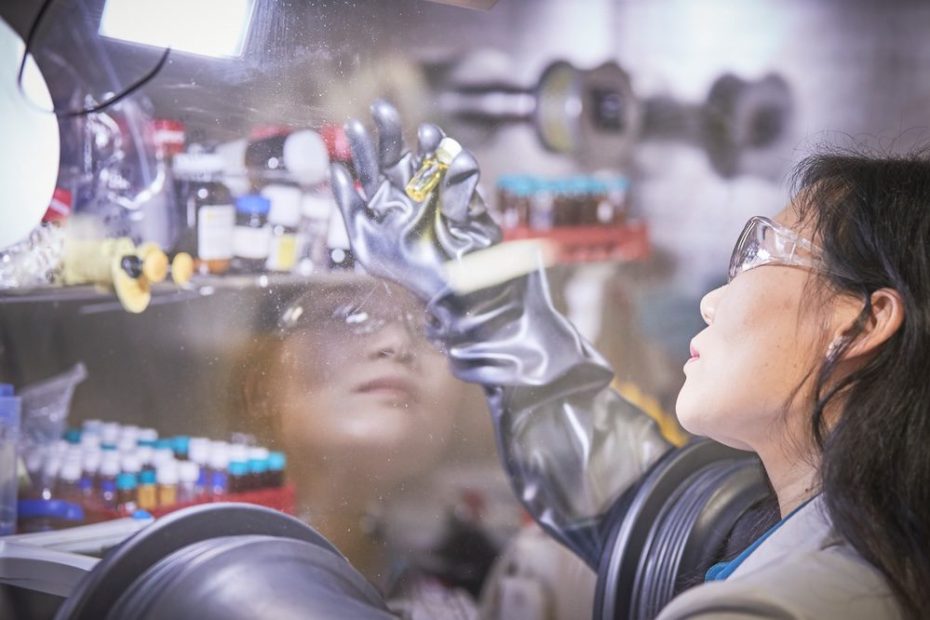
All she will say is they’ve removed a layer of nickel oxide and have introduced a new, still secret, molecule.
Perovskites are made with a liquid solution that when heated, turns into a light-absorbing crystal structure which can generate electricity from sunlight.
A metal oxide layer laid down on top of the dry solution directs positive charge and electron traffic.
But it also causes the crystals to break down.
Zhen Li, a member of Hao’s research group, says the team injected a molecule into the perovskite solution that does the same job but without the degradation.
The tricky bit was ensuring the molecule mixed evenly with the solution, but Li says solving this problem is one of the, still secret, innovations in their latest work.
Making it last
Perovskites have been the almost-there of solar technology for more than a decade.
Renew Economy has reported on years of efforts by researchers across Australia, many of whom hoped their latest result could be the harbinger of commerciality.
In 2023, one research house tipped the industry to be a 2 gigawatt (GW) competitor to photovoltaics this year.
But advocates of the technology have been consistently defeated by stability problems: the cells degrade fast in heat, moisture and, ironically, sunlight.
The most efficient crystals are also the least stable, degrading within days or months, and they don’t work well at scale, which in research terms means anything bigger than a 1 cm by 1 cm square.
“Everyone recognises the major issue is still, while we are achieving high efficiency, how to make them stable,” Hao tells Renew Economy.
“We see those things as the same target…When we improve the efficiency, we definitely remove some of the defects.
“Removing the nickel oxide, it actually removes the potential degradation pathway at the barrier interface caused by the nickel oxide.
“That improves the stability.”
They’ve just got to figure out what works as a high-performance material while also holding up when used in large-scale fabrication.
Corporate competition
Researchers and companies are still pursuing the dream because perovskite cells are cheaper and easier to make than silicon photovoltaics (PV), which need sterile cleanrooms and temperatures up to 1400ºC.
That, and the speed at which the industry is moving is exciting: Hao’s team went from a 1 cm² module to the 30 cm² in just two years, while patent applications and journal articles written on the topic have surged since the 2010s.
The companies commercialising perovskite cells today are mostly but not entirely in China.
UK-based Oxford PV has a factory in Germany, while Chinese firm Microquanta is currently putting its cells through their paces at UNSW’s Manly Vale perovskite testing site and compatriot GCL Perovskite is operating a 1 GW production line.
These are all tandem cells, however, combining perovskite and PV.
Great Wall spin off Utmolight is another company with commercial perovskite cells in the market, and they picked Hao’s team to turn the mini cell into a 2.8 m² module that can function outdoors.
They’re also part of the Australian Renewable Energy Agency (ARENA) grant Hao landed last month, which will see her team adapt their technology to a tandem cell.
Perovskite is seen as a way to juice silicon PV, allowing manufacturers to boost solar output without proportionately increasing their size.
Hao says the Utmolight partnership means they can test their ideas on a larger panel from the beginning, and won’t waste time on theories that were never going to work.
To support independent media, and help combat the spread of deliberate misinformation and disinformation about the energy transition, you can click here to make a one off donation or become a regular supporter of Renew Economy.
Rachel Williamson
Rachel Williamson is a science and business journalist, who focuses on climate change-related health and environmental issues.
Share this:
Facebook
X
LinkedIn
Reddit
Email
Print