From October 1, the federal incentives for mid-scale solar installations have changed due to the expansion of the Small-scale Renewable Energy Scheme (SRES).
This means solar systems between 100kW and 1MW will fall under the SRES instead of the Large-scale Renewable Energy Target (LRET), unlocking access to Small-scale Technology Certificates (STCs).
STCs are created upfront based on deemed generation and are typically applied by the installer as a point-of-sale discount – cutting initial installation costs by roughly 15–20 per cent.
By contrast, the Large-scale Generation Certificates (LGCs) created under the LRET are only created after electricity is first generated, meaning businesses must fund 100 per cent of the system upfront and wait a period to recoup the certificate value.
The Federal Government suggested the estimated discount for a 250kW solar installation through the SRES expansion is about $68,000, while $136,000 of savings could be achieved with a 500kW system powering a small manufacturing plant.
Additionally, a 250kW solar array producing around 345MWh of electricity a year could save around $50,000 of electricity costs each year.
According to Sigenergy managing director – Australia and New Zealand Will Hall, this is significant for commercial and industrial (C&I) solar installations, and the battery equipment that comes with it.
“A lot of commercial installers have revisited their pipeline,” he told Energy. “They quoted jobs where the return on investment wasn’t great, or where they needed a bigger system but didn’t want to go for one. A lot of big projects now make financial sense.
“We’ve just secured a 16-megawatt-hour battery system for a manufacturing facility in New South Wales. I think we’ll get six megawatt-hours of batteries in before December, and another 10, maybe, in February or March next year.
“This wouldn’t have gone ahead otherwise.”
Subscribe to the Energy newsletter and discover all you need to know about the energy transition.
Don’t miss a second and subscribe to Energy in print.
Hall said the savings created by the new SRES incentive “can be invested in batteries to store excess energy”.
“Financially, it’s a much better result for the customer,” he said.
Sigenergy solutions director Pradeep Anasuri said the Federal Government was incentivising the C&I industry to “help the grid” by becoming more energy independent.
This underlines the importance of battery systems.
“PV is great during the day because you’re using the power from the sun directly for the load,” Anasuri told Energy. “But some factories work 24/7, or specifically when the sun is down.
“Batteries change the equation: they can store power and supply it later.”
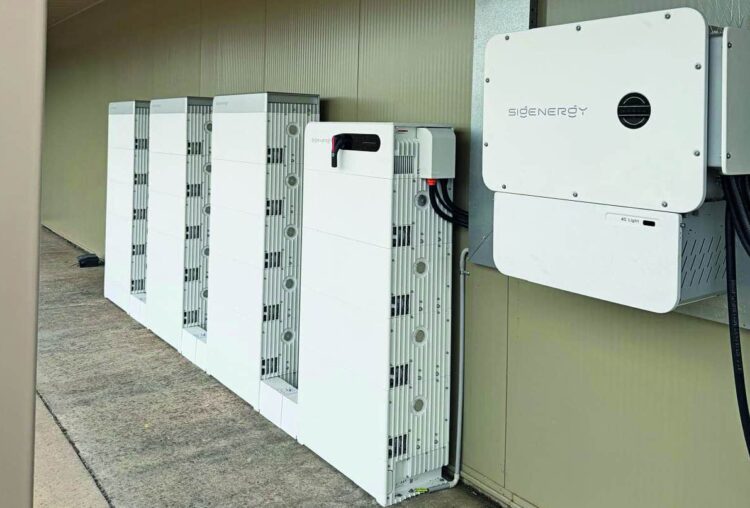
After being recognised by Sunwiz as the number one home battery brand in Australia for 2025 – only six months after entering the market – Sigenergy is pushing into the C&I sector on the back of its SigenStack and recently-released SigenCube battery solutions.
SigenStack is a modular, DC-coupled battery-only system that pairs with Sigen hybrid inverters, whereas SigenCube is a pre-assembled, all-in-one AC cabinet with the inverter (PCS), liquid cooling, and fire suppression built inside.
While SigenStack is well-suited to small-to-medium C&I applications, new solar and storage builds where DC-coupling boosts round-trip efficiency, or space-restricted locations with limited crane/forklift access, the liquid-cooled SigenCube supports large C&I sites.
Hall said Sigenergy has “the right product mix”.
“We have a flexible modular solution that takes up much less space than typical battery cabinets, and we have a more cost-effective solution,” he said. “I don’t think there’s another manufacturer with those C&I storage options.”
Learn more about the SRES expansion here.