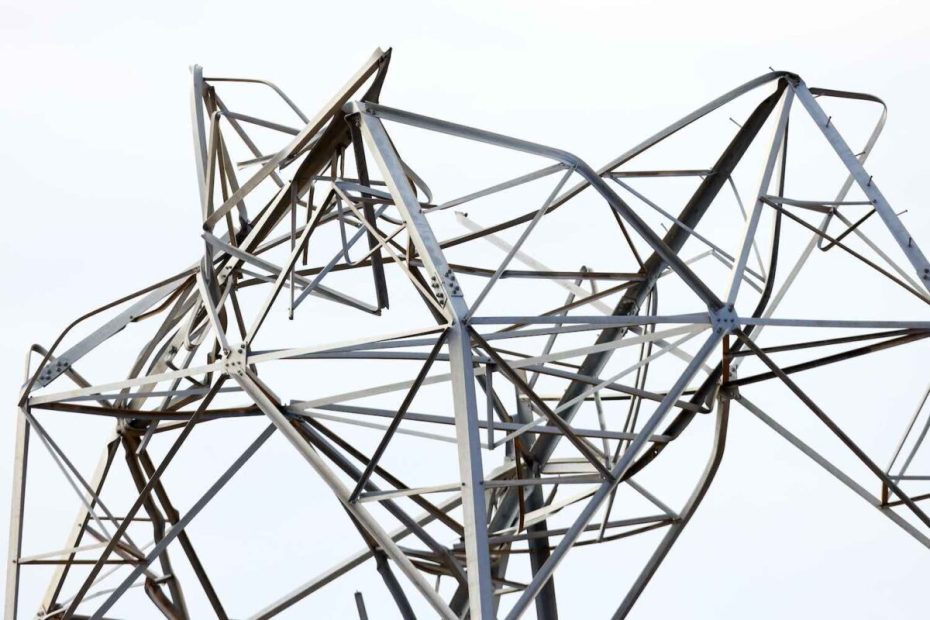
The ban on rooftop solar exports in the Eyre Peninsula in South Australia will continue for at least a few more days as the local transmission network operator races to replace newly-installed transmission towers that were blown down in a fierce storm last Thursday.
The ban on rooftop solar exports back to the grid has been imposed on 10,000 local homes and businesses to protect the ageing – and clunky – diesel generators in Port Lincoln which are now the main source of power for the southern part of the peninsula.
Homes and businesses with small batteries can continue to use their solar systems to provide power to their facilities and to store power, but are not permitted to export back to the grid.
Many residents in the northern part of the area have been reconnected to the main grid by a reconfiguration of the local network.
The situation in South Australia is broadly similar to what happened just over a year ago in Broken Hill and surrounding areas in NSW, when a fierce storm blew down a number of transmission towers in the solar transmission line that feeds into the regional city.
However, Broken Hill’s issues were complicated by the lack of maintenance on the town’s ageing diesel generators, the inability to use the town’s big battery to support a standalone micro-grid (even though it had the tech to do so), which in turn meant that the region’s plentiful wind and large scale solar generation could not be used.
The Eyre Peninsula has no big battery – at least on the part cut off from the main grid – and its only wind facility, the 20-year-old 62 megawatt Cathedral Rocks wind farm, is offline because of the damage to the transmission line and due to the lack of a properly configured big battery.
So it has no choice but to rely on the two diesel generators at Port Lincoln, one of which remains on standby. It reportedly took up to six hours to get the diesel generator working.
Some local renewable advocates are saying a series of community batteries would have been more efficient, more reliable, and a lot cheaper than the $9 million a year reportedly spent on keeping the rarely used Port Lincoln diesel generators in working order.
The failure of the transmission towers comes as a surprise because they were only installed in 2023 by transmission company ElectraNet as part of a new $300 million transmission link, and were built under the latest standard – AS7000 – brought in after the fierce storms that led to the state-wide blackout in 2016.
Residents spoke to local media about the impact of what has been described as a “one-in-2,000 year storm” that hit their farms and caused the transmission towers on their properties to crumple like paper.
Wind gusts were so powerful they blew in industrial farm doors, trapping
Jarrod Prime said the winds were so powerful it blew off the industrial farm doors and trapped him inside a shed on his property.
“All of a sudden there’s this big crash, bang,” Prime told 9News, according to a report in the Adelaide Advertiser. “I was already running at the other end of the shed.”
S.A. premier Australian Peter Malinauskas told journalists over the weekend that the state government would be looking into what happened.
“There are one of two possibilities here,” Malinauskas said.
“Either this was a genuine ‘one-in-2,000-year weather event’ here that understandably nothing can withstand — or, two, something went wrong in terms of the specifications of that infrastructure.
“That’s what the investigation will examine, and that’s what we’re very keen to look at before we rush to make a judgement.”
Energy minister Tom Koutsantonis expressed similar concerns.
Energy Minister Tom Koutsantonis struck a similar tone.
“There’ll be a lot of questions after this is all over about how these over $300 million worth of upgrades on the Eyre Peninsula just three years ago — that we’ve all paid for in our power bills — have failed, and what was the weather event that caused them,” Koutsantonis told 891 ABC Adelaide.
One problem is the lack of local data because the incident occurred where there was minimal BoM data collection. The bureau said it had no evidence of fierce winds – but that didn’t mean it didn’t happen.
An ElectraNet executive said on Friday that the transmission towers had been designed to withstand winds of up to 170km, and didn’t rule out the possibility that winds of more than 200 kms could have evolved in the storm.
Asked by journalists whether there was a structural fault in the new towers, ElectraNet’s Alex Trento conceded that was a possibility, but expressed confidence that the towers had been constructed in accordance with the appropriate standards.
“We are investigating … but at this point in time, seeing the localisation of the event, we do think that the towers have been designed and constructed effectively,” he said, according to an ABC report.
“We think the wind that has entered those towers has been above the specification that we’ve constructed it to. We could have been looking at a 250km/h wind session. We just don’t know.”
To join more than 29,000 others and get the latest clean energy news delivered straight to your inbox, for free, click here to subscribe to our free daily newsletter.
To support independent media, and help combat the spread of deliberate misinformation and disinformation about the energy transition, you can click here to make a one off donation or become a regular supporter of Renew Economy.
Giles Parkinson
Giles Parkinson is founder and editor-in-chief of Renew Economy, and founder and editor of its EV-focused sister site The Driven. He is the co-host of the weekly Energy Insiders Podcast. Giles has been a journalist for more than 40 years and is a former deputy editor of the Australian Financial Review. You can find him on LinkedIn and on Twitter.
Share this:
Facebook
X
LinkedIn
Reddit
Email
Print