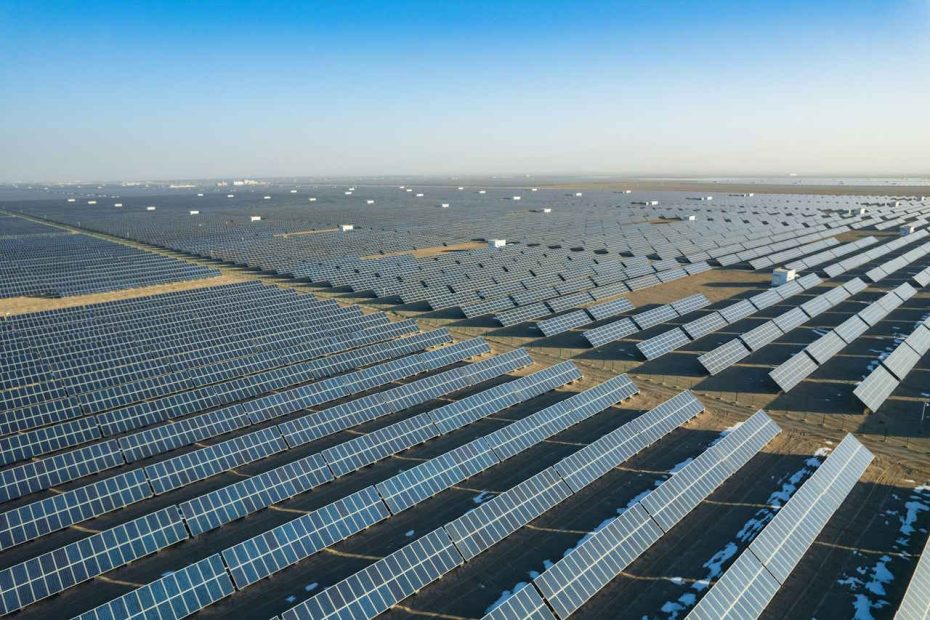
A new study from researchers out of China has demonstrated that solar farms can have a material impact on reducing dust pollution reaching major cities, revealing a new, unexpected upside to renewable energy technology.
Much like Australia, China boasts a range of climates and geographies, including the massive Gobi Desert, which stretches across parts of northern China and into Mongolia.
With an area measuring around 1,295,000 square kilometres, the Gobi Desert is the sixth largest desert in the world, and as such is a source for the dust storms which are a growing threat to air quality and public health across northern China. Dust storms that stem from the Gobi Desert can transport dust downwind into the massive metropolises like Beijing.
The Gobi Desert has also been a prime location for the development of solar farms – a key component of China’s goal of reaching net zero by 2060.
It is these solar farms which are the focus of a new study, published in the journal Geophysical Research Letters, and which found that solar farms in the Gobi Desert have a significant ability to mitigate dust levels.
Image Credit: Hao, et al, 2026
Specifically, and as has been demonstrated in other studies, solar farms exert a number of effects on its immediate geography, such as reducing surface albedo (the reflectivity of a surface or body) and increasing local vegetation.
It is this last factor which plays a specific role in mitigating dust levels. The study, which analysed 17 representative solar farms of the 42 which were found across the Gobi Desert by 2020, found that by stabilising the surface and lowering soil erodibility by as much as 17 per cent, solar farms were actively mitigating dust levels in their immediate vicinity.
Solar farms were also found to have other effects on meteorology which would normally be responsible for sweeping across the large desert expanses, whipping up dust storms that would inevitably send dust hurtling towards major metropolitan centres.
The increased surface roughness – which is to say, the physical existence of the solar farm on otherwise flat land – was found to reduce near-surface wind speeds within solar farms by over 9 per cent.
“Combining land surface and meteorological effects, solar farms enhance surface stability and aerodynamic resistance by reducing soil erodibility and near-surface wind speed, decreasing springtime Gobi Desert dust emissions by 352.4 kt/month,” the researchers concluded.
“Solar farms situated along the desert margins function analogously to a windbreak wall by attenuating near-surface southward and eastward wind speeds in downwind areas and inducing low-level atmospheric convergence, which subsequently weakens the downstream diffusion of low-altitude dust particles toward major urban centers.”
The current scale of China’s solar ambitions is already yielding measurable reductions in dust concentrations across northern China. Given that China recently reiterated its goal of increasing wind and solar capacity to 1,200 gigawatts (GW) by 2030, the multiple benefits created by solar farms will only continue to grow.
To join more than 29,000 others and get the latest clean energy news delivered straight to your inbox, for free, click here to subscribe to our free daily newsletter.
Joshua S Hill
Joshua S. Hill is a Melbourne-based journalist who has been writing about climate change, clean technology, and electric vehicles for over 15 years. He has been reporting on electric vehicles and clean technologies for Renew Economy and The Driven since 2012. His preferred mode of transport is his feet.
Share this:
Facebook
X
LinkedIn
Reddit
Email
Print