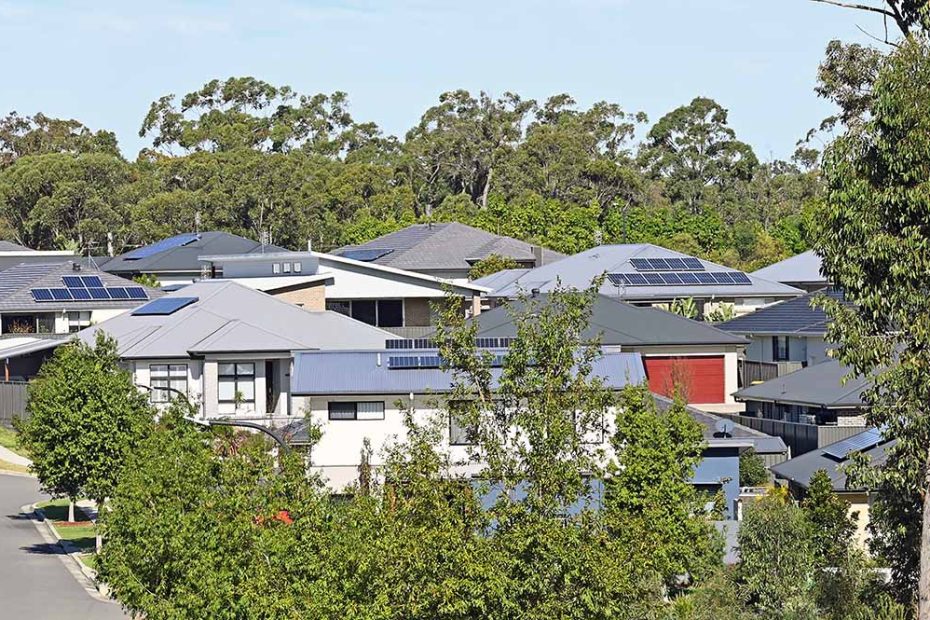
Australian households have installed a record number of rooftop solar systems and home batteries so far this year, as they took energy security into their own hands in the face of surging prices driven by geopolitical shockwaves.
More than 100,000 households installed new rooftop solar systems in the six months to June, but even more – over 150,000 – installed home batteries over the same period, driven by the rebates on offer in the federal government’s Cheaper Home Batteries program.
The latest bi-annual Rooftop Solar and Storage Report from the Clean Energy Council (CEC), published on Tuesday, reveals record installations in every state, in the second quarter, with a total of 102,234 installations amounting to 1,079-megawatts (MW) of capacity.
This brought the total number of rooftop solar systems installed in the six months to the end of June to 180,878, a 35 per cent increase over the same period in 2025 that marked the strongest six-month total since 2021.
In total, these systems delivered 1,894 MW of new capacity, up 41 per cent year-on-year and marking the highest six-month period on record – testament to the evolution of solar technology that is now delivering increased efficiency and energy generation.
At current rates, rooftop solar in Australia’s National Electricity Market (NEM) is expected to reach 40.3 gigawatts (GW) by 2029/30, around 4.5 GW or 13 per cent above the Australian Energy Market Operator’s (AEMO) ISP Step Change projection.
When tallying up all installations from January 2019, the CEC also found that Australians have installed 21,979 MW worth of rooftop solar – a figure which approaches the entire remaining coal-fired generation capacity currently operating in Australia today.
“The sun cannot be blockaded in the Strait of Hormuz,” said Jackie Trad, the CEC CEO.
“Australians not only understand this but they’re acting on it, taking control of their household energy at a time when fossil fuel price spikes and inflation are having a real impact on their finances.”
The first six months of 2026 also yielded the installation of 276,011 home batteries, which took total installations in the first twelve months of the federal government’s home battery rebate program to 457,439 installations and 12.9 gigawatt-hours (GWh) of storage capacity,
It meant that home battery systems being installed at a faster rate than solar systems – with 153 batteries installed for every 100 rooftop solar installations. And, at the current rate, consumer-level battery storage is forecast to reach 59.2 GWh by 2029/30, or 79 per cent above the ISP projection of 33 GWh.
“Solar and batteries provide Australian homes with lower bills, reliable power, and clean energy, which is why people are opting for them in droves,” added Trad, who described the current trends as a “household solar boom.”
But even as solar and battery installations continue to skyrocket, the CEC still sees increasing opportunities to unlock greater flexibility.
The CEC is concerned that most household batteries are focused on increasing solar self-consumption, and wants to see a greater adoption of virtual power plants (VPPs), flexible tariffs, and flexibility markets that can further reward households for supplying power during peak demand, absorb excess solar, and ease local network constraints.
It says this would allow for improved use of existing network infrastructure, temporarily mitigating the need for costly upgrades while increasing rooftop solar penetration.
To join more than 29,000 others and get the latest clean energy news delivered straight to your inbox, for free, click here to subscribe to our free daily newsletter.
Joshua S Hill
Joshua S. Hill is a Melbourne-based journalist who has been writing about climate change, clean technology, and electric vehicles for over 15 years. He has been reporting on electric vehicles and clean technologies for Renew Economy and The Driven since 2012. His preferred mode of transport is his feet.
Share this:
Facebook
X
LinkedIn
Reddit
Email
Print