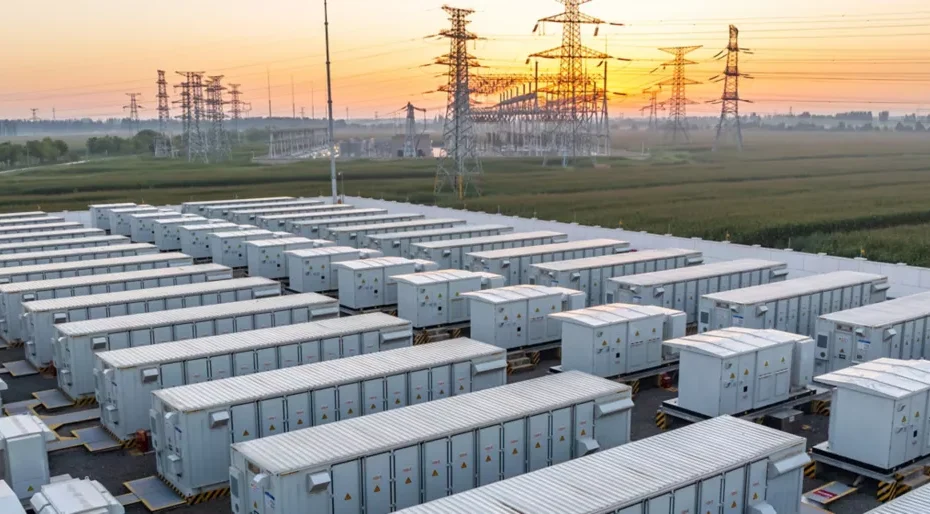
Origin Energy, Australia’s largest electricity retailer and the owner of the country’s largest remaining coal plant, has confirmed that renewables are the cheapest source of new generation, while big and small batteries increasingly step in and perform the role of peaking gas plants.
In its 2025-26 financial year results, announced on Thursday, the big-three gentailer posted a small dip in energy market earnings “against a backdrop of ongoing geopolitical uncertainty, significant shifts in global commodity markets, …a shifting regulatory landscape, and rapid technology change.”
What has remained consistent, however, is that “renewables remain the lowest cost form of new energy generation,” and that solar and wind, combined with consumer electrification and big and small batteries, are “bringing benefits including reduced emissions and lower wholesale prices.”
Origin, which also holds the largest battery and peaking portfolio in the National Electricity Market NEM, currently has 1.3 gigawatts (GW) and 4.1 gigawatt-hours (GWh) of large-scale batteries operational as at August, including the newly grid connected 300 MW / 650 megawatt-hour Mortlake battery in Victoria.
It also operates 3 GW of gas-fired generation assets and the 2.8 GW Eraring black coal-fired power plant in New South Wales, which is scheduled to close at the end of April in 2029, and the partially completed Eraring battery. It also has contracts for the big Supernode battery in Queensland.
“Our portfolio is increasingly well positioned for a changing energy market, with new battery capacity brought into commercial operation on time and on budget, as well as good progress across the remainder of our storage development pipeline,” Origin CEO Frank Calabria said on Thursday.
“Grid-scale batteries in the NEM have more than doubled in the last 12 months, and they’re now able to meet about 25% of peak demand. At the same time, you can see there’s greater than four times growth in behind-the-meter batteries in the last 12 months, and that’s having an impact on the shape of residential grid demand,” Calabria said.
“The role of batteries and gas work well together, with batteries being suited to managing those evening peaks and the short sharp spikes,” he said.
“That means that we start our gas fleet less. That defers maintenance costs, and gas peakers continue to play an important role managing extreme and long duration volatility events.
“So batteries will solve most days in summer and spring, where we have an abundance of renewable energy. However … the long-duration firming of gas peakers and hydro will be required to solve those seasonal swings.”
In the pipeline, Origin is aiming for between 4 and 5 GW of renewables and storage by 2030, including 1.8 GW of battery development projects underway and the huge up to 1.5 GW Yanco Delta wind, proposed for the NSW Riverina region, slowly working its way towards a final investment decision.
Origin, like the other big three gentailers, has come under fire from the renewable energy industry for not pulling its weight on the investment in and development of new large-scale solar and wind generation capacity, particularly ahead of the retirement of their huge coal assets.
In a results presentation on Thursday, Calabria said that the task of building new renewables capacity and supporting grid infrastructure was “proving more difficult,” with projects taking longer, costs rising, connection and approval processes remaining complex, and the regulatory outlook remaining uncertain.
“We’re seeing these challenges first-hand at Yanco Delta, where even with Capacity Investment Scheme support, the economics remain very challenging,” Calabria said.
“We’re continuing to focus on bringing Yanko Delta [to FID], but we’re being very clear about where we can get that cost and how we … get a return on those developments. So we continue to look at opportunities across the chain,” he told an analyst briefing.
But Calabria says policies and new market drivers continue to evolve and emerge, including the brand new announcement that Australia’s biggest aluminium smelter will transition to a new supply of firmed renewables underpinned by a $2.5 billion federal and state government package to help it secure long-term wind and solar contracts.
“We are always making assessments about a market … looking to see where the opportunity lies and what the market presents, and that’s what we continue to do,” says Calabria.
“Even if you look in the last, you know, month or so, we’ve got announcements about additionality for data centres as becoming a growth driver of electricity demand.
“And even today, there’s an announcement around ongoing growth… in renewable demand … as a result of the the announcement regarding Tomago [aluminimum smelter in NSW].
“So we’re going to still continue to see underlying drivers. What sits behind that is we just have to make sure that we continue to remain disciplined around it.”
To join more than 29,000 others and get the latest clean energy news delivered straight to your inbox, for free, click here to subscribe to our free daily newsletter.
To support independent media, and combat AI slop, you can click here to make a one off donation or become a regular supporter of Renew Economy.
Sophie Vorrath
Sophie is editor of Renew Economy and editor of its sister site, One Step Off The Grid . She is the co-host of the Solar Insiders Podcast. Sophie has been writing about clean energy for more than a decade.
Share this:
Facebook
X
LinkedIn
Reddit
Email
Print