Tomago Aluminium, Australia’s biggest aluminium smelter and energy user, is to transition from coal fired power to a new supply of firmed renewables after federal and state governments agreed on a $2.5 billion package to help it secure long term wind and solar contracts.
The smelter, which employs more than 1,000 people around Newcastle, and supports a further 5,000 indirect jobs, was facing possible closure because of the impending expiry of its long term and subsidised coal fired power supply deal with AGL’s coal generators.
As the country’s biggest electricity user, Tomago has a near constant load of around 950 megawatts, and it will require some 3,000 MW of new solar and wind capacity, firmed by storage and possibly peaking generators to continue operations and meet international demand for low carbon products
But the smelter’s joint owner, Rio Tinto, had said the increase from its historically low electricity cost – regardless if it was a new coal contract or a switch to renewables – was too much for it to bear, and the facility would need to close without government support.
The $2.5 billion “bailout” – as it is being described by most media – will be provided in equal portions by the federal and state governments and will reduce the cost of the power supply by around $35/MWh, meeting the difference between the asking price of new renewables and what Rio Tinto is prepared to pay to keep Tomago open.
It’s a move that will unblock the growing pipeline of wind projects and solar hybrids in the state, many of which had been struggling to land finance because of the absence of corporate buyers.
Rio Tinto has already sealed a similar deal in Queensland for the repowering of its Boyne Island aluminium smelter and associated refineries in Gladstone. It lined up more than $7 billion of long term contracts with wind and solar battery hybrids, but also needed a $2 billion package from the federal and state governments to get it over the line.
The Tomago deal will be a breakthrough for NSW energy transition, which had been stalled by the lack of investment in new wind projects, largely because of the absence of large corporate buyers. Now they have the biggest in the state.
The deal was formally announced at the smelter on Thursday morning by prime minister Anthony Albanese and premier Chris Minns, who attended along with the respective state and federal climate, energy and industry ministers.
A statement released late on Wednesday confirmed the broad aims of the deal, which which will see the contracts managed through the federal government owned Snowy Hydro, which also has the advantage of being able to back these up with “firm” power through its portfolio of hydro, pumped hydro, batteries and thermal generators.
It is, however, a vote of faith in Snowy Hydro management, which has been dealing with massive blowouts and delays in its two major projects – Snowy 2.0 and the Hunter gas generators – and still has not released an updated budget for Snowy 2.0, despite starting the process more than 10 months ago.
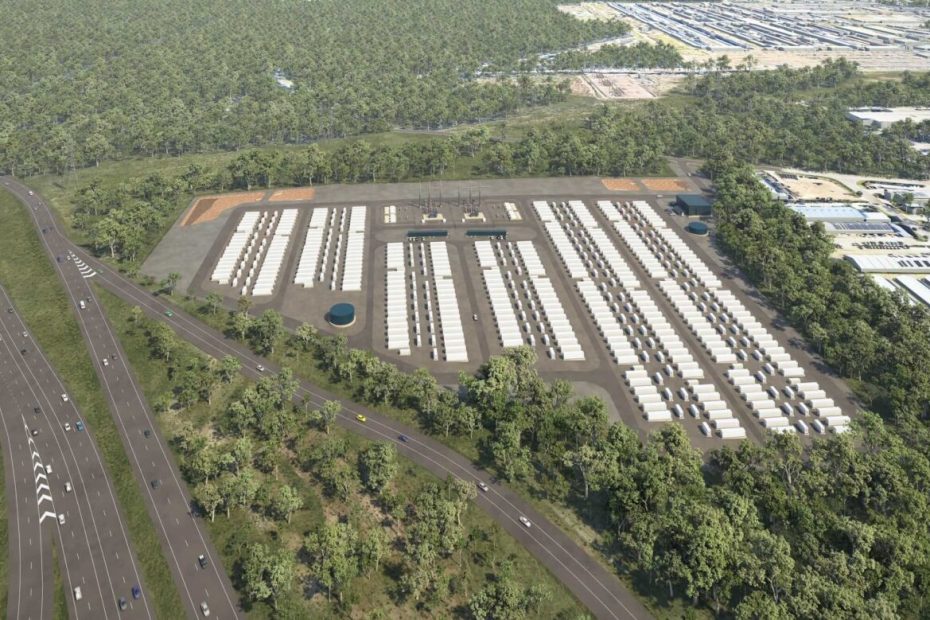
AGL, the long term supplier of coal power to the Tomago smelter, is also building a 500 MW, 2000 MWh battery near the site – the Tomago battery – which is also well positioned to play a role in the repowering of the smelter.
There are any number of potential wind projects in NSW that could be contracted for the project, including Tilt Renewable’s Liverpool Range, Origin’s Yanco Delta, Acen’s Valley of the Wind’s, AGL and Soma’s Pottinger, Spark’s Dinawan, and Goldwind’s Coppabella projects.
It is also yet to be seen what the interim arrangements will be for the power supply, given that if the contracts are designed for new renewables, and new wind farms, they will not be built by the end of 2028.
The arrangements also ensure revenue comes back to the federal government when aluminium prices are high, although the details of that arrangement were not released on Wednesday. It also means that the federal government contribution is not capped, whereas the NSW part is.
Industry minister Tim Ayers said on Thursday morning that the deal was “complex”, but did provide further details about the revenue sharing deal.
“This site isn’t just important for Newcastle and the Hunter, it’s a critical asset for the country and our manufacturing future,” Albanese said in a statement.
Minns said the deal would give the region certainty about its future.
“The Hunter has powered NSW and helped build this country for generations. This agreement is about making sure it remains an industrial and manufacturing powerhouse for generations to come,” he said.
Tomago Aluminium has agreed to invest at least $1.1 billion in the facility as part of the deal. This includes $100 million to drive further decarbonisation activities at the smelter and undertake an innovative demand-response program to support the NSW grid.
This demand-response program – which effectively means it acts as a kind of big battery – will position the Tomago smelter as the international leader in electricity demand response and flexibility services.
Federal energy and climate minister Chris Bowen said Tomago Aluminium has made it clear that it needed reliable and affordable renewable energy to remain competitive, and that ageing coal-fired power options were prohibitively expensive.
“We’re fighting for the regions and bringing more renewables online faster – so we can deliver the modern and affordable energy grid Australian’s deserve and industry needs,” he said.
Oliver Yates, the former head of the Clean Energy Finance Corp, and chair of the expert advisory panel of the UNSW Green Energy Statecraft program, said Australia’s aluminium industry was built on deliberate post-war nation-building policy and cooperation between state and federal governments.
And, he noted, its international competitors have benefited from up to US$70 billion in state support through energy subsidies and concessional finance.
“If we want to be competitive – we need to recognise and see what China, Québec, and the Middle East are doing to actively back their industrial bases,” he said
Yates said the Tomago deal could help break the current stalemate in Australia’s energy transition and unlock up to $10 billion in new renewable investment, and up to 4,000 construction jobs, and will inject new power supply into the grid faster.
“Turning the smelter into a strategic energy asset capable of providing significant load balancing services provides extra resilience to our energy system is of significant value to all energy consumers,” he said.
“Aluminium is one of the most commonly used materials in the world, with uses ranging from making foils and beer kegs to buildings and aircraft parts. That is why the entire global aluminium industry has been built on structural subsidies and does not operate as a free market.”
To join more than 29,000 others and get the latest clean energy news delivered straight to your inbox, for free, click here to subscribe to our free daily newsletter.
To support independent media, and combat AI slop, you can click here to make a one off donation or become a regular supporter of Renew Economy.
Giles Parkinson
Giles Parkinson is founder and editor-in-chief of Renew Economy, and founder and editor of its EV-focused sister site The Driven. He is the co-host of the weekly Energy Insiders Podcast. Giles has been a journalist for more than 40 years and is a former deputy editor of the Australian Financial Review. You can find him on LinkedIn and on Twitter.
Share this:
Facebook
X
LinkedIn
Reddit
Email
Print