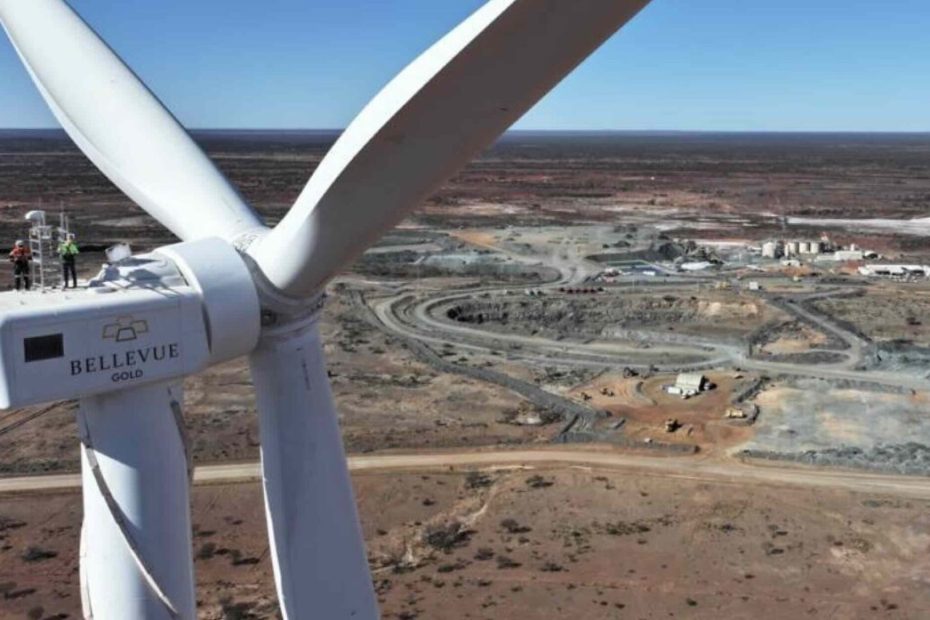
An off-grid Western Australian gold mine has got through one of the darkest periods of winter still running at an average of 75 per cent renewable energy.
Bellevue Gold, which finished bringing the last of its 51 megawatts (MW) of wind and solar capacity last year, was still able to rely on renewables to get it through the September quarter with minimal reliance on the gas and diesel backup.
Off-grid power specialist Zenith Energy built the 24 MW of wind, 27 MW of solar and 15 MW, two hour battery to supply the miner’s Northern Goldfields site, with a view that it would supply 80 per cent of the power needs for the mine.
In the year to June 30, Bellevue Gold’s first full year with the new system, the mine beat expectations and ran on average 83.5 per cent renewables for an average load of 12.8 MW, with monthly peaks of 93.8 per cent and 155 consecutive hours running the facility on 100 per cent renewables, and with “engines off,” in May.
Mines are increasingly embracing the use of wind and solar, thanks recently to the growth in battery storage and management systems, and Liontown Resources and Lynas Gold – two companies backed by Australia’s richest person Gina Rinehart – have achieved similar success.
Andrew Forrest, another iron ore billionaire who, in contrast with Rinehart, is a green energy evangelist, is currently building more than 2 GW of wind and solar capacity, and more than 4 GWh of battery storage, to help eliminate fossil fuels completely from Fortescue’s giant Pilbara mines.
Bellevue Gold already claims to be the world’s first net zero scope 1 and 2 emissions gold mine, although it achieves some of this with offsets, and is yet to decarbonise its mining equipment and transport.
Bellevue Gold’s energy performance in the year to June 30. Image: Bellevue Gold
In the last financial year, the lowest share of renewables occurred in the middle of winter, in June, – the darkest and least windy month of the year, according to Bureau of Meteorology data from its weather station at Leinster Airport, the closest to the mine in the northern Goldfields region.
June this year was a below-average year for sunshine, pulling in just 3.3 kilowatt-hours (kWh) per square meter, or 11.9 megajoules per square metre as shown in the BOM chart.
Of the last 37 years, just 13 Junes have registered a lower level of sunshine in Leinster and one of those years was 1992, a grim winter triggered by the volcanic eruption of Mt Pinatubo in the Philippines the year before.
April and January, however, both months that saw a spike in diesel use, were bang on the local mean for solar radiance.
June was also a rotten month for wind (although not as bad as July – a month that falls just outside Bellevue’s FY26 report), according to the Leinster airport data taken between 1994 and 2026.
Maximum wind gusts for April and January were lower than peaks measured in 2010 and 2022, respectively.
And wind run, which effectively describes wind speeds, was higher than the mean for both of those months.
To support independent media, and help combat the spread of deliberate misinformation and disinformation about the energy transition, you can click here to make a one off donation or become a regular supporter of Renew Economy.
Rachel Williamson
Rachel Williamson is a science and business journalist, who focuses on climate change-related health and environmental issues.
Share this:
Facebook
X
LinkedIn
Reddit
Email
Print