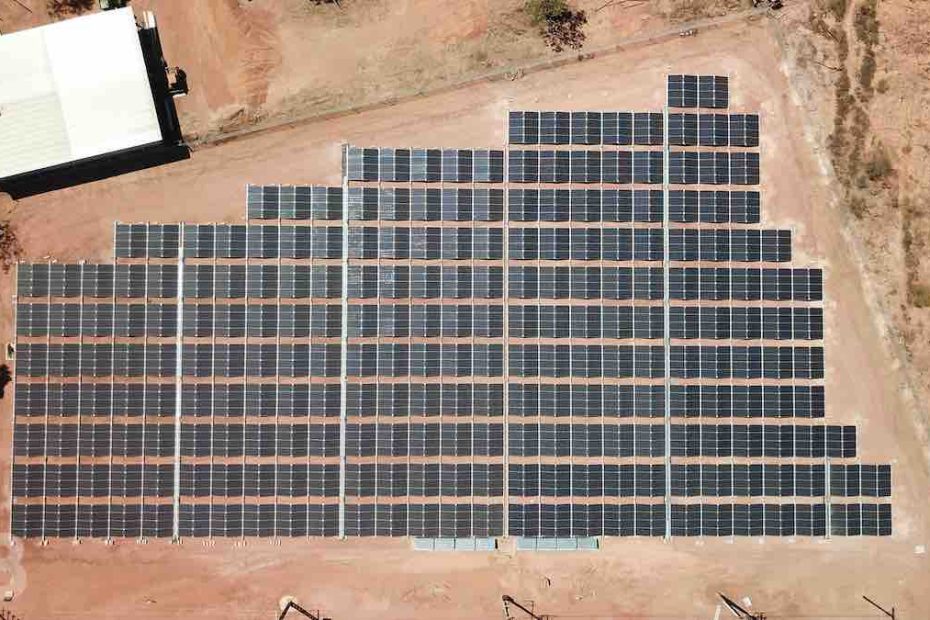
A Northern Territory partnership has landed $8.3 million to build a utility-scale solar-battery microgrid in Borroloola, a remote town on the McArthur river in the Gulf of Carpentaria
The Australian Renewable Energy Agency (ARENA) grant will allow the Ngardara Solar Microgrid to reach financial close in the next few months and start construction in September, says First Nations electricity advocate Original Power.
The microgrid will consist of 2.1 megawatts (MW) of solar and a 1.8 MW, 6.6 megawatt-hour (MWh) battery, and is designed to deliver up to 80 per cent renewable energy penetration and save 1.2 million litres of diesel every year.
Original Power was behind the Marlinja microgrid, a 100 kilowatt (kW) solar array and a 136 kilowatt-hour (kWh) battery, which the company’s clean energy program director Lauren Mellow says is producing enough for the network to contemplate figuring out how to do exports from the system.
The Borroloola project is significantly bigger and is the first utility-scale microgrid project led by a First Nations group.
Mellor recently told Renew Economy that locking in finance for these types of projects – big, complex, and with locally-specific hurdles such as the way billing is handled for remote Indigenous towns – is one of the big challenges.
But with the Marlinja project proving the concept and solving some of the hurdles, the way has been cleared for the bigger Borroloola microgrid.
“The innovative solutions developed by Original Power overcome many systemic obstacles to Indigenous communities accessing clean, affordable and reliable electricity,” says Indigenous Business Australia chief David Knights.
“It provides a scalable blueprint with the potential to benefit many more Indigenous communities like Borroloola, which face significant social and economic disadvantage.”
ARENA is also kicking in nearly $3 million for another microgrid proposed for Ltyentye Apurte, near Alice Springs by the Atyenhenge-Atherre Aboriginal Corporation (AAAC).
The Ltyentye Apurte plan is to solve reliability, says AAAC chief Ellie Kamara.
“In the past few years blackouts have occurred for significant lengths of time, and there is no alternative if power is down in the community,” she says.
“In the extreme hot or cold our old people suffer from either no heat or air-con, and the store cannot open – impacting food security for the community. The microgrid aims to alleviate this challenge enabling a constant source of electricity in the event of a blackout.”
The Northern Territory may be forced to act on solutions such as microgrids that allow people keep their power on, after a remote community launched a law suit against the government saying it’s failing to provide safe public housing during periods of extreme heat.
The suit, by residents in the remote community of Papunya, focuses on badly built houses and broken air conditioners, but as Kamara says black outs and disconnections are as dangerous.
Solving a fairness problem
Not only is electricity distribution patchy in remote townships and communities in Northern Territory, but some 10,000 households are required to pre-pay for power using cards bought from a local store.
It’s a situation unlikely to be tolerated elsewhere in Australia, and it causes the highest disconnection rates in the country and adding to major health and financial insecurity.
A landmark report last year found Northern Territory households on pre-payment meters each experience 41 to 59 disconnections annually, compared to 33 disconnections in Western Australia and 14 in South Australia.
The Ngardara project, however, demonstrates that with the right policies, resources and partnerships, community-led ideas can fix electricity problems and, importantly, fairness issues in remote areas, says Ngardara Company chair Scott McDinny.
“We can overcome decades-old challenges around the high cost of remote power generation, solve household disconnections and build genuine economic prosperity and independence for our regions,” he says.
Scraping diesel
Currently, generation and distribution to Borroloolo are managed by Power and Water Corporation which operates and maintains a 653kW solar array, and 3.3 MW worth of diesel generators providing about 87 per cent of the community’s current power needs.
The microgrid will cut that diesel need and, because it’s majority owned by the Ngardara Cooperative, Borroloolo households will be paid for the electricity sales.
Original Power estimates bill savings of around 50 per cent, thanks to ‘solar credits’ added directly onto household prepayment meters.
The project is pushing legacy power distributors and operators to do better, says Original Power’s Madie Sturgess.
“Despite underdeveloped regulatory frameworks and traditionally monopolistic energy arrangements, the Ngardara Solar Microgrid project has driven the Northern Territory energy sector to co-deliver a viable blueprint for genuine ownership and benefit of local energy futures,” she says.
“[It’s] the democratisation of energy for communities historically excluded from the renewables transition.”’
If you would like to join more than 29,000 others and get the latest clean energy news delivered straight to your inbox, for free, please click here to subscribe to our free daily newsletter.
If you wish to support independent media, and accurate information, please consider making a one off donation or becoming a regular supporter of Renew Economy. Please click here. Your support is invaluable.
Rachel Williamson
Rachel Williamson is a science and business journalist, who focuses on climate change-related health and environmental issues.
Share this:
Facebook
X
LinkedIn
Reddit
Email
Print