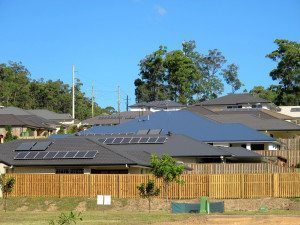
You may have read and heard in the media how the roll-out of solar and batteries is helping out the rich while hurting the poor.
This narrative is built upon a supposition of logic rather than actual evidence – solar and battery systems typically cost several thousands of dollars, so you’d naturally expect the uptake of such systems must surely be concentrated amongst high income households.
Yes it seems logical, but it’s not actually true.
A good example of this narrative was provided by the Daily Telegraph in an article which labelled the Australian battery rebate program as a “scheme benefiting the rich.”
It noted that, “struggling households are stumping up the cost of home batteries for wealthier Australians” because based on what it claimed as “analysis” provided to them by the Liberal-National Party, Australia’s 100 highest average income postcodes had installed four times more battery storage capacity than Australia’s 100 lowest average income postcodes – 1797 kilowatt-hours on average per rich postcode vs 418kWh on average per poor postcode.
That sounds very evidence-based, doesn’t it? Except that the Daily Telegraph didn’t seem to appreciate that the way that Australia Post assigns postcodes to geographic areas isn’t based on their population.
The postcodes populated by Australia’s poorest people tend to be in rural locations and have very low population density. Our rich postcodes tend to be in inner city locations with much higher population density.
The chart below illustrates in each bar the number of households in each of the 100 poorest postcodes relative to the richest ones, with the left half being the poor postcodes and the right half the rich postcodes. As you can see the number of households in the majority of the poor postcodes barely register on the chart.
All up there are 13 times more households in the top 100 highest income postcodes compared to the poor postcodes (390,000 vs 29,500). Once we correct for this population difference, we can see the 100 poorest postcodes installed 3 times more battery capacity per household than the 100 richest postcodes.
If we take a more comprehensive look at the Clean Energy Regulator’s data on solar installations by all Australian postcodes (provided by the Clean Energy Regulator) as at the end of March 2026 and then match that up with Australian Bureau of Statistics 2021 Census data we see that postcodes with lower median incomes (divided up in terms of quartiles of the total number of households) have a higher proportion of dwellings with solar systems installed than the postcodes with higher median incomes.
In terms of batteries there is a slightly higher prevalence of battery systems in the higher income postcodes vs the lower income postcodes (2.1% in quintile 1, 2.8% in the middle quintile and 3% in quintile 5). But it is extremely early days in terms of the battery rebate (less than a year old), whereas solar installations reflect a program in operation since 2001, so it is a far more reliable indicator of long-term outcomes.
Of course this hasn’t stopped interest groups claiming batteries are a tool for redistributing money to the rich, such as the Australian Energy Council. Yet they are oddly silent about the contrary pattern evident in the solar postcode data or even just claim the opposite is true for solar.
In the end, we actually have to be careful about making strong conclusions about the link between incomes and adoption of solar and batteries based on this postcode data.
For example, if we arrange the postcode data in a way that makes rates of battery adoption transparent for each individual postcode and map that relative to the median income of that postcode in a scatter plot we end up with a mess of dots essentially arranged at random.
There are postcodes with very high incomes and very low levels of battery adoption and also with quite high rates of battery adoption (relative to the norm, not in absolute terms) and plenty in between.
The same goes for postcodes with low incomes. Good luck to anyone who thinks they can correctly predict the rate of battery adoption in a given postcode based on the typical incomes in that postcode. Also please don’t get carried away by the fact some postcodes already have 20%+ penetration of batteries, as these are postcodes with a very small number of households.
When we arrange the solar penetration and income postcode data in the same scatter chart we end up with an arrangement of dots that shows a very faint downward slope where solar penetration rises as median income declines.
But really, just like batteries, there is not a particularly strong relationship between the median income of a postcode and its level of solar adoption. This data is suggestive that solar and batteries are being adopted by a very wide mix of both low income and high income households, they aren’t something that only high income households can afford.
The beauty of this postcode-level data is it is a very comprehensive and frequently updated picture of solar and battery installations by location. However, the weakness is that it doesn’t provide us with data on the specific circumstances of the households within each postcode that are purchasing solar and battery systems.
This is where the research of Bruce Mountain and Rohan Best has revealed further useful insights. The Australian Bureau of Statistics’ Survey of Income and Housing from 2017 and 2019 as well as the Household Energy Consumption Survey of 2013 collected data on household ownership of solar as well other characteristics of each household such as income and home ownership.
Best’s conclusion from this analysis was that adoption of solar was inequitable because he found that solar adoption was higher in households with higher levels of wealth.
Now, at this point, it is very important to note that wealth is different to income. Wealth represents the financial value of a household’s accumulated assets including physical assets such as their home. Whereas income is the actual dollars that a household receives each year from their wages as well as dividend and rental income from their investments. The charts I’ve provided earlier are based on incomes, not wealth.
However, Bruce Mountain subsequently took a further look into the same data that Best had used. What Mountain discovered was rather obvious but also incredibly important in assessing equity issues related to adoption of solar and batteries (and I would say energy efficiency upgrades more generally).
In reviewing the same data used by Best, Mountain warned:
“With respect to the claims of wealth effects, we find that across all homes solar uptake is positively associated with wealth. But this headline fails to account for the fact renters do not install solar because they lack the wealth to do so, but because property rights, transaction costs and building form make it difficult or impossible for them to install solar.
“The analysis of owned homes reveals that poorer households install solar at a similar or greater rate than richer households. Existing studies have failed to account for the difference between rented and owned homes in their ability to choose solar. When correctly segmented, the positive relationship between wealth and solar evaporates.”
In other words, the reason Best found that solar adoption was higher at higher levels of wealth was simply a function that those who own a home (or are paying off a mortgage) are in a position to install solar and have higher levels of wealth due in large part to the value of their home.
It is very important to recognise that in spite of the significant value embedded within their home, many of these people have low incomes. What is often not well appreciated, including by me until recently, is that income levels are not correlated with whether you are likely to rent or own a home as shown in the chart below based on Reserve Bank analysis.
Most normal people looking at the circumstances of low income households with solar would not assess these people as rich because they happen to not rent. A large proportion are of modest means who bought their homes back when housing was much more affordable in this country.
Large rises in house prices since then have dramatically driven up their on-paper wealth. But in the end the wealth embedded within their home is practically inaccessible to them as money they could spend without having to sell up and move out of an area close to friends, family and a community they love.
None of this means we should ignore the reality that renters are missing out on a large portion of the benefits from solar and battery technology (but not all the benefits because they benefit from lower wholesale electricity prices and avoided need for new network upgrades).
But what I find rather odd is that many of those keen to highlight equity issues never seem to recommend government policies that would help renters access these technologies. Instead, they recommend policies to deter households from adopting solar and battery technology or penalise them for doing so.
I would note that is not true for all those that have express concerns about equity – the Australian Council of Social Services, for example, has been very active in arguing for policies that would require landlords to upgrade their rental properties and expand access to solar.
But for others it is painfully obvious that their concern is not for renters’ or low income households’ welfare, but rather protecting large energy companies from increased competition.
There are also what I would consider well-meaning academic researchers who have decided they might want to have a dabble at energy and climate change policy.
Their experience and knowledge of energy and climate policy might be wafer thin, but it doesn’t hinder them from venturing ideas for major modifications to emission reduction policies that could possibly help with equity outcomes, yet leave the policy completely ineffective in its main objective of lowering emissions.
It’s also important to recognise that technological developments from the solar and battery industry are opening up the potential for us to get around landlords’ disinterest in their renters’ energy bills.
There are now a large range of semi-portable battery and solar products in widespread use in markets overseas that households simply plug-in to a power socket to augment their power supply.
Efforts are in train by some product suppliers to enable Australian households to also use these products. In addition, if vehicle manufacturers and regulators can their act together on standards, it is conceivable that in the future renters could use their electric vehicle to power their home.
If people are genuinely concerned about renters missing out on the benefits of solar and battery technology, then you’d think they would be the loudest in arguing for policies to expand access to renters.
If they would instead prefer to talk about restricting the growth of these technologies and penalising those adopting them, then you can probably safely assume that renters aren’t who they really care about.
Tristan Edis
Tristan Edis is the Director – Analysis and Advisory at Green Energy Markets. Tristan’s involvement in the clean energy sector and related government climate change and energy policy issues began back in 2000.
Share this:
Facebook
X
LinkedIn
Reddit
Email
Print