Gina Rinehart, Australia’s richest person and one of its most vocal anti-renewable voices, is getting a front seat view of how wind, solar and battery storage can successfully power mining and industrial operations, and slash diesel costs along the way.
The Rinehart-backed lithium miner Liontown Resources has already reached an average of 80 per cent renewables at its off-grid Kathleen Valley mining and processing operations in the first quarter, reducing diesel costs to a fraction of other miners.
Now, another of Rinehart’s mining investments, Lynas Rare Earths, has gone even better, achieving a remarkable 95.7 per cent renewables share at its off-grid Mt Weld mining operations in the first quarter.
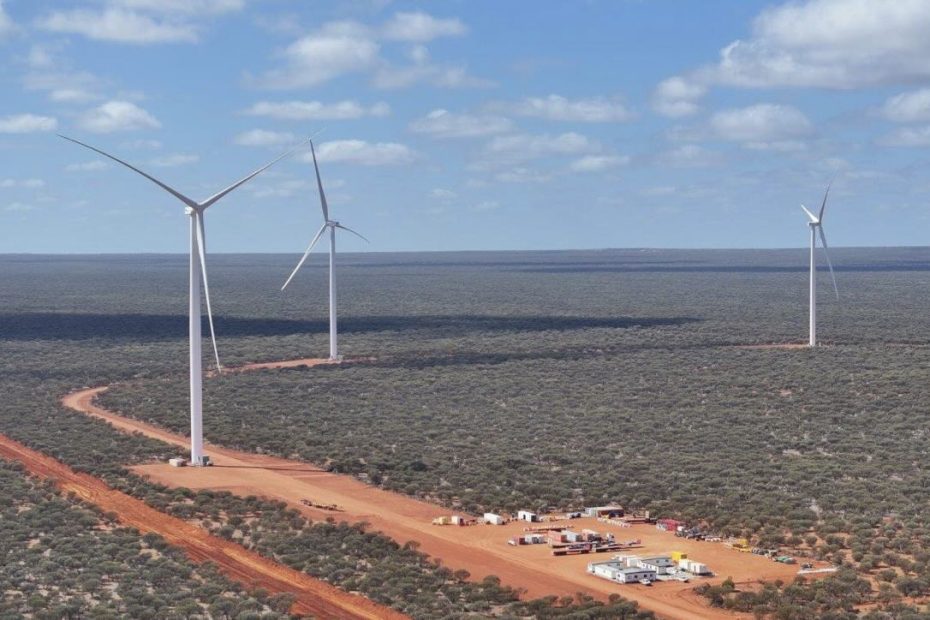
That is way more than the 70 per cent renewables share that had been anticipated after the completion of the new hybrid renewables facility, combining 7 megawatts (MW) of solar, 24 MW of wind, and a 12 MW/12 MWh battery.
The four 6 MW Goldwind turbines were only full commissioned last November, but the hybrid facility was already doing better than expectations with a 92 per cent renewables share in the month of December, largely because it was producing more power at night than expected.
It bettered that in the March quarter, and the Mt Weld mine now regularly operates with “engines off” – supported only by two small synchronous condensers – meaning no burning of fossil fuels for power needs during those periods.
Lynas says that in the March quarter alone, this has saved more than 870,000 litres of diesel compared to the March quarter of last year when the facility was operating a diesel power plant. The diesel generators have now been replaced by a 16 MW gas plant.
CEO Amanda Lacaze told analysts in an earnings call on Tuesday that the company was “enormously proud” of its hybrid renewable power station at Mount Weld.
“Our diesel use now is virtually only in the mining fleet at the Mount Weld site. The renewable power station is actually delivering significantly more than designed,” Lacaze said.
“We were expecting renewables to be delivering around about 70% of our power requirement, and the average renewable content was 95.7%. That is 870,000 liters of diesel saved just during the March quarter. This does put us in a much better position as we’re looking at the various global effects at present.”
The next step for miners achieving high renewable shares, such as Lynas Rare Earths, Liontown and Bellevue Gold, is the electrification of transport.’
However, they are likely to let the likes of the deep-pocketed Fortescue take the lead on this, as it buys up to 400 giant electric haul trucks to help it reach its target of real zero by 2030.
Fortescue is also pushing for the the diesel rebate to be removed, or capped, for big mining companies, arguing that it is a subsidy that is not needed, and is making the country more reliant on imported fossil fuels.
If you would like to join more than 29,000 others and get the latest clean energy news delivered straight to your inbox, for free, please click here to subscribe to our free daily newsletter.
If you wish to support independent media, and accurate information, please consider making a one off donation or becoming a regular supporter of Renew Economy. Please click here. Your support is invaluable.
Giles Parkinson
Giles Parkinson is founder and editor-in-chief of Renew Economy, and founder and editor of its EV-focused sister site The Driven. He is the co-host of the weekly Energy Insiders Podcast. Giles has been a journalist for more than 40 years and is a former deputy editor of the Australian Financial Review. You can find him on LinkedIn and on Twitter.
Share this:
Facebook
X
LinkedIn
Reddit
Email
Print