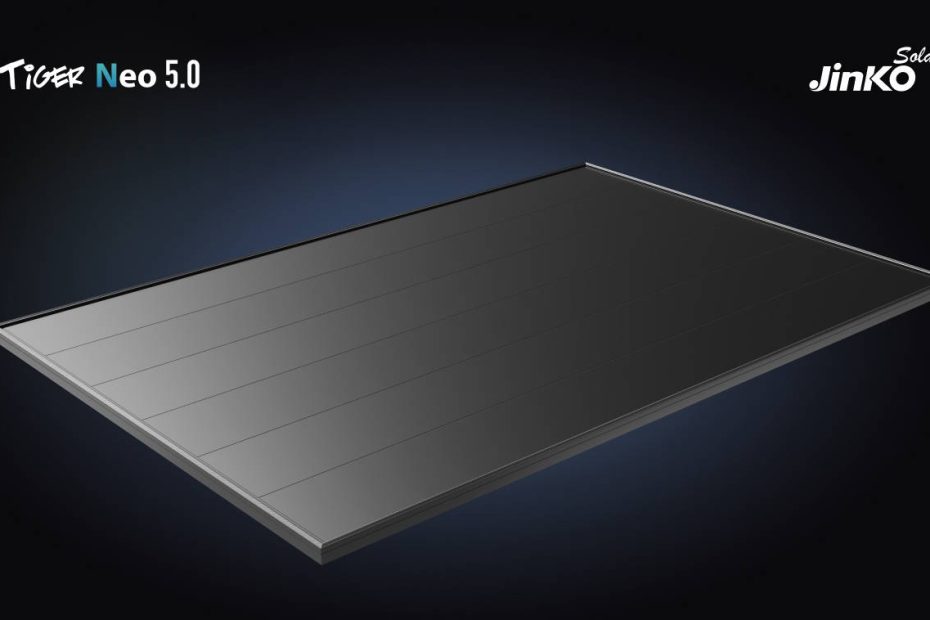
Chinese solar manufacturing giant Jinko Solar has unveiled a new 510 watt (W) all-black rooftop solar panel boasting a module efficiency of 25.52 per cent.
Billed as a solar panel that “was designed to redefine the upper limits of what a scenario-specific module can deliver in both appearance and efficiency”, the new Tiger Neo 5.0 is targeted towards what Jinko Solar describes as “premium homes and other architecturally refined residences.”
The Tiger Neo 5.0 is the first solar panel from Jinko Solar built on its new TAC technology, short for TOPCon-based Amorphous-Si Passivating Cell that the company says is a “2+1” design that pairs TOPCon electron-selective contacts with HJT hole-selective contacts in a rear-electrode layout.
This design is intended to eliminate front-side metallisation and the associated optical shading losses and has already demonstrated peak efficiency of up to 28 per cent – nearing the theoretical limit of monocrystalline silicon cells.
While Jinko Solar’s new TAC technology benefited from its own reveal at the company’s Global Tech Day last week, the new Tiger Neo 5.0 is less focused on the company’s technical achievements and more on its appearance.
Image Credit: Jinko Solar
Jinko Solar claims that the new solar panel “showcases a deeper, more uniform, and more refined black appearance than conventional back-contact (BC) modules.” A “deeper, more premium black appearance” supposedly ensures the panel blends seamlessly into residential rooftops, especially dark coloured ones.
“Our vision for Tiger Neo 5.0 was to develop a panel tailored to premium residential rooftops,” said Charlie Cao, CEO of Jinko Solar.
“It pushes the boundaries of both performance and aesthetics with innovations in cell technology, passivation processes, structural design, module format and interconnections. With this launch, we aim to help move the industry toward solutions tailored to specific applications.”
The Tiger Neo 5.0 also boasts semiconductor-grade low- and high-temperature processes which combine to bring the power temperature coefficient down to -0.24%/℃, resulting in stronger energy yields in high-temperature environments.
A zero-gap cell layout and hidden-ribbon technology at the module level helps deliver the advertised 25.52 per cent efficiency, and compared to conventional back-contact products, the Tiger Neo delivers approximately 30 W more power and its lower temperature coefficient.
To join more than 29,000 others and get the latest clean energy news delivered straight to your inbox, for free, click here to subscribe to our free daily newsletter.
Joshua S Hill
Joshua S. Hill is a Melbourne-based journalist who has been writing about climate change, clean technology, and electric vehicles for over 15 years. He has been reporting on electric vehicles and clean technologies for Renew Economy and The Driven since 2012. His preferred mode of transport is his feet.
Share this:
Facebook
X
LinkedIn
Reddit
Email
Print