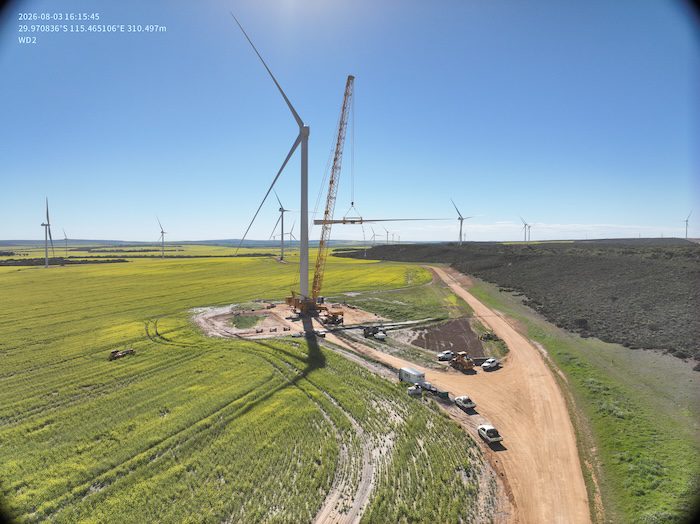
A 2 gigawatt hybrid wind, solar and battery storage project proposed for Australia’s biggest isolated grid has been waved through the federal environmental assessment process, signed off with list of conditions to protect endangered black cockatoos and a range of native flora.
The Tathra wind farm proposes to combine up to 1,000 megawatt (MW) of wind, an up to 500 MW solar farm and up to three battery energy storage systems (BESS) with a combined capacity of up to 500 MW at a site around 15 km east of the town of Eneabba in Western Australia’s mid-west region.
Developer Synergy Renewable Energy Developments (SynergyRED), a subsidiary of state-owned gentailer Synergy, has described the already state-approved project as “crucial” to maintaining affordable and reliable electricity supply for customers across the WA South West Interconnected System (SWIS).
According to the referral documents, the 140-turbine wind farm would span 14 freehold lots, on land zoned “rural,” that Synergy has legal access to through option to lease agreements or consent letters with landowners.
SynergyRED says the proposed project area is mainly used for agricultural purposes and consists of predominantly cleared land, with pockets of remnant native vegetation that are proposed to be largely retained.
In an EPBC decision published last week, the federal government said the proposed project was “not a controlled action provided it is taken in the manner set out … to avoid significant impacts on Listed threatened species and communities.”
Many of the measures set out by the federal environment department are designed to project Carnaby’s Black Cockatoos, including a limit of clearing no more than 97 potential nesting trees and a ban on clearing any suitable or known nesting trees of the endangered bird.
On the turbine layout, the decision says that the centre point of any wind turbine tower outside the Targeted Survey Area must be located at least 200 metres from the base of the trunk of any black cockatoo potential nesting tree and at least 100 metres from any existing habitat.
Further, to avoid and mitigate harm to black cockatoos, no part of any of the project’s wind turbine blades should be less than 64 metres above ground level.
The project’s referral documents said the wind turbines would have towers up to 160 metres in height with blades up to 90 m long and a minimum tip-height of 40 m and maximum of up to 250 m. But they also stressed that the final turbine model had not been selected, because “flexibility in the layout is required.”
The EPBC decision comes nearly five months after it was referred for assessment – a similar turn-around as at the state level, where the wind component of the project was waved through by the development and environmental approvals process within four months.
Synergy, which has in the past sourced most of its power generation from coal, plans to shut its ageing 240 MW Collie A coal power station in 2027 and the Muja 7 and 8 (both 227 MW) in late 2029.
On the renewables side of the ledger, Synergy has four wind projects in development or under construction, including Tathra; the biggest of which is the expanded Warradarge wind farm, where work is underway not to lift capacity to 283 MW in 2027.
It owns two operating wind farms that are less than 2 MW each and the two-stage Kwinana battery, which totals 300 MW and 1000 megawatt hours (MWh) of storage.
The company’s experience with grid-scale solar is the 47 MW, two stage Greenough River project. Most of its recent efforts have been focused on battery storage.
Synergy is currently commissioning one of the country’s biggest battery projects, the 500 MW, 2,000 MWh facility at Collie, adding to the two big batteries it has built at the site of its Kwinana gas generator (and former coal plant) that total 300 MW and more than 1,100 MWh.
The Collie battery – located just up the road from Neoen’s even bigger 560 MW, 2,240 MWh battery at Collie – will take Synergy’s total big battery capacity to more than 800 MW (and nearly 3,200 MWh).
If you would like to join more than 29,000 others and get the latest clean energy news delivered straight to your inbox, for free, please click here to subscribe to our free daily newsletter.
Sophie Vorrath
Sophie is editor of Renew Economy and editor of its sister site, One Step Off The Grid . She is the co-host of the Solar Insiders Podcast. Sophie has been writing about clean energy for more than a decade.
Share this:
Facebook
X
LinkedIn
Reddit
Email
Print