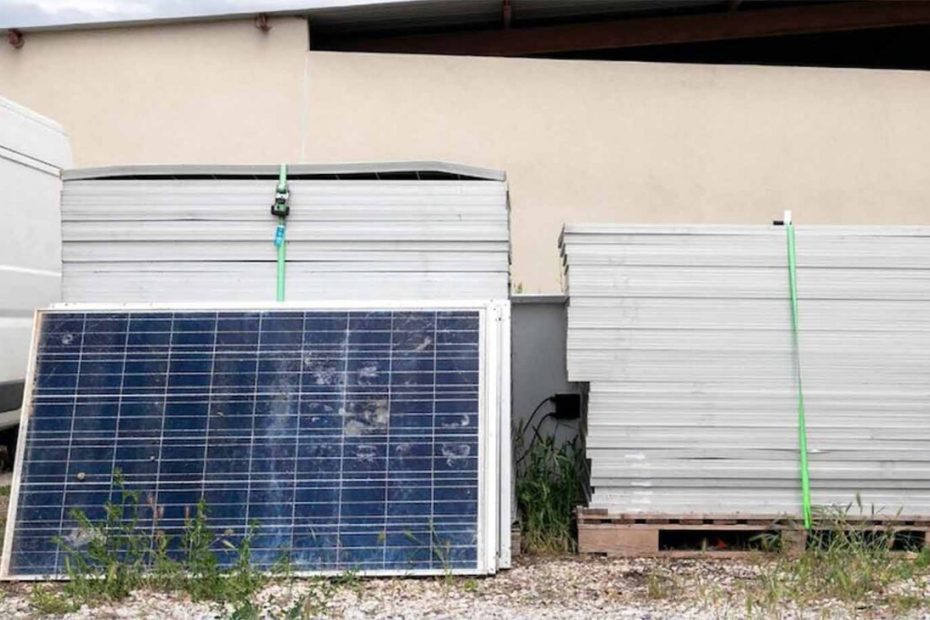
One of Australia’s leading solar experts has called for at least some of the cost of a mandatory national panel recycling scheme to be paid by end-users, including rooftop solar households, in a bid to prevent PV modules from being discarded well before their use-by date.
Dr Rong Deng, a senior lecturer at the School of Photovoltaic and Renewable Energy Engineering at UNSW was one of the first experts to appear before a federal Parliamentary Inquiry that launched this week to nut out how best to design a national solar stewardship scheme.
The establishment of mandatory scheme governing the reuse and recycling of solar in Australia is well overdue, despite the best efforts of industry groups like the Smart Energy Council (SEC) and despite a growing level of urgency to manage a growing pile of potentially highly valuable waste.
The inquiry was supposed to run alongside a $25.7 million pilot that the federal government had intended to start in July, but that, too, has been delayed – much to the SEC’s and industry’s dismay – after a legal complaint was made about the process to appoint a scheme administrator.
This leaves the inquiry and a newly announced state-based push from New South Wales as the best hopes for establishing a mandatory solar stewardship scheme anytime soon.
But as Deng told the Inquiry on Thursday, the preferred national approach that the NSW government is currently consulting on – to charge retailers and project developers with a mandatory recycling fee at the point of panel installation – might not be the best way to go.
“I have a different view from what the NSW government is proposing,” Deng told the standing committee members, which includes “teal” independent MPs Zali Steggall and Nicolette Boele.
“My view is that a small, transparent end-of-life charge should sit at the point where the retirement decision is made.
“We are seeing perfectly functional residential panels coming off the roof and, from my personal experience, we’ve seen panels as young as only two years old.
“Those panels are designed to last 25, 30 years, and because currently there is no charge to recycle and get rid of them, that really encourage lots of early retirement.
“So a small price signal … may discourage unnecessary early retirement and keep working panels on roofs for longer,” Deng said.
What to do with discarded solar panels that still have plenty of useful life left in them is just one of the puzzles within the puzzle that is solar stewardship. An SEC-led pilot conducted in Queensland put the average age of decommissioned panels at just 8 years, with most able to operate for another 10–15 years.
Reuse is the obvious solution, but this is not easy. It requires discarded panels to be handled with the utmost care during decommissioning and transportation, so that they are not damaged, and then it requires electrical testing and sing-off, so that consumers can be confident they are safe to use.
As the SEC’s executive general manager of sustainability, Darren Johannesen has told Renew Economy, these sort of early life panels appear so prominently in the waste stream because people are choosing to upgrade their rooftop systems as technology costs fall and as households electrify.
And the SEC has warned that this practice is likely to balloon under the federal home battery rebate, as households replace old rooftop modules with newer much bigger systems to go with their discounted and plus-sized storage systems.
“The good news is we’re going to get lots of batteries and expanded systems, the bad news is it’s going to create decommissioning … somewhere between an additional 7.5 million to 15-20 million [modules a year],” Johannesen told Solar Insiders last year.
“So it’s a lot of modules that will be de-installed and this is why, getting back to pilots, why pilots are important. And critically, it’s why we need action on a national scheme.”
But while the SEC favours a set-up where the mandatory stewardship fee is charged to installers and developers, and then passed on to consumers through slightly higher system costs, Rong Deng argues that it is “reasonable” to put a modest cost at the other end of the panel life-cycle.
“When a system generally reaches …[the] end of its useful life after delivering value for 20, 30 years, the household has already received value from that asset. They’ve recovered all the value and they’ve received additional value from that asset, and [so] a modest cost to responsibly manage that at the end of life, to me, is reasonable,” she told the inquiry.
“There is also a cost question: if a recycling cost is imposed upstream on brand owners or manufacturers, that cost, or some of that cost, will eventually pass on to the customer, and it is not just that one cost … all the overheads associated with managing the cost flow will eventually be passed on to the customer,” Deng says.
“So if it’s eventually passed on the customer, if it’s eventually the customer who pays, then a small direct, transparent charge at the point where the retirement decision is made is probably the lowest-cost option to fund the scheme, and the lowest cost option to these customers,” she said. “That’s my opinion.”
Deng says she will also put this argument in a submission to the NSW consultation on a scheme.
“We’ve seen too many… panels retire way too early, and they’re perfectly fine,” she told the inquiry. “And you will probably hear from other people how difficult [it is] to reuse – even if [the panels are] perfectly fine.
“It’s so hard to find a reuse market. So the best option is just to keep those panels on the roof and let them keep generating electricity.
“If there is a small charge … when the retirement decision is made, people may want to keep the panels there for longer, and we eliminate the waste problem from the beginning. I mean, we don’t eliminate all the waste problem, but we eliminate some waste problem, which shouldn’t really exist, at the beginning.
“And the second point is on the cost,” she says.
“When the customer pays …for end of life after the asset retires, they’ve recovered their value from this asset. But now we’re asking them to pay for even more upfront.
“If the customer has to fund the scheme, then why don’t we let the customer fund it with a least cost … lowest cost option,” Deng says.
To support independent media, and help combat the spread of deliberate misinformation and disinformation about the energy transition, you can click here to make a one off donation or become a regular supporter of Renew Economy.
Sophie Vorrath
Sophie is editor of Renew Economy and editor of its sister site, One Step Off The Grid . She is the co-host of the Solar Insiders Podcast. Sophie has been writing about clean energy for more than a decade.
Share this:
Facebook
X
LinkedIn
Reddit
Email
Print