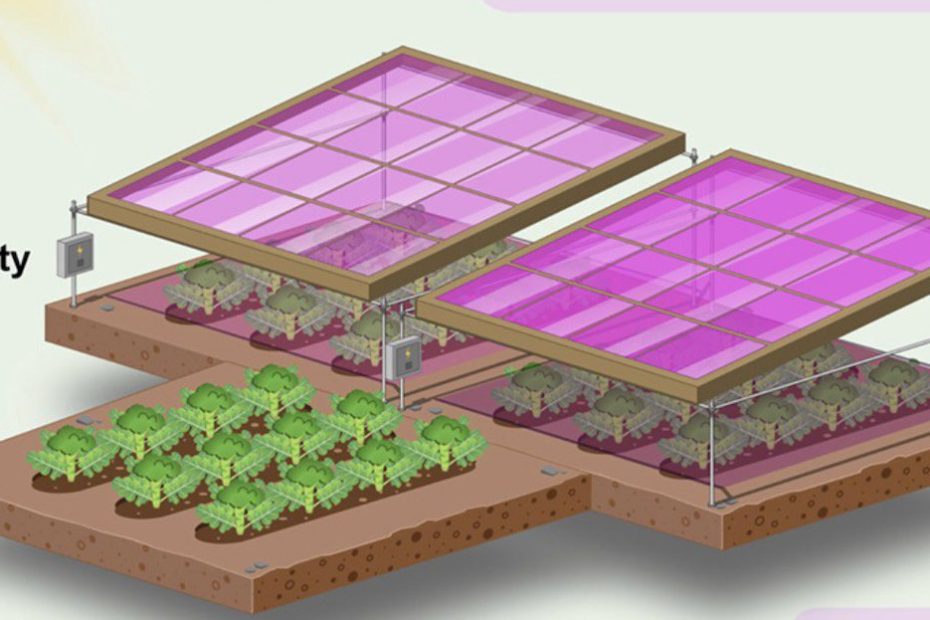
Broccoli grown under semi-transparent solar panels tinted magenta takes 30 per cent longer to grow than those in full sunlight, but they get just as big, a study has found.
The research out of Europe, where a backlash against solar “fields of iron” is making dual-land use a political imperative, found that one hectare of integrated solar and horticulture could produce the same combined amount of broccoli and electricity as 1.18 hectares of just broccoli or just solar energy generation.
“Despite substantial reductions in incident light, the investigated systems support fresh biomass production and most macronutrient concentrations comparable to full-sun conditions, while increasing the photosynthetic efficiency and radiation use efficiency,” the study in CellPress journal found.
“Overall, these findings provide proof-of-concept evidence for the potential of wavelength-selective PV technologies to support combined food and electricity production.”
The results could have been even better had they used modern silicon-PV cells rather than the old-school cadmium-telluride modules that were available when the research team needed them, the study suggested.
Solar developers have resisted making utility scale solar truly dual use to date. Standardised designs and equipment that don’t need to be adjusted to withstand animals or be lifted higher off the ground to account for cropping machines is cheaper to do.
But in Europe, land constraints and political activism mean crops and farming under solar are becoming a necessity, to the point that German company Schletter is already signing sales for cow- and horticulture-friendly systems that stand metres off the ground.
In Denmark, the rapid growth of solar from just 4 per cent of the grid to 13 per cent is now a political movement, inflamed by imagery such as photos of a solar farm surrounding a town called Hjolderup in Jutland (below).
But it wasn’t all positive news from the Swedish and Italian research team, led by Mälardalen University’s Silvia Ma Lu.
The solar broccoli took an extra 25 days to reach their full size and the study noted a marked drop in micronutrients, even if macronutrient levels stayed the same.
It put these down to the combined effect of reduced light, the changes in light spectrum that was allowed through to the crop, and the microclimate created under the panels.
The cadmium-telluride solar panels were structured so the ‘transparency’ came from gaps between the modules inside the panel that let through light.
One set let through 50 per cent of the light, the other 70 per cent of the light available, and had a built-in magenta filter to change the wavelengths which made it to the broccoli.
Plants do not require the full spectrum of sunlight for growth, preferring blue and red light for photosynthesis.
Sunlight that is too intense sunlight can actually cause plant cells to become over-excited and dissipate the energy as heat, or if it happens too often can damage the plant itself.
Technologies that would have been ideal for this project include organic PVs (OPVs), dye-sensitized solar cells, perovskites, or even the same design but using silicon-based photovoltaic cells, the study said.
The concept of transparent solar panels is making its way into commercial applications.
Australian horticulture solar company Storm Safe Solutions is talking to a panel maker with a plan to let red light wavelengths through, but says those conversations remain secret.
Cofounder Rosie Oldfield says they have a prospective client in the South Australian winegrowing industry who is keen to use solar shading to protect grapes from Australia’s intense sun.
Charles Sturt University is testing a design like the Europeans which puts gaps between the opaque modules to allow light through.
More than the sum of parts
The site, an organic research farm called Kärrbo Prästgård in Sweden, produced broccoli that were better at using the radiation allowed through the grid of modules.
But the power output was equally important.
The study focused on the panels that let through 50 per cent of light, saying this had an estimated installed capacity of 1.1 kilowatt peak (kWp) and generated an estimated 447.6 kilowatt-hour (kWh) of power over the June to October trial period – a power conversion efficiency of 7.2 per cent.
Put together, the site under the 50 per cent transparent system produced slightly less broccoli and slightly less power than the same site in broad sunlight or full solar panels, but together they produced more than the sum of their parts.
The average broccoli yield under the 50 per cent system produced 0.54 tonnes of dry mass per hectare, compared with 0.66 tonnes in the open-field.
Spreading that solar system over a hectare would generate about 224.7 megawatt-hours (MWh) over the same cultivation period, compared with 325.2 MWh produced by a no-gaps solar system.
That results in a land equivalent ratio – how much the land could produce when growing crops and producing solar compared to just doing one or the other – of 1.18.
“This value highlights that if the wavelength-selective PV system does not significantly reduce crop yield, the added electricity generation… still provides considerable value to the agri-photovoltaic system as a whole,” Ma Lu and her co-authors wrote.
If you would like to join more than 29,000 others and get the latest clean energy news delivered straight to your inbox, for free, please click here to subscribe to our free daily newsletter.
Rachel Williamson
Rachel Williamson is a science and business journalist, who focuses on climate change-related health and environmental issues.
Share this:
Facebook
X
LinkedIn
Reddit
Email
Print