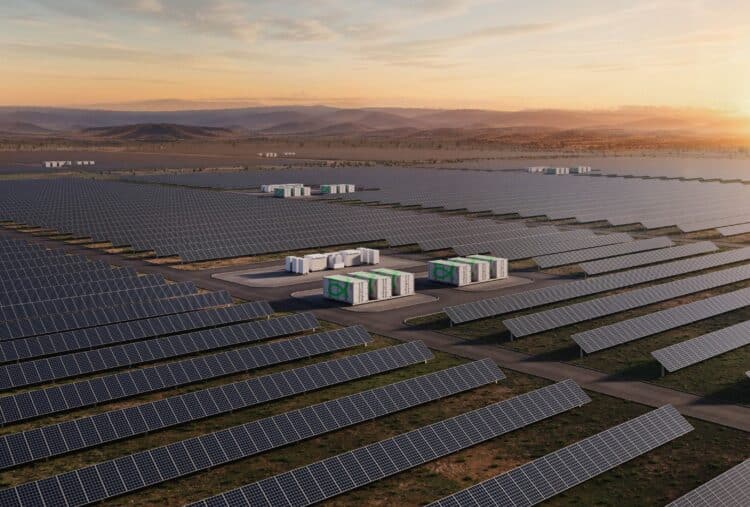
Edify Energy’s Smoky Creek & Guthrie’s Gap project in the Banana Shire, central Queensland, will be reinforced by advanced battery and network-support capabilities.
Developed through an agreement with DT Infrastructure and supplied by Power Electronics, the project is welcoming 164 GEN 3 2.0 PCSM battery inverters, medium-voltage transformers, 536 Freesun DC/DC converters and power plant controllers.
Edify reports that the DC-coupled architecture is connected at peak efficiency and minimises energy loss while providing network stability and disturbance resilience, aided by a single set of grid-forming inverters, with Power Electronics claiming the new integration will improve the way renewable energy is controlled and utilised.
Power Electronics business development director Glenn Clark said Smoky Creek & Guthrie’s Gap sets an example for how to “support complex hybrid projects” and provide customers with “greater certainty throughout the complete project lifestyle”.
“Grid-forming projects require technology, engineering capabilities and local experience to work together from the earliest stages of grid connection,” he said.
Subscribe to the Energy newsletter and discover all you need to know about the energy transition.
Don’t miss a second and subscribe to Energy in print.
The Smoky Creek & Guthrie’s Gap site spans around 1800 hectares and has the potential to generate up to 1589GWh per year of renewable energy. Rio Tinto has signed offtake for 90 per cent of the project’s power and battery storage capacity for 20 years to power its Gladstone aluminium operations, with the twin power stations to connect with Powerlink’s 275kV network via a new terminal station.
Peak construction is projected to employ approximately 800 people, with completion set for the end of 2028.
In May, Edify Energy reached financial close on Smoky Creek & Guthrie’s Gap, attracting support from 14 domestic and international lenders. Finance is being delivered through a “market-first” greenfield renewable energy debt financing platform, set to provide a “scalable foundation for future greenfield project delivery”.