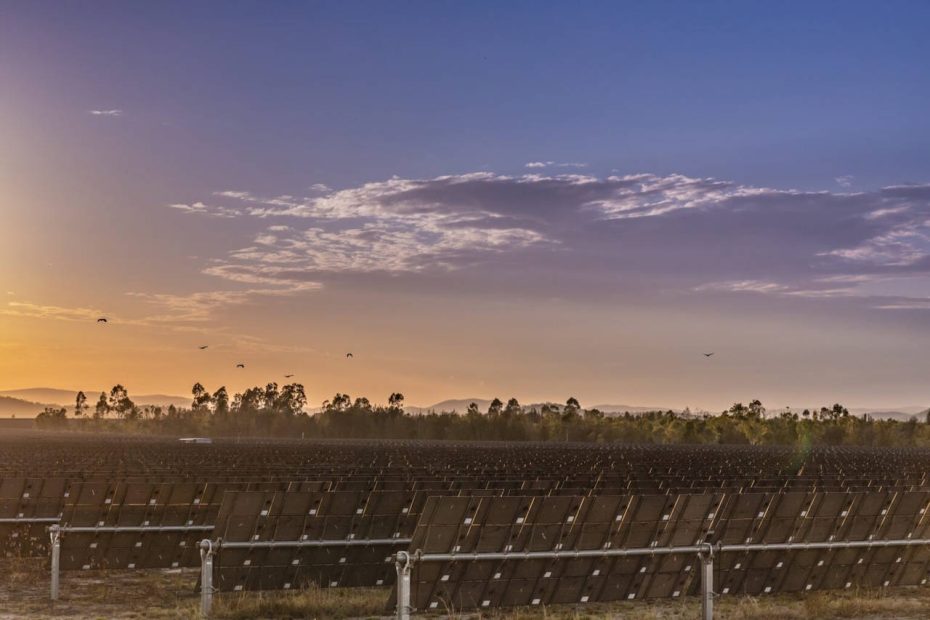
Renewable energy and storage developer Genex Power has more than halved the first stage of its enormous 2.5 gigawatt (GW) Bulli Creek solar-battery project and has a new plan to start building in 2028.
The new 300 megawatt (MW) first stage will be partnered with a 425 MW, 1,700 megawatt-hour (MWh) battery that will be built at the same time, rather than half way through the first solar build.
Genex was forced to change its strategy for the enormous project – which would be the country’s biggest if built to full capacity – after failing to convince equity investors that a standalone solar component, particularly at the original first stage size of 775 MW, could compete in wholesale markets currently flooded with daytime electricity.
It was impossible to ignore negative wholesale prices, the ongoing consequences of rooftop solar being the biggest generator in the National Energy Market (NEM), and the fact that solar projects are rarely being built now without a co-located battery to time-shift the power to evening peaks, Genex CEO Craig Francis said last week.
This is even though he believes the rise of large and small batteries will fix this problem in the coming years.
Other stakeholders, such as banks, were still keen on the original plan, he told Renew Economy on Tuesday.
“The way we’re looking at this is the first stage is 300 MW of solar and a 425 MW, 1700 MWh battery, and it’s likely that subsequent stages will look similar,” he says.
“Ultimately what we’ve done is optimise the configuration to be lower cost.”
The first 775 MW stage was supposed to be financially committed by the end of 2025 and construction was de to start this year. The first battery stage – then-sized at 400 MW and 1600 MWh – was supposed to start being built half way through that, with the second two stages of solar coming later.
A final investment decision (FID), financial close and then construction are now all pencilled in for 2028, because while the project is fully permitted it now needs to go through the grid connection process again.
Genex says it’s still committed to the full scale of the project in southern Queensland, which will be a 2 GW solar farm and a big battery as large as 600 MW and 2400 MWh.
Uncoupling community cash from FID
There is a danger that these kinds of radical changes in tack by energy developers badly damage trust in both projects and the industry, as landowners don’t get closure on what’s happening on their properties and local businesses miss out on work.
It’s an issue noted by the energy infrastructure czar this week, and one that is frustrating one local in Armidale who is keen to see a Squadron Energy project go ahead.
Francis admits there’s some frustration in the community that the first stage is not going ahead at the scale they originally planned, and these are sentiments he shares.
We share those frustrations, we’d like to be building the project as well… the scale and configuration was probably a bit much in the context of the market background so we’ve had to scale it back,” he says.
“Today, we’re saying to the community that we’re standing behind all of the commitments we made previously.”
One of those is to release funds immediately for a promised community centre reredevelopment in Millmerran, the closest town to the Bulli Creek project.
Genex is decoupling a $500,000 redevelopment of the Domville Place community hub from FID, promising to make the funds available now to start building next year.
Genex bought the Bulli Creek project in 2022, with all government planning approvals in place.
If you would like to join more than 29,000 others and get the latest clean energy news delivered straight to your inbox, for free, please click here to subscribe to our free daily newsletter.
If you wish to support independent media, and accurate information, please consider making a one off donation or becoming a regular supporter of Renew Economy. Please click here. Your support is invaluable.
Rachel Williamson
Rachel Williamson is a science and business journalist, who focuses on climate change-related health and environmental issues.
Share this:
Facebook
X
LinkedIn
Reddit
Email
Print