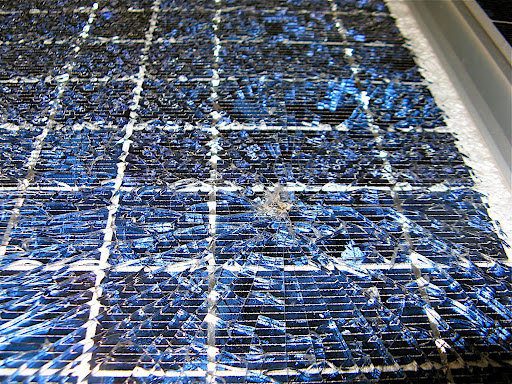
Do 10 per cent of solar panels arrive already broken? Industry insiders say such a loss rate would break the solar industry, but an anecdote that a tenth of the panels do arrive damaged at large scale solar projects is proving to be very persistent.
This week, Tindo Solar chief Richard Petterson repeated a version of this to a parliamentary hearing on solar panel reuse and recycling.
“Anecdotal evidence would suggest that when some companies do test panels before they go in, something like 10 per cent are rejected,” he told a House of Representatives committee, a single line in a broader discussion about finding ways to make panels last longer.
Renew Economy has seen different versions of this anecdote pop up on social media in anti-renewable energy groups, and has traced it back as far as Muswellbrook in January 2025.
That was when shire council mayor Jeff Drayton told the Independent Planning Commission in New South Wales that unnamed “industry experts” warned council staff some 10 per cent of the panels arriving for the 135 megawatt (MW) Muswellbrook solar project “will be defective, damaged in transit, or damaged during construction.”
That fear led to the now under-construction solar project being approved with a condition to “remove all waste from the site as soon as practicable, and ensure it is reused, recycled or sent to an appropriately licensed waste facility for disposal.”
Renew Economy has asked the Muswellbrook shire council for the source of the claim.
But a number of industry experts say a rejection or loss rate that high would break the solar industry.
It would be “a horrific cost” to the industry, Smart Commercial Energy managing director Huon Hoogesteger told Renew Economy, and to his own business.
He plans for losses of up to 1 per cent, mainly caused by mistakes in local transit, and manufacturer testing is so stringent that defective panels are vanishingly rare, Hoogesteger says
Data from the Smart Energy Council suggests a 1-3 per cent breakage rate, with 10 per cent rendering a project unviable.
Thomas Bywater, the country director of solar manufacturer Aiko, says profit margins in the solar industry are too thin to sustain a loss rate of 10 per cent.
They get maybe 50 panels breaking over a year.
For large projects, Aiko adds 1 per cent fat to what it delivers just in case, with these able to be stored on site in case of breakages during operation, but “definitely not 10 per cent”, Bywater says.
What constitutes ‘broken’ or rejected is also a muddy issue when it comes to utility solar projects, because contracts stipulate certain levels of efficiency and output.
PV Labs chief Michelle McCann says solar developers might reject a 500 watt panel that can still produce 480 watts for 30 years, but doesn’t meet contracted criteria.
Developers urged to test panels
Companies that test solar panels say there is another side to this story.
Developers are beginning to test panels before installation and just after, and making sure the manufacturer knows they are, as a way to avoid low grade solar panels.
The problem lies in China. Over-production has created a supply glut and plunging prices, but also means that trusting buyers may be receiving subpar goods.
No testers spoken to by Renew Economy had seen a 10 per cent damage or rejection rate.
But they did say that developers who don’t make it clear they will be scrutinising the product as it comes in, are at risk of receiving the rejects.
“We’re in a market where manufacturers are losing a lot of money because there is so much over supply, so they’re playing close to the edges,” says McCann, whose company specialises in PV testing.
“We’re definitely seeing a low quality of panel being delivered. But what that means is for the rising number of developers who are doing pre-operations testing, this is paying itself back faster than ever before.”
McCann says a 10 per cent fail rate isn’t outside the bounds of possibility, given the state of the current market, but she’d be disappointed to find it in the course of her work.
Developers are also wising up to the issue.
McCann says they’re doing more incoming goods inspections.
“The gold standard way of doing that is a pre-gate inspection before they go into the project, where the developer has the right to reject entire containers if what’s tested is not up to scratch. Then we follow that with another inspection just post-install,” she says.
To join more than 29,000 others and get the latest clean energy news delivered straight to your inbox, for free, click here to subscribe to our free daily newsletter.
To support independent media, and combat AI slop, you can click here to make a one off donation or become a regular supporter of Renew Economy.
Rachel Williamson
Rachel Williamson is a science and business journalist, who focuses on climate change-related health and environmental issues.
Share this:
Facebook
X
LinkedIn
Reddit
Email
Print