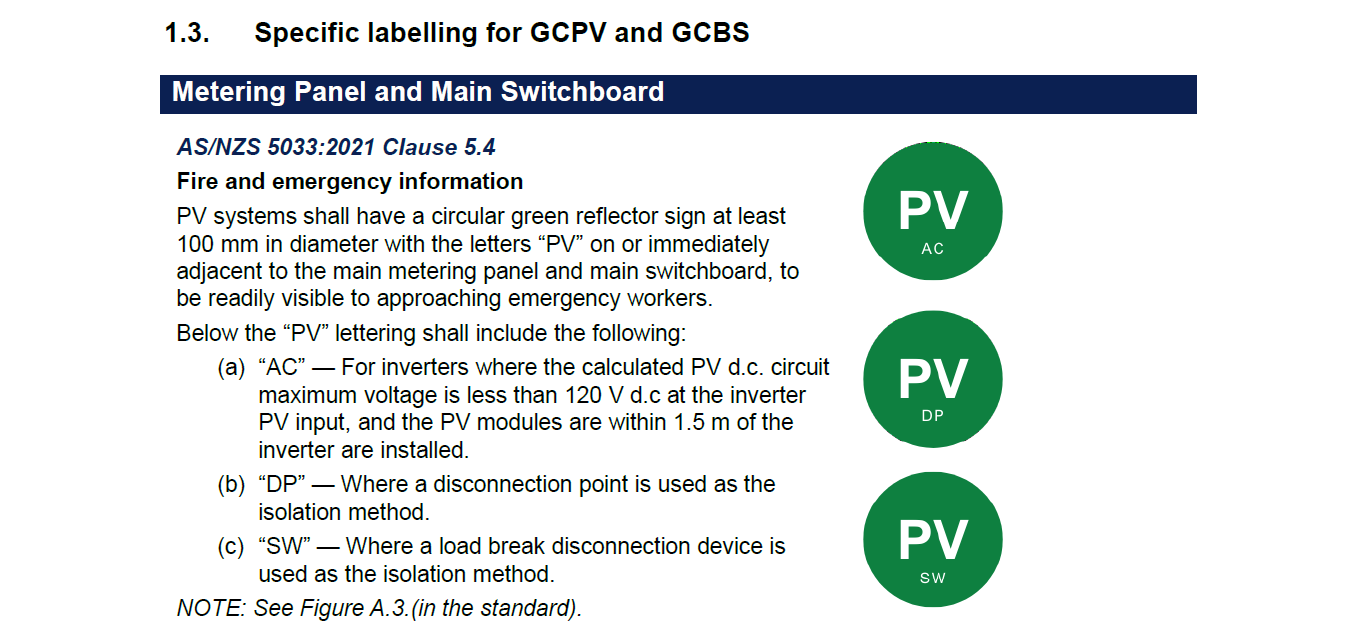
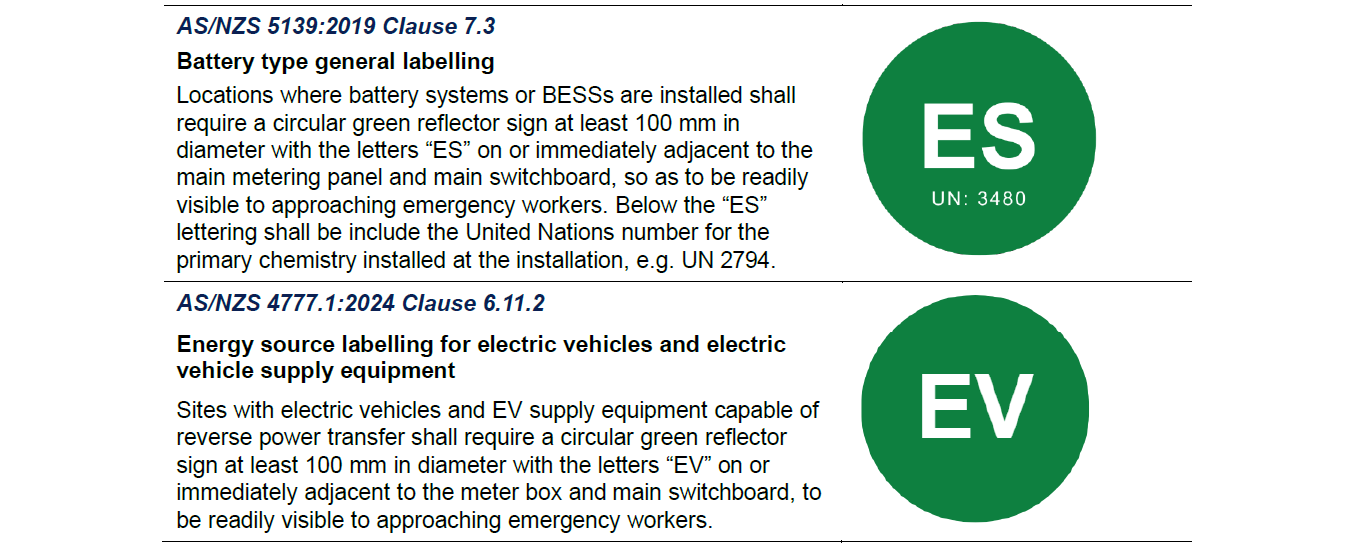
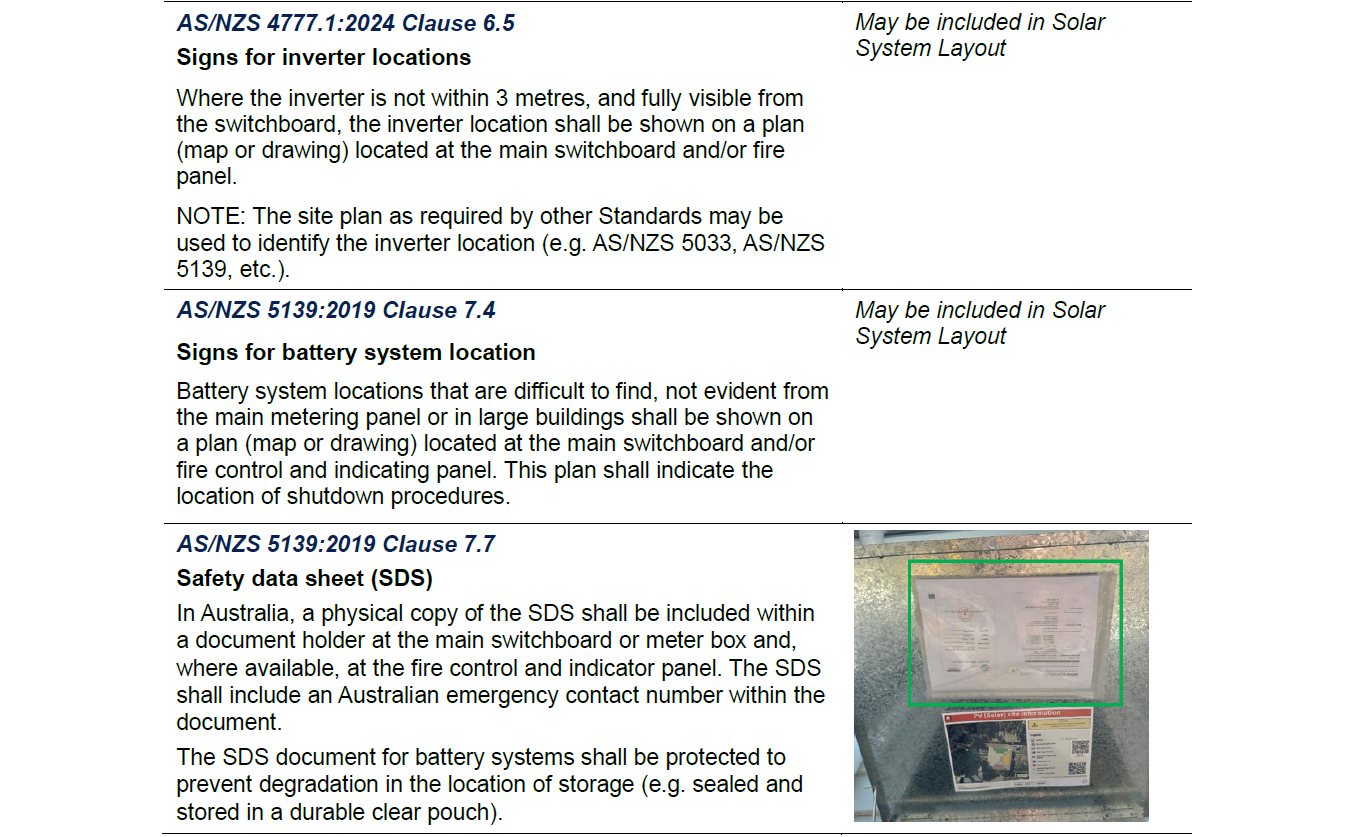
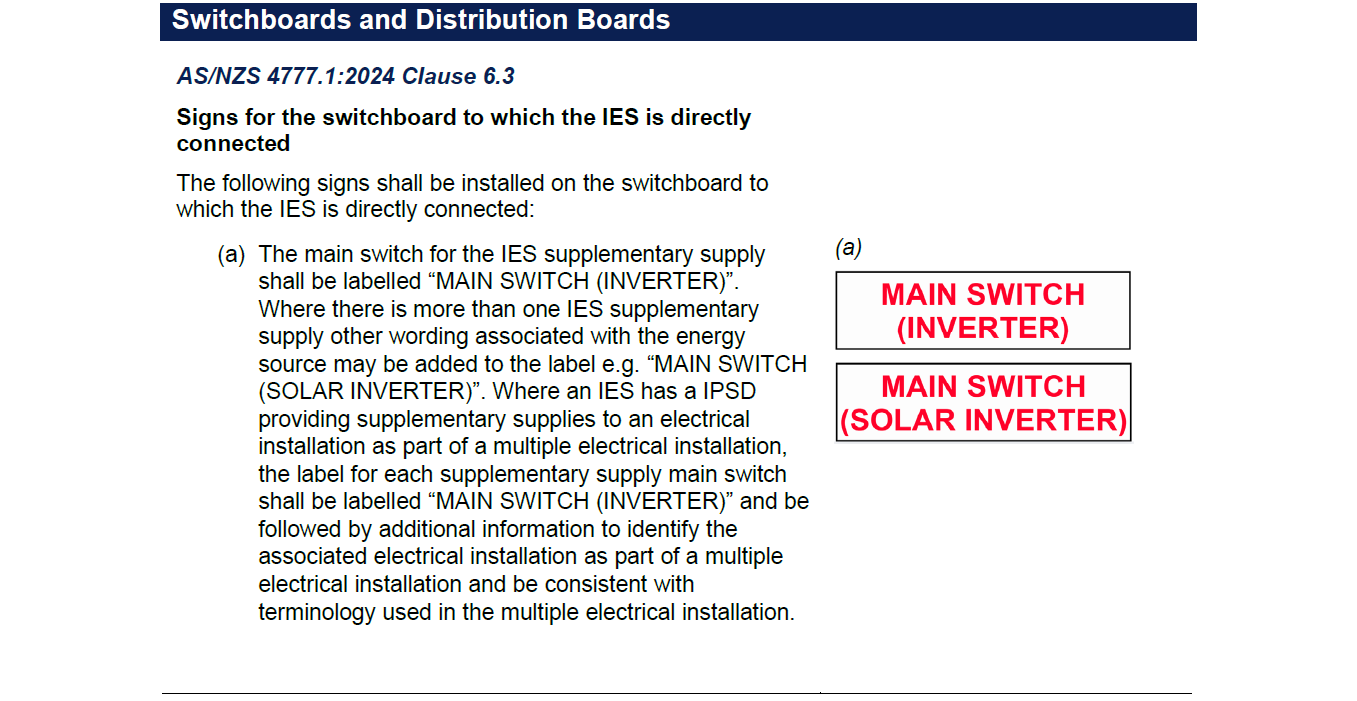
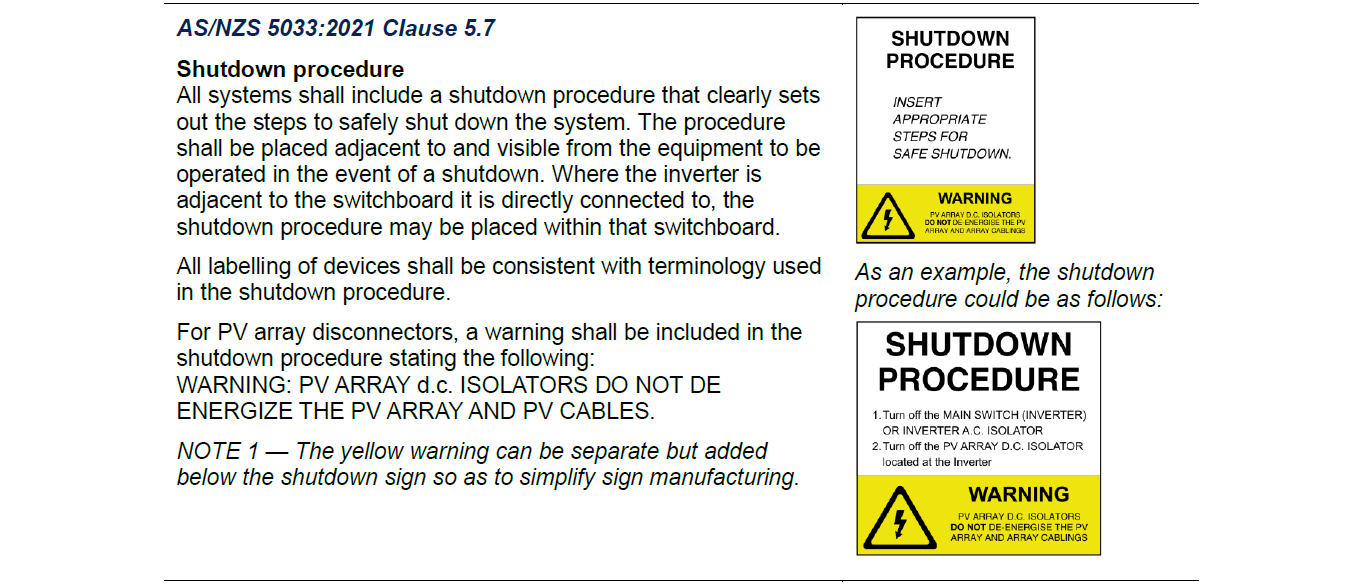
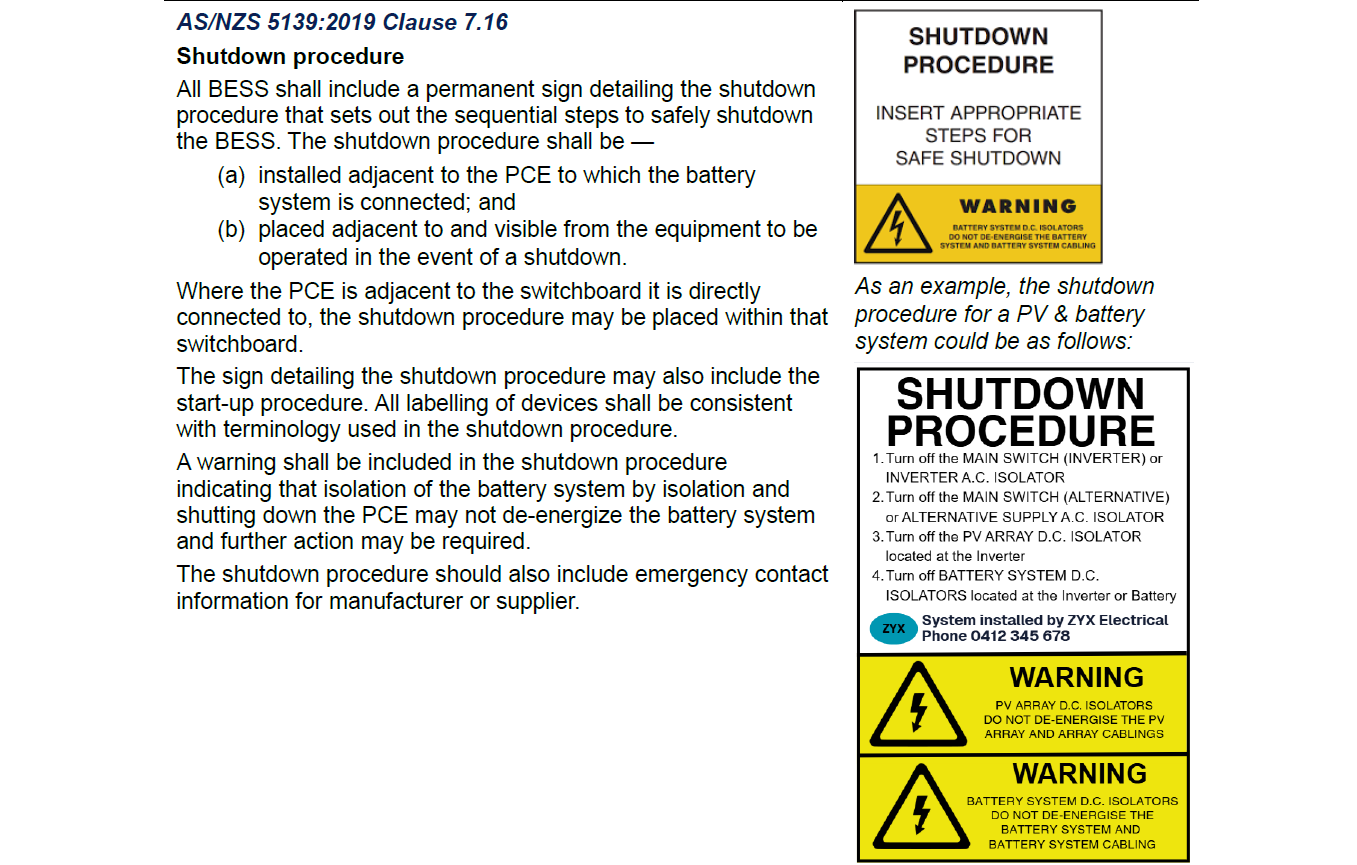
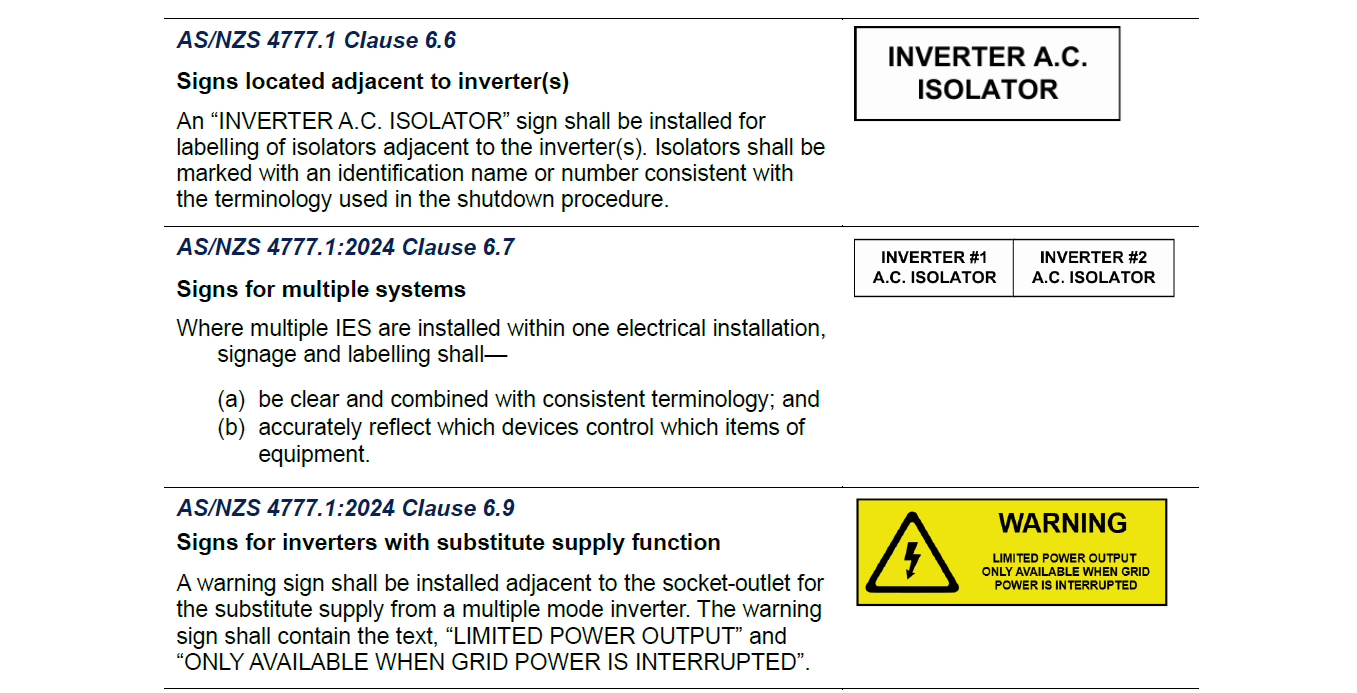
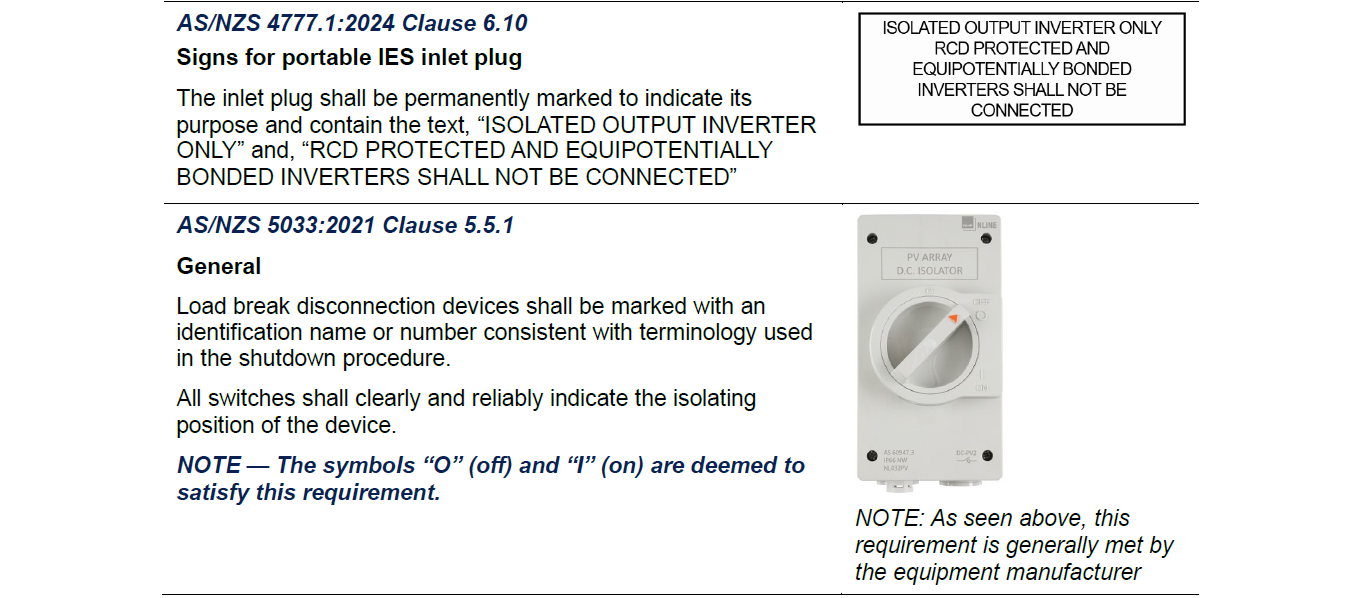
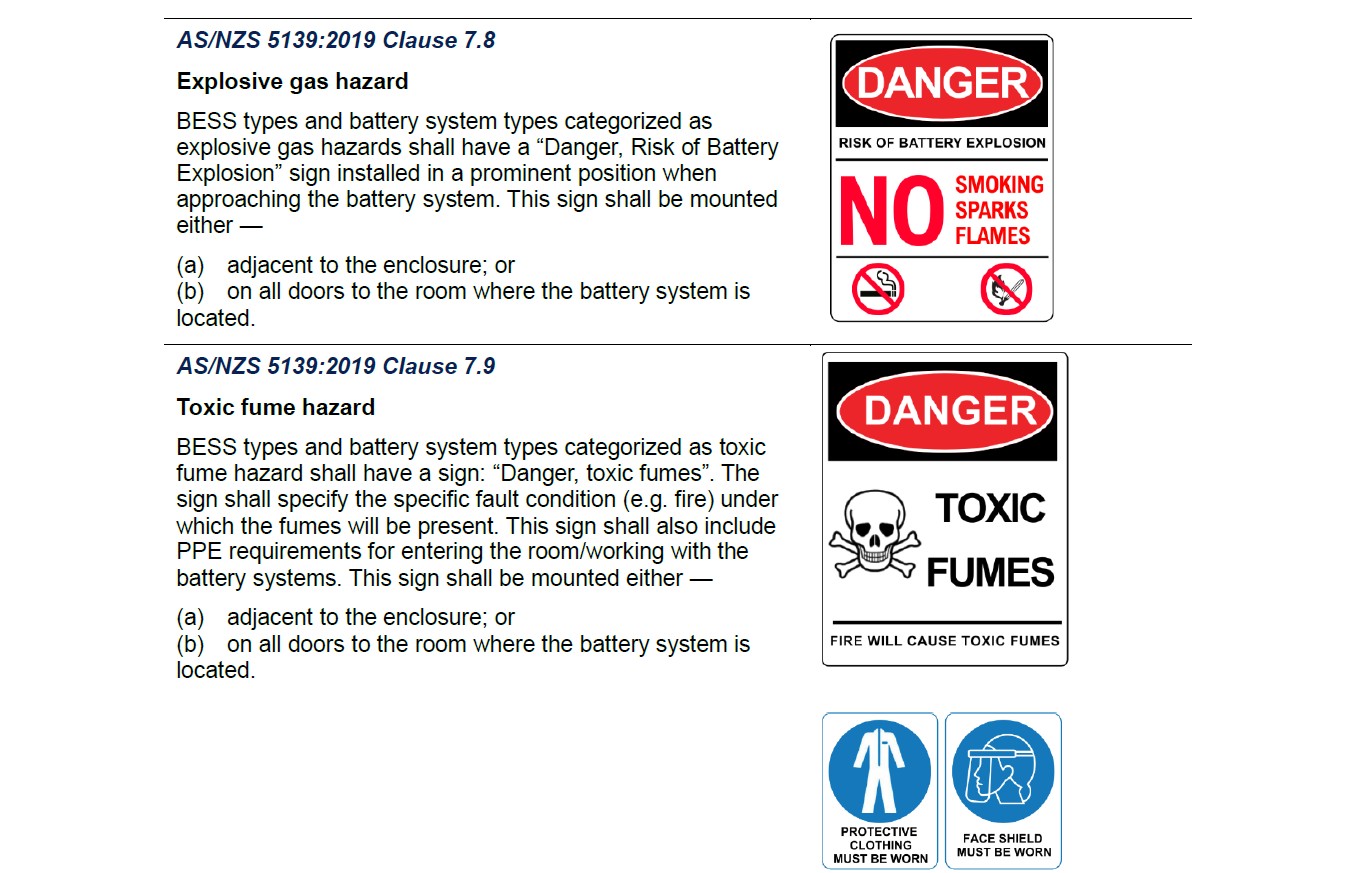
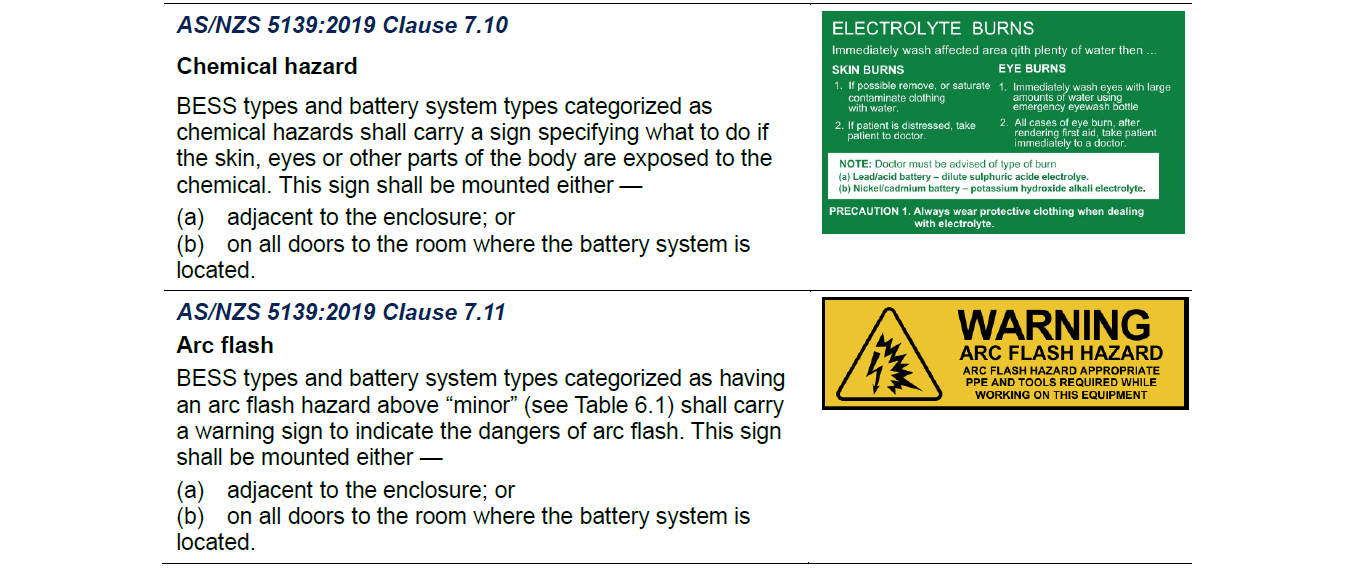
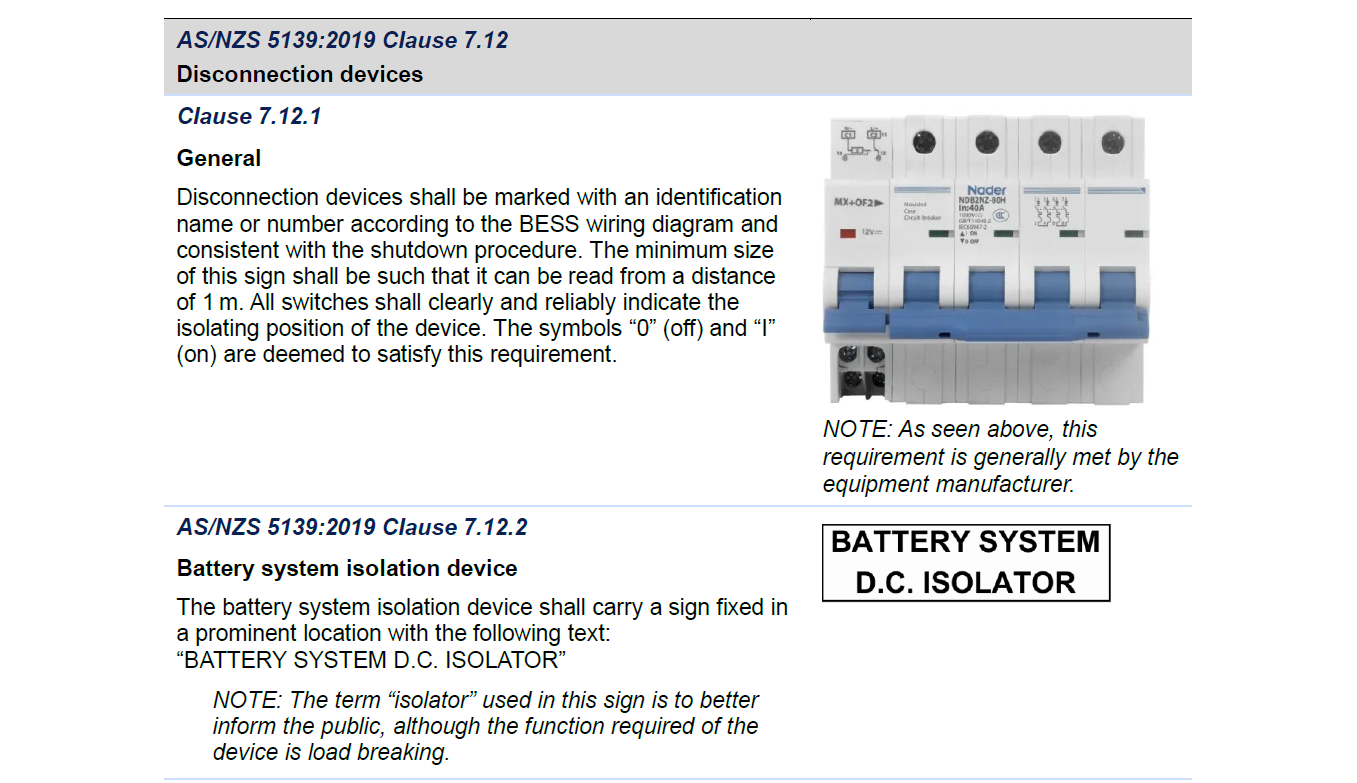
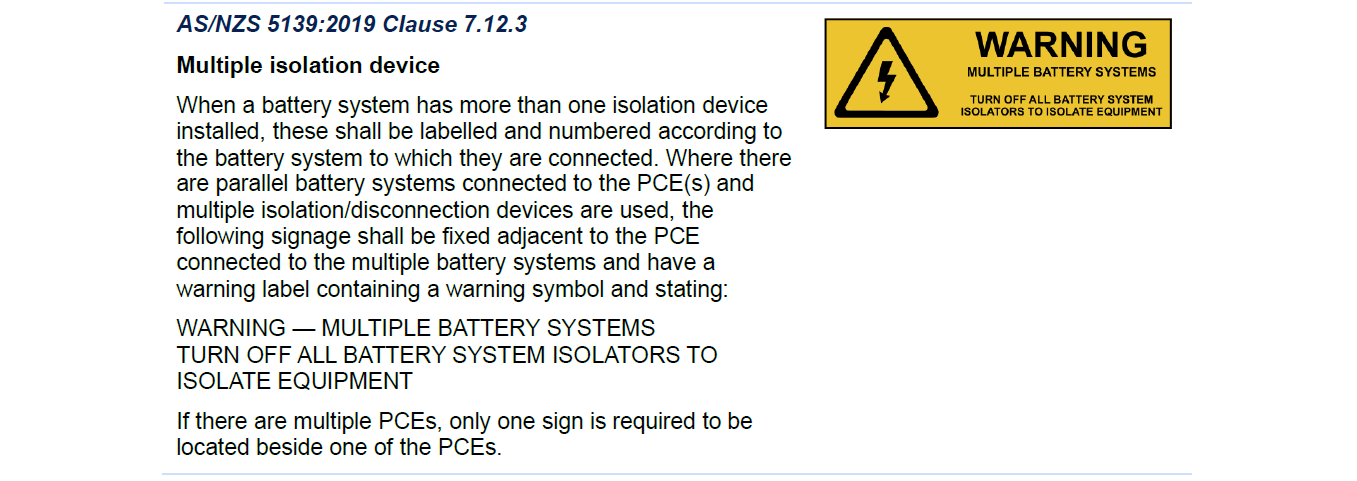
Covering the requirements of • AS/NZS 3000 • AS/NZS 4777.1 • AS/NZS 5033 • AS/NZS 5139
Overview
This support guide has been developed by Solar Accreditation Australia (SAA) to assist Accredited Persons in meeting labelling obligations under the relevant Australian Standards. Inspection findings from the Small-scale Renewable Energy Scheme (SRES) consistently show that incorrect or missing labelling on photovoltaic (PV) and battery systems are among the most frequent reasons for substandard or non-compliant installations. The numerous issues relating to labelling errors, highlights the need for clearer guidance. The document is intended to help installers understand and comply with all applicable standards and labelling requirements assessed under the SRES audit program. It supports—rather than replaces—the need for installers to consult the full suite of standards governing grid-connected PV and battery systems. Information is correct at the time of publishing. This document is a support guide only and SAA is not liable for any omissions or issues arising from labelling decisions and use of the guide.
Applicable Standards and Reference Documents
This support guide summarises requirements outlined in the following standards, as they relate to labelling of grid-connected photovoltaic (GCPV) and grid-connected battery systems (GCBS). Readers should ensure they have access to the following standards, including any current amendments: • AS/NZS 3000:2018 Electrical installations Known as the Australian/New Zealand Wiring Rules • AS/NZS 4777.1:2024 Grid connection of energy systems via inverters • AS/NZS 5033:2021 Installation and safety requirements for photovoltaic (PV) arrays • AS/NZS 5139:2019 Electrical installations – Safety of battery systems for use with power conversion equipment NOTE: the definitions in AS/NZS 3000, AS/NZS 4777.1, AS/NZS 5033 and AS/NZS 5139 apply to this support guide.
Licensing agreement
Elements of the relevant Australian Standards are reproduced and distributed in this document under a licensing agreement with Standards Australia [LIC-01208]. Users who wish to have access to full standards can purchase them through Standards Australia’s website https://standards.org.au/access-standards, or via industry membership organisations that hold subscriptions. Users of this document do not have a right to further reproduce or re-use the Licensed Material.
1. Requirements for signs and labels
Many requirements for signs and labels used in PV and battery systems are shared across the relevant standards—particularly those relating to sizing, materials, colours, durability, and identification. Following is a summarised list of common requirements followed by the full clause within each applicable standard. The document then details the specific labelling for grid-connected photovoltaic systems and grid-connected battery systems.
1.1. Summarised list of common requirements
(a) Labels and signs must be designed to remain durable for at least the full service life of the system. (b) They must be made from materials that are robust and suitable for the installation environment. (c) They must be securely affixed in a manner that ensures long-term durability. (d) All labelling must be written in English. (e) Text must be clear and appropriately sized to ensure readability. (f) Labels must be indelible so they cannot fade or be removed. (g) Labels must be positioned so they are visible wherever required.
1.2. Clauses on identification, sizing, materials, colours and durability
This section provides full requirements across relevant standards relating to sizing, materials, colours, durability and identification of markings, labels and signs.
Identification
AS/NZS 3000:2018 Clause 2.3.3.5
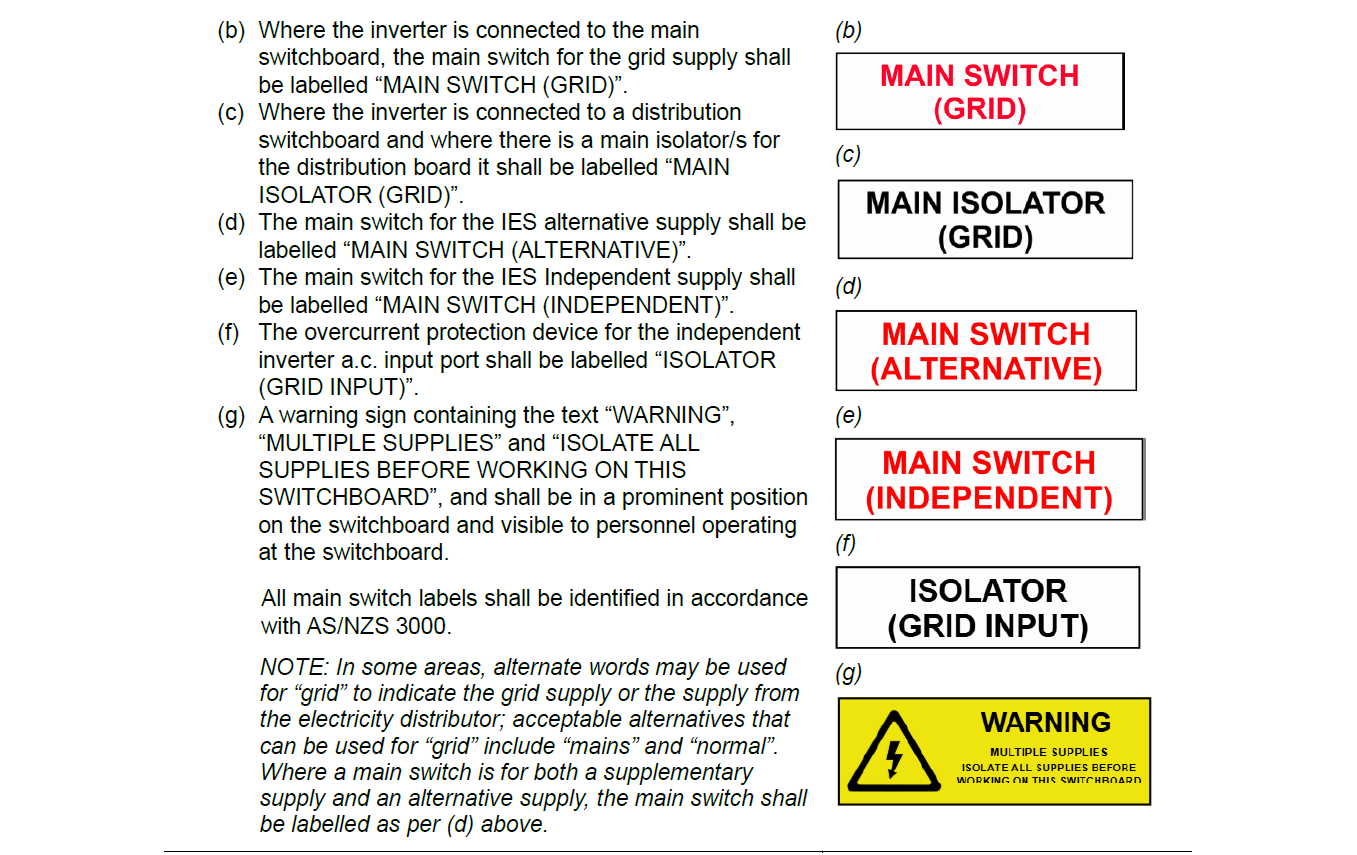
Main switches shall be identified as follows: (a) Each main switch shall be marked ‘MAIN SWITCH’ and shall be readily distinguishable from other switchgear by means of grouping, contrasting colouring or other suitable means to provide for prompt operation in an emergency. (b) Where there is more than one main switch, each main switch shall be marked to indicate the electrical installation or portion of the electrical installation it controls. (c) Where the opening of a main switch brings into operation or isolates an alternative supply, a notice shall be provided to indicate the position of the main switch controlling the alternative supply. (d) Where supply is provided at more than one point in any building, a prominent notice shall be provided at each main switchboard, indicating the presence of other supplies and the location of other main switchboards. (e) Main switches for supplementary or alternative supplies shall be labelled to indicate the energy source. NOTE: Marking requirements for other switches are contained in Clause 2.3.4.4 (of the standard).
Sizing, materials, colours, durability
AS/NZS 4777.1:2024 Clause 6.1 General All labels and signs required in this section shall be — (a) durable and designed to have a lifetime greater than, or equal to the service life of the IES; (b) constructed of appropriate materials suitable for the location; (c) where installed outdoors, be physically engraved, embossed, or etched with durable markings and be UV resistant; (d) fixed in a manner appropriate for the location; (e) in English; (f) legible and the letter size to be appropriate for the location (see Note 1); (g) indelible; and (h) visible where applicable (e.g. some signs may be enclosed in a switchboard cabinet, but visible when an operator opens the switchboard to perform maintenance or emergency services); NOTE 1: Sign lettering should be sized with uppercase lettering of 5 mm high and lows of 4 mm high per metre of viewing distance, unless otherwise specified. NOTE 2: As a guide, the background colour and lettering colour should follow the following principles: (i) Signs for general information should be white with black lettering. (ii) Signs for the essential safety of service personnel should be yellow with black lettering with a warning symbol. (iii) Signs for attention of emergency personnel should be red with white lettering. (iv) Special signs may use other colours.
AS/NZS 5033:2021 Clause 5.2
Requirements for labels and signs
Clause 5.2.1 General All labels and signs required shall be — (a) durable and designed to have a lifetime greater than or equal to the service life of the PV system; (b) constructed of appropriate materials suitable for the location; (c) fixed in a manner appropriate for the location; (d) in English; (e) legible and the letter size to be appropriate for the location (see Note 1); (f) indelible; (g) visible where applicable (e.g. some signs may be enclosed in a switchboard cabinet, but visible when an operator opens the switchboard to perform maintenance or emergency services); and (h) where installed exposed to direct sunlight conform to Clause 5.2.2. NOTE 1: Sign lettering should be sized with uppercase lettering of 5 mm high and lowercase of 4 mm high per metre of viewing distance, unless otherwise specified. NOTE 2: As a guide, the background colour and lettering colour should follow the principles listed below:
(a) Signs for general information should be white with black lettering. (b) Signs for the essential safety of service personnel should be yellow with black lettering with a warning symbol. (c) Signs for attention of emergency personnel should be red with white lettering. (d) Special signs may use other colours.
AS/NZS 5033:2021 Clause 5.2.2 UV resistance Labels/signs exposed to direct sunlight shall be UV resistant. Labels/signs shall conform to the following tests as specified in IEC 60068-2-5:2018: (a) Ten samples of the markings shall be exposed for 720 h to open-flame sunshine carbon-arc, in accordance with ISO 4892-4. (b) The test samples shall be mounted on the inside of the cylinder in the ultraviolet light apparatus perpendicular to the light source and in such a way that the samples do not touch each other. (c) There shall be continuous exposure to light and intermittent exposure to water spray. The cycle shall consist of 102 min without water spray and 18 min with water spray. The apparatus shall operate with an open-flame sunshine carbon-arc lamp, borosilicate glass Type 1, inner and outer optical filters, a spectral irradiance of 0,35 W/m2/nm at 340 nm and a black panel temperature of (63 ± 3) °C. The temperature of the chamber shall be (45 ± 3) °C. The relative humidity in the chamber shall be (50 ± 5) %. Legibility of markings on equipment intended for outdoor use shall not be degraded by UV radiation. EXCEPTION — This requirement does not apply to markings that are physically engraved, embossed or etched with durable markings.
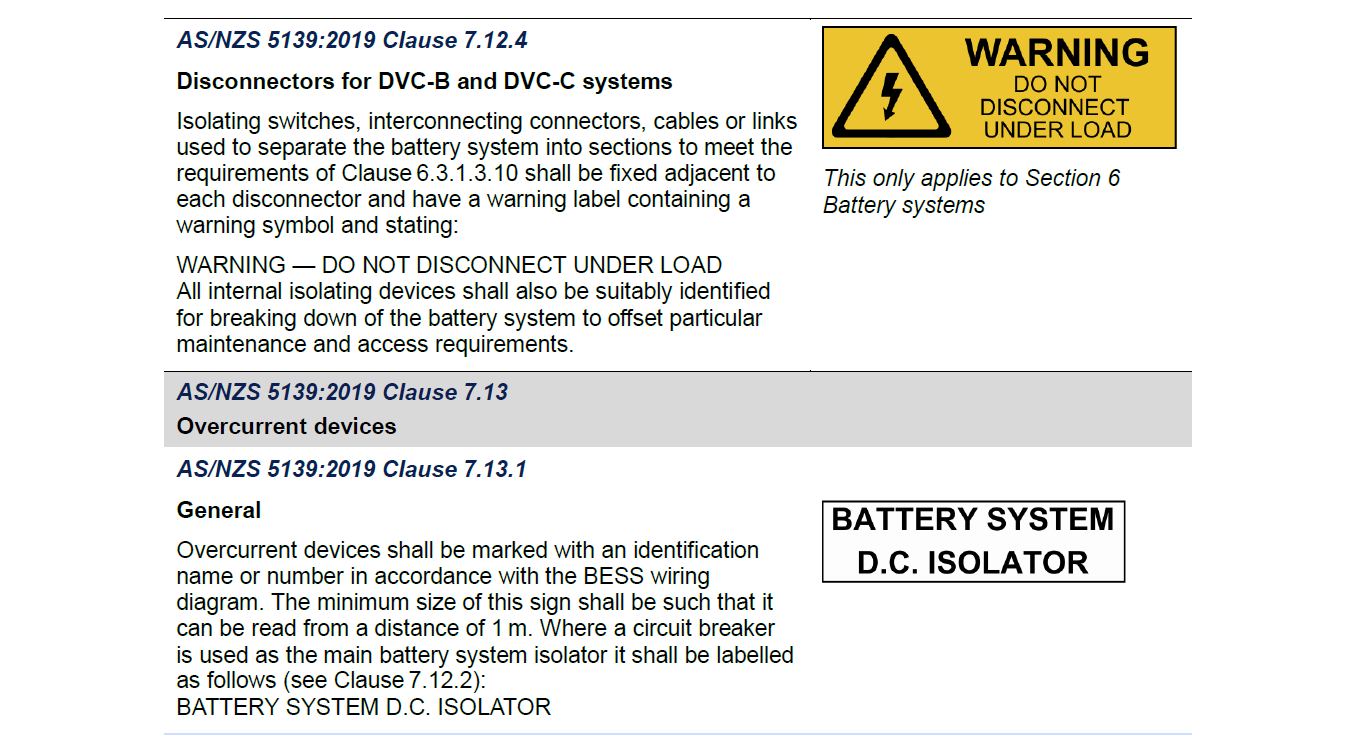
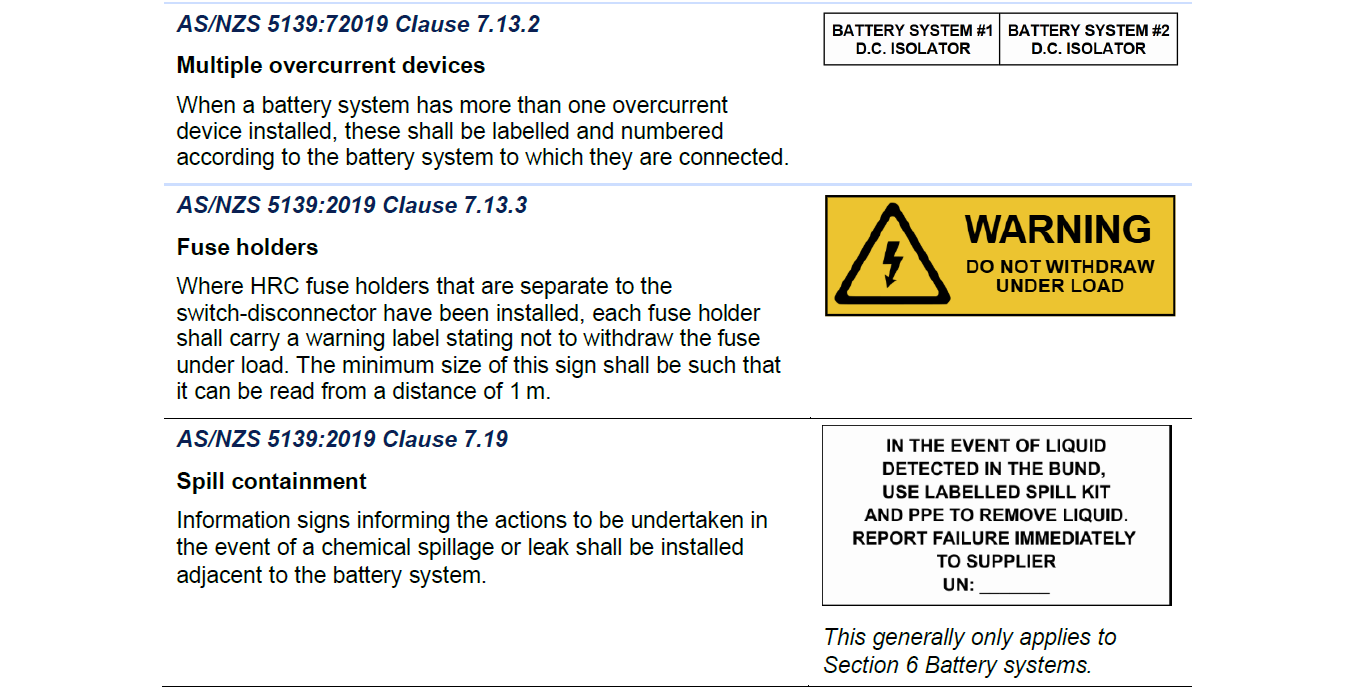
AS/NZS 5139:2019 Clause 7.2 Requirements for signs and labels All signs required in this Section shall be — (a) sufficiently durable and designed to have a lifetime greater than or equal to the service life of the battery system or BESS; (b) constructed of durable materials suitable for the location, and where installed exposed to direct sunlight, shall use UV stabilized materials; (c) fixed in a durable manner (d) in English; (e) legible and in a letter size appropriate for the location (see guidance in Note 1); (f) indelible; and (g) visible, as required, at the installed position. Signs should not be — (i) obscured by being located inside cupboards, behind doors or other materials; (ii) located where they can be obscured by materials placed in front of them or be located where it is likely that material will be placed in front of them (e.g. immediately above a shelf); and (iii) obscured by the door of the enclosure when in an open position. Some battery signs may need to be within the battery system enclosure and may only become visible after opening the battery system enclosure. Where more than one sign is required at the same location they may be incorporated into one physical label provided each individual sign requirement is met.
Safety signs should be designed and constructed to conform to AS 1319 and should be permanently displayed in prominent positions. The minimum size of a danger sign shall be 175 mm × 175 mm. NOTE 1 Sign lettering should be sized with upper case lettering of 5 mm high and lower case of 4 mm high per metre of viewing distance. NOTE 2 As a guide, the background colour and lettering colour should follow the principles listed below: (a) Signs for general information should be white with black lettering. (b) Signs for the essential safety of service personnel should be yellow with black lettering with a warning symbol.