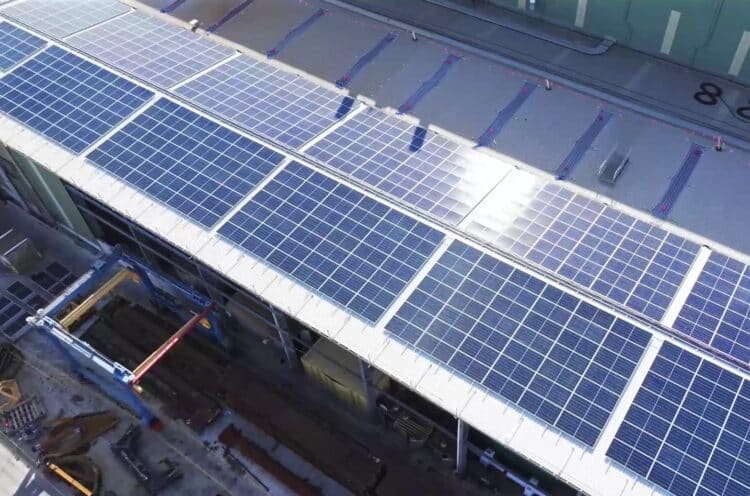
Westsun Energy installed 10 Fronius Tauro inverters at a 1.3MW commercial solar project in WA. It’s easy to see why.
In an Australian renewable energy industry rife with new brands, there’s more choice for developers and installers than ever before.
While a stream of new products and innovations is always welcome, it creates added complexity and a larger margin for error, with many solutions not proven or field-tested.
This is why having a trusted partner is critical.
“We’ve had difficulty with the reliability of Chinese-made products in the past, with customers facing breakdowns and costly downtime, while many of these companies come and go,” Westsun Energy director Ben Emery told Energy.
“This is why we go with Fronius, a European manufacturer with a strong local presence and diversified global supply chain.
“I can call Shane (Arnold, Fronius Australia WA state manager) any day of the week and visit their office in Subiaco to discuss any queries or pain points I’m experiencing. Fronius is upfront and reliable.”
Westsun partnered with Fronius at a recent 1.3MW commercial solar project in WA, with 10 Fronius Tauro 100kW inverters installed to support the array and provide additional grid protection in a highly regulated WA power industry.
Emery discussed the motivation for the installation.
“The customer – a major engineering company – has seen their electricity bills soar in recent years, and they’ve had to think creatively about energy generation as they face grid constraints,” he said.
“They’ve also expanded their factory by installing more CNC (computer numerical control) machines, which need to be consistently kept at about 24 degrees Celsius and require constant air conditioning to ensure the machines consistently operate at a perfect tolerance. This requires more energy.”
Ten Fronius Tauro 100kW inverters have been installed at the commercial solar project. Image: Westsun Energy
Industrial companies in WA operating on the SWIS (South West Interconnected System) increasingly face constraints on how much electricity they can draw from the grid.
This comes as many businesses look to expand their operations, with electricity a key enabler of growth. At the same time, the SWIS is facing heightened demand as companies transition from fossil-fuel generation to electrification, and through the rising adoption of grid-connected renewables.
It is because of WA’s stretched and distinct energy market that the state has become a proving ground for alternative, high-efficiency solutions underpinned by reliability, value and grid compliance.
The need for evolution in the WA energy market caters not only for new ways of thinking but also a steady hand, something which Fronius is known for.
“With the applications and rules in WA, installers need protection equipment and a lot of engineering done to comply with standards, trip settings, frequencies, and so forth,” Emery said.
“Installers need to know what they’re doing, and they need to design installations correctly, otherwise customers could face system issues and trips. This is why we always use top-shelf, Tier 1 engineers and products, and why we turn to Fronius.”
Fronius Tauro inverters offer remote monitoring capabilities through the Solar.web platform, enabling solar installers and operators to monitor and alter their equipment from afar.
“Fronius inverters allow us to have a clear view of operations,” Emery said. “We can monitor contactors and relays, and we can dial into the system through our own designated network.
“If there’s ever any issues or trips, we know in real-time and can diagnose them remotely. This allows us to quickly turn systems back on.
“Using the right equipment can be the difference between the main switch of a workshop constantly tripping or the power staying on. This is significant for our larger customers who can’t afford their plant to be without power for long periods of time.”
Westsun avoided around $55,000 in extra spend simply by using the Tauro’s integrated wired shutdown capability. Image: Fronius
Because Westsun’s 1.3MW installation exceeded 220kVA, grid protection was mandatory. This traditionally necessitates additional hardware, engineering time and significant installation cost.
Westsun avoided around $55,000 in extra spend simply by using the Tauro’s integrated WSD (wired shutdown) capability. This in-built functionality removed the need for external protection devices while still meeting all compliance requirements.
Emery explained the upside of this capability.
“When AC (alternating current) is lost on an inverter, the inverter turns off – a capability built into the inverter,” he said.
“But Western Power, having their own network, are very strict, and they require secondary anti-islanding protection – a second means of shutting the inverter off when there’s no AC.
Fronius Australia WA state manager Shane Arnold. Image: Fronius Australia
“Most inverters don’t have in-built contactors and relays to support secondary anti-islanding protection, because it can require extra materials, costs, labor and space.
“Fronius, on the other hand, has manufactured Western Power-approved in-built contactors that provide that additional layer of protection. For us, it’s a great sales and installation point.”
Arnold said it’s also a great “risk remover”.
“When using a motorised contactor, you are held by the lifespan and warranty of that hardware, which is usually quite short,” he told Energy. “When using the Fronius onboard disconnect you are protected by Fronius’ extended warranty options.
“So as far as the end consumer’s concerned, yes, they might have a warranty with a motorised contactor, but if you had to replace the contactor in two years’ time, you’ve got to shut the whole system down to do that.
“In Fronius’ instance, if you experience a trip but the contactor on the Fronius inverter doesn’t work when it comes back online, you’ve got nine other inverters as back-up. We’ll then go out with a replacement product under warranty, swap it out, and get that inverter up and running again.”
The partnership between Westsun and Fronius is a pairing of two respected energy players, which goes a long way in an industry strewn with unproven products and solutions.
This has underpinned Westsun’s growing order book and further verified Fronius’ inverter technology and software.
“A lot of people in this industry get in and get out – they don’t see the longevity,” Emery said. “As a renewable energy installer and solutions provider, I want to work with companies I know are going to be around for a long time.
“Fronius is one of those companies. You can go into an engineering workshop anywhere in Perth and you’ll find a Fronius welder, which are just as well regarded as their inverters.
“Fronius is constantly evolving and diversifying, while staying true to product quality and reliability. That is a partner I want to work with.”
This feature appeared in the March edition of Energy.