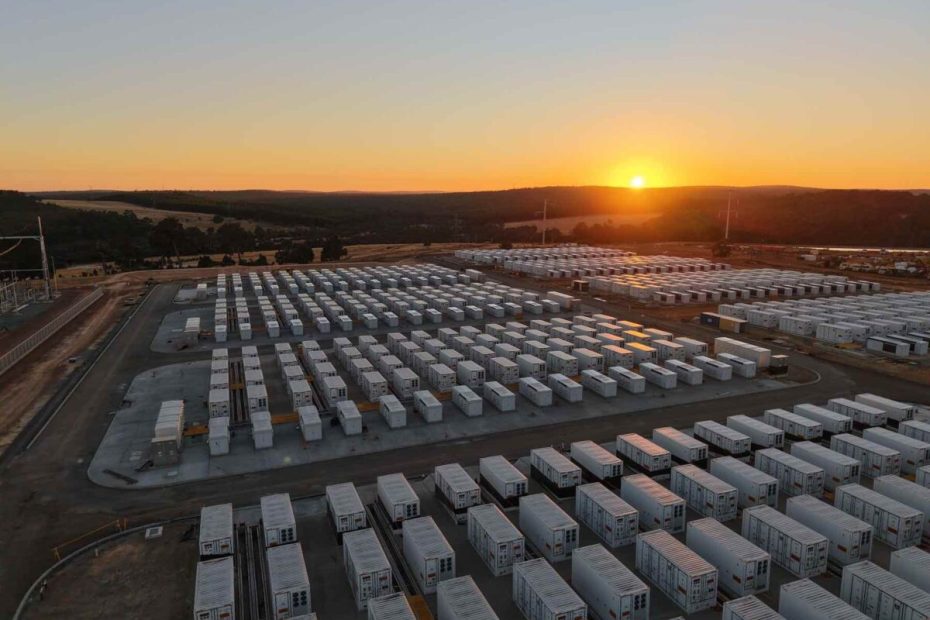
Solar and wind reached a remarkable new milestone in Western Australia’s isolated grid over the weekend, reaching 100 per cent of demand at various occasions on Sunday morning, as the state’s growing fleet of batteries allowed coal and gas generators to keep running in the background.
The W.A. grid, with no links to other states, is becoming a fascinating focal point for the green energy transition, largely because of the huge impact of rooftop solar and the high levels of variable renewables seen on almost a daily basis.
At 9.35am (local time) on Sunday, wind and solar contributed a combined 2,650 megawatts (MW) – with bioenergy a further 48 MW – and with net demand sitting at 2,613 MW.
Gross demand was higher, with the state’s big batteries – including the country’s two biggest at Collie – soaking up 443 MW (see graph below from Open Electricity).
Screenshot
That contribution from the big batteries was important, because it allows the market operator to keep online a minimum amount of coal and gas generators – its thermals – which are considered essential to provide grid security and the levers to respond with any grid disruptions.
It meant that the total share of generation for the W.A. grid, officially known as the South West Interconnected System – reached 88.7 per cent for renewables at the time. That itself is remarkable, given the naysayers that insist such levels are not possible for a modern economy.
As Rob Grant noted in a LinkedIn post, 56 per cent of grid demand was met from renewable energy across the week, beating the country’s main grid in the east, which was at 50 per cent for the same period.
But there is an issue around definitions of 100 per cent renewables here that energy boffins and authorities are wrestling with.
South Australia reaches 100 per cent renewables on a daily basis, (share of wind and solar compared to state demand) and the state has an official target of reaching 100 per cent “net” renewables by the end of 2027, meaning that it will import and export to other states when needed.
South Australia may soon be able to run with no synchronous generators at certain times. It is currently obliged to run at least one gas unit to ensure sufficient supply of “system strength”, but that need will be redundant most times when the new transmission link to NSW is complete.
In W.A, there are no imports or exports, because there are no transmission links to other grids. But the state is storing a growing amount of its wind and solar excess in big batteries – so there will be some who favour comparisons with gross load and others with net load.
The “real” 100 per cent renewables will occur when the “engines are off”, as we are seeing regularly in smaller isolated grid such as those powering mine-sites. The Bellevue gold mine recently reported a record 101 consecutive hours of “engines off” as it powered its entire mining operations with wind, solar and battery storage.
In W.A.’s main grid, the last of the state-owned coal generators are expected to retire before the end of the decade, and the last privately owned coal fired generator will likely be gone by then too.
That leaves gas generation, and it will be interesting to see how that plays out, and whether the market operator will rely on a certain amount of “always on” gas generators, or find other solutions – synchronous condensers and grid forming inverters – to provide the levers and the essential grid services to respond to grid disruptions.
The latest Transition Plan for System Security report, published by AEMO this week, highlights the importance of this, as it flags the potential of the country’s biggest grid, NSW, running at times with no coal as early as 2031.
Operating a grid the size of NSW should be the same principal as Bellevue Gold, at least on paper. But more things can go wrong in a bigger grid than a smaller one – and more people impacted – so the market operator has to prepare for all contingencies.
How it does that in a period of rapidly expanding renewables, the uptake of consumer energy resources, and the dramatic technology changes – particularly around grid forming inverters – and the partisan political positions – is an ongoing and fascinating debate.
If you would like to join more than 28,000 others and get the latest clean energy news delivered straight to your inbox, for free, please click here to subscribe to our free daily newsletter.
Giles Parkinson
Giles Parkinson is founder and editor-in-chief of Renew Economy, and founder and editor of its EV-focused sister site The Driven. He is the co-host of the weekly Energy Insiders Podcast. Giles has been a journalist for more than 40 years and is a former deputy editor of the Australian Financial Review. You can find him on LinkedIn and on Twitter.
Share this:
Facebook
X
LinkedIn
Reddit
Email
Print