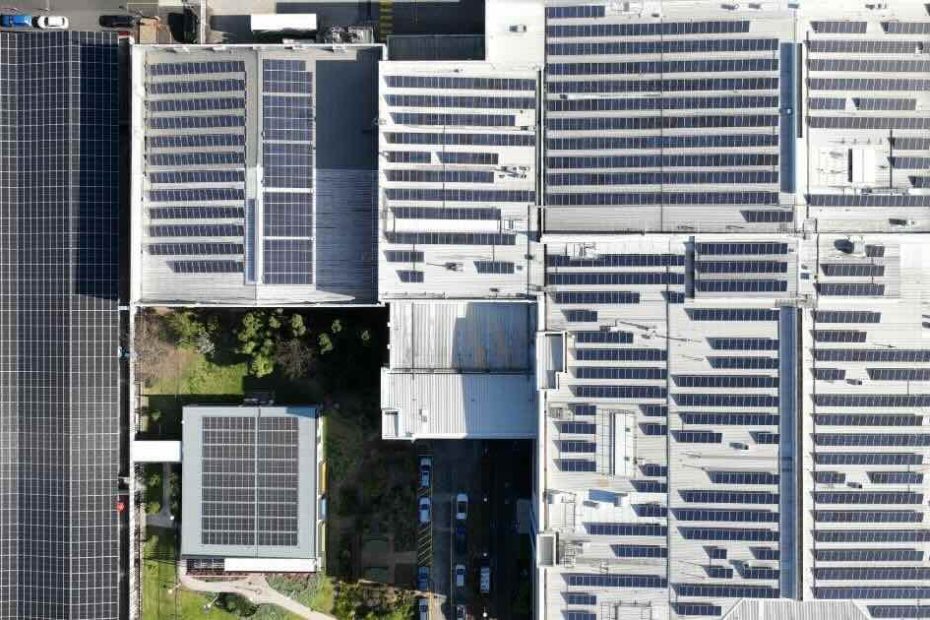
Months-long grid connection delays and costs that blow out by up to six times the originally quoted amount are among a bevy of barriers preventing commercial and industrial customers from sharing in the benefits of solar and battery storage, a new report has found.
The Smart Energy Council (SEC) report, Unlocking the Missing Middle, underscores that while Australia leads the world in residential and large-scale solar, the medium-sized C&I market is being stalled by outdated regulations, slow grid approvals, collapsed rebates, and landlord-tenant disputes.
The report focuses on the 100 kilowatt (kW) to 30 megawatt (MW) segment for rooftop solar – systems too large to qualify for residential incentive schemes like the SRES, and too small to access the policy and market mechanisms built for utility-scale generation.
This gap in targeted policies, compounded by a series of investment and regulatory barriers, is not only depriving a huge number of businesses from huge potential savings from solar and battery storage, but is holding back a key contributor to the energy transition.
“Australia is sitting on a rooftop power station the size of ten coal plants,” says SEC chief David McElrea. “It is time we switched it on.
“We are engineering under-investment into our own clean energy switch, one big rooftop at a time.”
The report – which draws from more than 80 studies, a survey of 61 SEC members, and 10 expert interviews – reveals slow sign-offs from network companies as a major and common barrier, with grid connection approvals taking up to five months instead of the standard 5-10 business days.
According to the survey, 71% of respondents cited the length of DNSP approval times as a leading connection challenge, and 82% identified connection requirements as the area where governance is least consistent.
In one particular example, the SEC heard from a community energy and midscale generator that its original grid connection cost estimate of $250,000 ultimately reached $1.6 million once feeder upgrade works were complete.
The report also heard of a distributed energy resource management system requirement that only became apparent in the final weeks of a generator performance standards approval process – at a cost that “could kill a comparable project without the right financial buffer.”
Meanwhile, the C&I sector has no coherent policy framework to support investment in solar and battery storage, the report says.
The Small-scale Renewable Energy Scheme (SRES) caps out at 100 kW, while the Large-scale Renewable Energy Target (LRET) has seen certificate prices collapse to $3-$4/MWh, down from between $20 – $30.
State programs – with the notable recent exception of New South Wales and its C&I-focused revamp of the Peak Demand Reduction Scheme (PDRS) – have tended to focus on residential batteries, community energy or large-scale procurement.
Then there are problems of asset ownership and lease sticking points. Nearly 75% of survey respondents identified tenant-landlord cost sharing as a major hurdle, and probing further found it is causing problems on both sides of the equation.
The report cites one landlord-side interviewee as explaining that power purchase agreements (PPA) – a commonly sought path around the tenant-landlord conundrum – as having largely failed because most tenants do not occupy a facility for the duration a PPA requires.
Ultimately, the report says, these barriers wind up meaning that investing in solar and battery storage for many C&I businesses just doesn’t stack up economically – despite the consistently decreasing cost of the key technologies.
“Several interviewees described C&I customers comparing solar and storage investment directly against alternative uses of capital, such as production line upgrades, and noted that solar frequently loses that comparison once payback periods extend beyond three to four years,” it says.
“One interviewee described electrification requirements, particularly government and large tenant commitments to remove gas and support electric vehicle charging, as a stronger current influence on lease negotiations than solar or storage economics on their own.”
And the urban versus remote contrast is stark. The report finds that a 2 MW solar and 7 MWh battery system at an urban industrial site (15 cents/kWh tariff) delivers only 8% savings, or around $150,000 per year.
The same system in a remote location, replacing diesel at 45 to 60 cents/kWh, by contrast produces a compelling business case.
And on battery economics, the report finds this is strongest where grid electricity is expensive or unreliable – which is a dynamic with direct implications for where policy support is most needed.
So what can be done to level out the playing field? The SEC is calling on the federal energy minister, Chris Bowen, to establish a national taskforce within six months and to implement five practical fixes.
The fixes include fast-tracking network approvals and strictly enforcing connection deadlines; reforming network pricing; restoring rebate support and raising SRES system-size caps above 100 kW; standardising lease models to share costs and benefits evenly; and making grid data more visible to customers and developers.
In the case of rebate support, the SEC recommends the introduction a Medium-Scale Renewable Energy Scheme (MSRES) – a new performance-based certificate scheme for systems between 100 kW and 30 MW, with a floor price somewhere around the $20-$25 mark.
Another option – which the SEC says is “the fastest and most administratively straightforward reform available” – is to expand the SRES to at least 1 MW, thus eliminating the “artificial under-sizing” phenomenon currently being driven by the “100 kW cliff edge.”
The report also points that a “German-style” export-capped model for systems sized between 135-500 kW (export capped at 270 kW, no complex certification), which reduces DNSP workload, supports grid stability and unlocks mid-scale rooftop solar.
“This report makes a clear case that Australia’s C&I sector is significantly under-investing in distributed solar, battery storage and electrification relative to its potential, and that the primary causes are policy and regulatory rather than technological,” the report concludes.
“The economics are sound for a meaningful share of C&I sites and are strengthening as storage costs fall and tariff structures evolve. Appetite for investment is present; every interview and the survey data confirm that financial savings are a powerful driver.
“But that appetite is being frustrated by connection delays, threshold gaps, split-incentive problems and a policy environment that is creating uncertainty and project paralysis.”
To join more than 29,000 others and get the latest clean energy news delivered straight to your inbox, for free, click here to subscribe to our free daily newsletter.
To support independent media, and combat AI slop, you can click here to make a one off donation or become a regular supporter of Renew Economy.
Sophie Vorrath
Sophie is editor of Renew Economy and editor of its sister site, One Step Off The Grid . She is the co-host of the Solar Insiders Podcast. Sophie has been writing about clean energy for more than a decade.
Share this:
Facebook
X
LinkedIn
Reddit
Email
Print