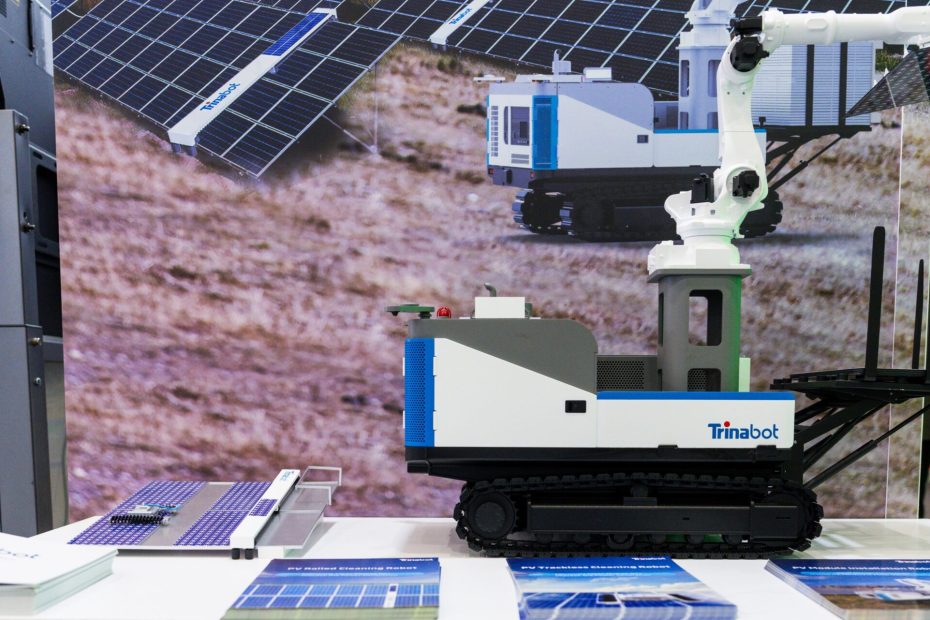
Trinasolar is the latest solar player to plan a robot trial in Australia, with the manufacturer looking at securing a green grant for its ‘Trinabot’.
The Trinabot is a solar panel installation robot, similar to other machines already tested in Australia such as Luminous’ Lumi and Leapting’s Litian robots.
It’s part of an initiative to help developers reduce their whole-of-system cost, says Trinasolar ANZ and Pakistan group director Edison Zhou.
“We want to bring new technology, high efficiency panels, the Elementa 3 which is our new [utility scale] battery, and the installation robot… to help developers not just reduce the manufacturing cost, but also the total system cost,” Zhou told Renew Economy at the All Energy conference in October.
He says the Trinabot is already being used across “so many” projects in China, and they are now working with a contractor to apply for grant funding from the Australian Renewable Energy Agency (ARENA) to run a local pilot.
Luminous panel installer robot at the Goorambat solar project. Image: Engie
ARENA is keen to fund these kinds of trials as part of a push to bring down the cost of large scale solar to below $20 a megawatt hour.
This week it promised $45 million to Fortescue alone to test up to 10 different novel solar technologies on projects in the Pilbara.
Other funded technologies are automated, or semi-automated pile driving rigs such as Nextracker is testing at several solar projects in Australia, again thanks to an ARENA grant.
These kinds of technologies will become increasingly important from this year onwards, as it looks like the ongoing collapse in solar panel prices is over and the cost of modules tipped to edge up from now.
Leapting says its solar panel installer can do the work of up to four humans, while Trinasolar’s Andrew Percival says theirs can improve the economic value of a project by a third.
“It changes the efficiency level and improves the economic value of a project by potentially up to 30 per cent, it just depends on the project, site and location. The idea is that we’re not trying to change how much labour is involved, but streamline the labour, so you’re getting better cost outcomes,” he told Renew Economy.
“As modules become more efficient, we’re trying to keep the size and the format the same. We’re also trying to allow developers and EPCs to be more efficient with their project delivery.
“If we can give them that efficiency through value adds… this is a real value point of difference.”
Reducing the number of people needed on site as solar equipment is installed is the unspoken, carefully hedged motivation for all of these projects.
It’s partly because labour is expensive in Australia, but also because there aren’t that many people available to do the work.
Labour shortages combined with remote or, as in the Pilbara, harsh environmental conditions are making robotic aids increasingly useful for contractors as a way to build very large scale solar projects faster.
If you would like to join more than 27,800 others and get the latest clean energy news delivered straight to your inbox, for free, please click here to subscribe to our free daily newsletter.
Rachel Williamson
Rachel Williamson is a science and business journalist, who focuses on climate change-related health and environmental issues.
Share this:
Facebook
X
LinkedIn
Reddit
Email
Print