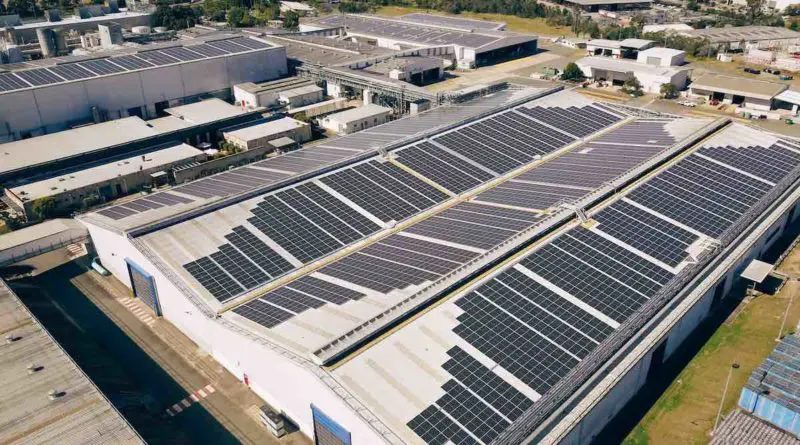
The huge potential of commercial and industrial solar and battery storage to help balance an increasingly volatile grid, while also crushing one of the most costly line items in business power bills, is the focus of a new partnership between two Australian energy market innovators.
South Australia-founded Optigrid and Victoria-based Acacia Energy announced on Wednesday that they will collaborate to transform behind-the-meter commercial and industrial solar batteries into cutting edge participants in the National Electricity Market (NEM).
The companies say the collaboration will accelerate the rollout of batteries for Acacia Energy’s existing commercial and industrial (C&I) customers while using OptiGrid’s AI-powered forecasting and optimisation platform to maximise revenue for those customers – and minimise their bills.
They will do this partly by applying OptiGrid’s optimisation and trading intelligence software to allow aggregated C&I storage capacity to participate in the NEM in the same markets usually reserved for large-scale renewables and big battery developers; namely, energy arbitrage and frequency control ancillary services.
“Australia’s distribution networks are full of battery development potential. With greater value capture and smarter optimisation, the C&I and sub-5 MW segments stand out as a major opportunity,” OptiGrid CEO and co-founder Sahand Karimi says.
“Working with Acacia Energy means we can support distributed battery developers and commercial customers to provide them with the insight and performance they need to invest confidently in batteries and accelerate Australia’s clean energy transition.”
OptiGrid is the product of the combined research of two of its co-founders: Sahand Karimi, a power system engineer who did a PhD on battery operation optimisation at University of Adelaide; and Nam Dinh, a data scientist whose studies focused on electricity price forecasting.
“OptiGrid basically came out of the research we started at uni about six years ago,” Karimi tells Renew Economy. “We began working together, got interesting results, began talking to the industry, and … raised the capital to spin out of the university and create this company, build the product.”
Following a successful seed funding round about 18 months ago – led by IP Group, with participation from the Clean Energy Finance Corporation (managed by Virescent Ventures), Hostplus, University of Adelaide, EnergyLab, and the UNSW – the company today has around 12 staff, mostly data scientists and software engineers, and manages around 75 megawatts (MW) of assets, including the Hepburn Energy Park.
Acacia Energy, meanwhile, was co-founded by Stephen Thomson, a former aeronautical engineer who says he “fell into the energy industry in 1998 and never left,” with roles including preparing state-owned Victorian utilities for the introduction of full retail competition and helping to set up the Australian Energy Market Operator (AEMO).
Thomson, who is now the CEO of Acacia Energy, says the company was kick-started around six years ago when he met co-founder, Richard Martin, and they decided that the renewable energy assets they were developing for regional and agricultural businesses also could be put to use in energy markets.
“We did all of the work to get registered with AEMO,” Thomson tells Renew Economy. “We were, in those days, a small generation aggregator… We established ourselves as a demand response service provider, particularly focusing on FCAS and we …initially and tested our development on generators.
“So we set the business up to do that, and … our system is operating across around 10 MW of assets across Victoria and New South Wales, working very successfully with some generation assets and providing effectively a price response service,” he says.
“But we didn’t have an optimisation tool, and we searched the market to look for what’s …going to give the best value for money to the customer, in terms of the assets, and that’s why we selected OptiGrid to partner with.”
Karimi says that up until now, OptiGrid’s focus has been on front-of-meter or utility-scale assets and addressing the challenge of gaining enough returns on big battery investment, as FCAS prices fall due to market saturation and energy prices become even more volatile.
“Basically, we’ve developed a solution designed specifically for [big batteries] to better deal with that and basically improve the performance of the utility scale batteries. But now we are saying this can be applied to the C&I sector,” he says.
“What we’re doing here with this partnership is we’re making that capability that has been really honed for the utility scale market, available now to participants in the C&I market by participating through an aggregator,” Thomson adds.
“We’re using this market leading tool that’s tuned for the utility-scale and making that available to much smaller projects.”
The set-up being used by Acacia Energy and OptiGrid is all-important to its success in the C&I market. The battery is put behind a “child meter” – a separate meter that sits behind a “parent” meter, which measures the total energy supplied to a business, or embedded network, from the grid.
“Really, there’s two use cases for a battery for a commercial and industrial customer,” Thomson explains, “and one of them is that traditional … you put more solar on the roof and you store some of that and you discharge that later in the day.
“That’s the simple use case for a battery… but the more comprehensive use case is to put the battery behind a child meter and then participate with that battery in those wholesale markets and then deliver benefits to the customer through the demand savings.
“And that’s really where our partnership with OptiGrid makes the most value for the customer.”
Demand charges are network charges based on the highest amount of electricity drawn from the grid at any one time in a billing period and are designed to reflect the cost of supporting a customer’s peak power needs, as well as to encourage businesses to spread out their load.
But for some C&I customers, demand charges can account for up to 50 per cent of a bill, making them the highest component of total electricity costs.
Acacia and OptiGrid say optimising C&I batteries in the way they propose offers significant opportunity to reduce the demand charge on electricity bills – as well as get a return from participating in arbitrage and FCAS markets – and potentially other revenue streams.
“If we aggregate enough C&I batteries, then they can also be contracted through off-take agreements to basically the buyers of these kind of contracts, like gentailers,” Karimi says.
“And so even that type of revenue stream would be available, at scale, to the C&I batteries. …[They] can also basically generate value by reducing that peak demand charge, which is not available to the utility-scale or front-of-meter batteries.
“So there are some kind of value streams that are available to the CNI that the big-scale batteries cannot capture.”
Thomson says the hope is that the new partnership can boost Acacia Energy’s aggregated C&I capacity to 25-30 MW, potentially by the end of the year, and then continue to grow it “on a considerable basis” going forward.
“Once you prove it and show that it can be done … and once you’ve done it once or twice with the distribution business … it’s a lot easier because they’re very familiar with the way that this actually works.
“Australia is on a journey to transition from fossil to renewables, and we have to have storage to be able to do that,” Thomson adds. “And the plans of these large storage capacity facilities, which are in renewable energy zones a long way away, are heavily reliant on transmission to bring that energy to the load centre.
“There’s still a massive amount of storage that is needed. What we’re looking to do is to complement that with storage that is embedded in parallel with where the load is and …help make a contribution to the energy transition with distributed energy storage that we aggregate and participate in the market.
“There is plenty of opportunity for this to fit in the [energy transition] environment for the next many, many years.”
If you wish to support independent media, and accurate information, please consider making a one off donation or becoming a regular supporter of Renew Economy. Please click here. Your support is invaluable.
Sophie Vorrath
Sophie is editor of Renew Economy and editor of its sister site, One Step Off The Grid . She is the co-host of the Solar Insiders Podcast. Sophie has been writing about clean energy for more than a decade.
Share this:
Facebook
X
LinkedIn
Reddit
Email
Print