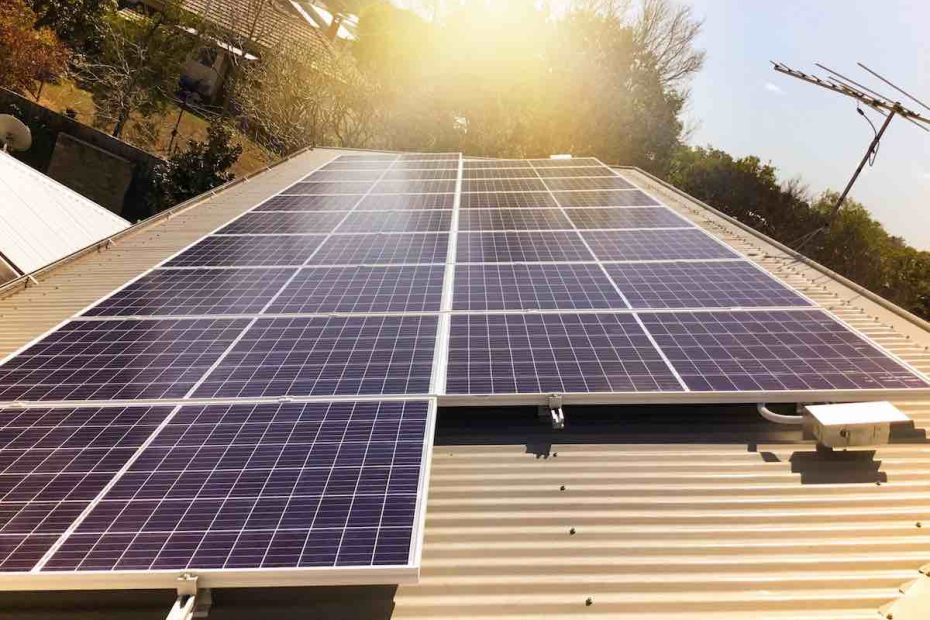
I am now one of half a million Australians who have installed a household or business battery – part of the revolution in how electricity is generated, stored, and traded.
While this is only a single case study, it illustrates just how rapidly battery economics and technology are improving, and the positive implications for the future electricity system.
Until recently, I had little interest in purchasing a household battery. Despite having rooftop solar the economics were unattractive: battery capacities were small, prices high, and payback periods long.
My intention was to wait for an electric vehicle with vehicle-to-grid capability to provide a much larger storage at minimal extra cost, notwithstanding the gentle chidings from my battery-owning colleagues.
However, my position changed with the federal government’s 30 per cent Cheaper Home Batteries subsidy and plunging battery prices.
The catalyst was a series of online advertisements for a 50 kilowatt-hour (kWh) battery costing $3,999. Initially I assumed there must be a catch, but eventually curiosity prevailed.
I contacted the advertiser and found that the price applied for a single‑phase system; I required a three‑phase system, which would cost $6,999. Even so, it still looked compelling.
I asked lots of questions and ran the numbers. I confirmed that my 8 kilowatts (kW) of solar panels could meet my daily consumption for most months when paired with battery storage. Winter shortfalls could be covered by the government’s forthcoming Solar Sharer Offer of three hours free electricity every day.
My 54kWh battery, and 12kW inverter, were installed a few weeks ago.
The author’s 54 kWh battery (three stacks) and 12 kW inverter
My attention then shifted to retail arrangements.
On advice from colleagues, including Battery IQ’s Daniel Middlemiss, I transferred from a traditional retailer – whose customer service staff were unfamiliar with energy arbitrage – to one of a growing number of smaller retailers catering for battery owners.
The plan I selected provides free electricity between 11am and 2pm (ahead of the Solar Sharer Offer being in place) and pays $1 for avoiding imports between 6pm and 8pm plus $15 cents/kWh for the first 10kWh exported during that evening peak window.
I expect my bills to always be in credit, with peak export revenues well exceeding the $1.28 daily supply charge.
I am avoiding around $1,500 in annual electricity costs, earning $900 from peak exports, and expect to earn a further $500 or more when my inverter is enabled for Virtual Power Plant (VPP) participation (hopefully soon).
The payback period should be under two-and-a-half years!
It would have been even shorter had my consumption been higher (e.g. if I had an EV, though that is coming), and had my battery been eligible for the NSW Government’s VPP Incentive of up to $1,500, that applies for batteries under 28kWh.
Apples, oranges and batteries
I was curious to compare my battery’s cost with large-scale grid storage, expecting it to be far more expensive.
For the comparison, my system qualifies as four hours’ storage [54kWh÷12kW] although having sufficient capacity to supply my household for more than three days. Without the 30 per cent subsidy its installed cost is $830 per kilowatt [$6,999÷0.7÷12kW].
I discovered that the current cost of four-hour grid batteries is $1,548/kW (AEMO Draft 2026 ISP Inputs and Assumptions Workbook) – almost double that of my home system! Even more surprising, AEMO does not project grid battery costs to fall to $830/kW until after 2050.
Whilst this is a simplistic apples vs oranges comparison and there are additional features and costs for grid-scale batteries (offset by economies of scale), the magnitude of the disparity seems inexplicable.
It suggests that AEMO’s cost assumptions and projections may warrant review, and that the uptake of both grid and household batteries could exceed expectations, with more profound, and immediate, impacts on the electricity system than currently envisaged.
Chemical batteries are following the same trajectory as solar photovoltaics: rapid technological improvement, plunging costs, and exponential uptake.
It was only in 2017 that Australia’s first grid-scale battery was commissioned – the Hornsdale Power Reserve – which was then the world’s largest lithium-ion battery. At that time there were few household batteries.
Over just nine years there are now 53 grid-scale battery units registered in the NEM, totalling 7.5 GW/16.6 GWh of capacity – 19 units were energised in 2025 alone. There are no official figures for household units, but their combined capacity would be roughly 2.5 GW/7.5 GWh.
The uptake of batteries has been revolutionary, with no sign of slowing.
Ted Woodley is a former managing director of GasNet, PowerNet and EnergyAustralia
Ted Woodley
Ted Woodley is a former Managing Director of PowerNet, GasNet, EnergyAustralia and China Light and Power Systems (Hong Kong)
Share this:
Facebook
X
LinkedIn
Reddit
Email
Print