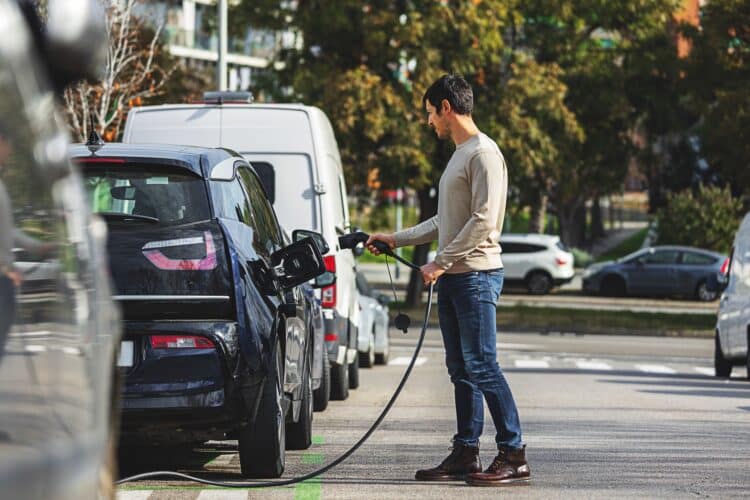
Home batteries, electrification and EVs are converging to transform households into active players in Australia’s energy transition.
Having ushered in a rooftop solar boom, Australia has opened the door for its next revolution through the widespread adoption of utility-scale and household batteries.
Fourteen new generation and storage projects totalling 3.9 gigawatts (GW) were commissioned to full output in the National Electricity Market (NEM) during the June quarter, while home battery capacity grew by 3283 megawatt-hours (MWh) or 41 per cent. Grid-scale battery capacity exceeded 9GW as of June 30, more than doubling over the past year.
The Cheaper Home Batteries scheme recently clocked 500,000 installations (it was inaugurated in July 2025).
Energy sat down with Energy Consumers Australia (ECA) general manager – advocacy and policy Brian Spak to understand the trends driving today’s consumer energy resources (CER) landscape.
Spak leans on a recently completed ECA survey to inform his views.
“It’s fantastic that the government has committed funding to boost household battery uptake, which has clearly been very popular with a segment of the population,” he said.
Energy Consumers Australia general manager – advocacy and policy Brian Spak. Image: ECA
“Before and after the Cheaper Home Batteries program came into place, we asked households about their interest in batteries. And an interesting takeaway is that we’ve seen similar interest in battery ownership before and after the rebate.
“The scheme has accelerated uptake among households already interested in purchasing a battery, but the data suggests it has not substantially expanded overall interest across the broader population.
“This equates to a little more than half of Australian households who are not researching or considering buying a battery at all.”
An upside to surging battery adoption, Spak said, is the fact that a grid supported by more behind-the-meter batteries provides a stronger foundation for the electricity system.
“A household battery can provide more benefits than a big battery connected at a transmission level,” Spak said. “It can provide individual households with their own backup power and solve problems for DNSPs and TNSPs overseeing the network.”
By discharging power direct to a household, home batteries can reduce the flow of electricity through local distribution lines during peak times, and ease congestion in the neighbourhood network.
And by pairing with other households, home batteries can collectively reduce demand in the transmission system and help balance wholesale supply and demand.
In turn, when combined with their back-up power benefits for households, home batteries streamline every level of the electricity hierarchy. They’re also an intrinsic partner to rooftop solar systems – another form of consumer self-sufficiency.
And rooftop solar’s power in Australia cannot be understated, with this source of energy powering South Australia’s entire grid for a period on March 8, 2026 – the 18th time this has occurred since September 16, 2023.
Households can be influential in other ways too, as Spak explained.
“The energy transition is a massive undertaking, not just because of the scale of new technologies that need to be integrated, but because we have to do two things simultaneously,” he said.
“While Australian consumers are playing a starring role in adopting renewables, they also have a significant role to play in electrification.
“To achieve our net-zero goals at the least cost, all households and small businesses over the next 25 years will need to replace their gas appliances and their petrol or diesel cars when they fail with electric alternatives.”
Rooftop solar powered South Australia’s entire grid for a period on March 8. Image: zstock/shutterstock.com
But there is a disconnect, Spak said, with only a small proportion of households understanding their multi-faceted role in the energy transition.
“While more than 60 per cent of households are supportive of the energy transition occurring, only 21 per cent say they know what the energy transition means to them,” he said.
“What it means to them, practically speaking, is that if they don’t replace their gas water heater with an electric system in the coming years, they’ll be in for a rude awakening when their gas bill spikes as more consumers transition off this energy source.”
Under new Victorian legislation, all new homes and commercial buildings in the state must be built all-electric starting January 1, 2027. By March 1 of next year, any gas hot water system that breaks and can’t be repaired must be replaced with an electric alternative.
The City of Sydney adopted a similar approach from January 1 this year, with all new residential developments in its council area now needing to install all-electric systems.
Despite these measures, Spak called for more support for the “stars of the show”.
“Consumers are the lead protagonists in the energy transition, but for them to willingly take up this role, they require additional incentives like what has been offered through the Cheaper Home Batteries program,” he said.
ECA commissioned CSIRO to develop FlexCost, a new study exploring cost comparisons for demand-side resources such as home batteries, EVs, and heat pumps, to name a few.
If CSIRO’s GenCost study relates to the optimal mix of energy supply resources such as wind farms and utility-scale batteries, FlexCost, which was launched in May, catalogues unit costs for end-use demand flexibility and energy efficiency options, with a focus on residential and small business sectors.
“Cheaper Home Batteries and rooftop solar are great, but there are other ways households can help the grid, which hinges on flexible usage as it relates to flexible hot water or flexible EV charging, or the adoption of more energy-efficient electric appliances,” Spak said.
“What we would like to see, concerning the full range of options, is for government to decide which technologies are the best bang for buck for the consumer, and tailor their support mechanisms as such.
“This is what FlexCost aims to inform.”
Within FlexCost is what Spak calls “maybe the single greatest opportunity in the energy transition”.
“Electric vehicles are going to be influential in the energy transition, not only because they’ll save households money as they’re cheaper to operate and maintain, but because they also help the electricity network operate more efficiently, and put downward pressure on other consumers’ bills,” he said.
ECA research finds that Australia’s collective EV fleet has the potential to save consumers more than $100 per year today and $500 per year by 2050 on their electricity bill.
“EVs are a win for households that have them, and they’re a win for households that don’t have them,” Spak said. “They’re a benefit to the electricity grid, they’re a benefit to the environment, and we’re now seeing how they’re a benefit to national security amidst the fuel crisis.”
By March 1, 2027, broken gas hot water systems in Victoria must be replaced with an electric alternative. Image: Ingrid Balabanova/shutterstock.com
But Spak said more thought needs to be given to EV charging infrastructure, with the International Energy Agency finding Australia has one of the lowest deployments of public EV charging in the world.
“If you don’t have off-street parking or live in an apartment with charging infrastructure, buying and owning an EV is a difficult proposition,” he said. “The solution to this is kerbside EV charging.”
Kerbside EV charging involves the installation of charging units on power poles or streetlights so those without private parking can charge their vehicle on-street.
A partnership between RACV and kerbside charging manufacturer EVX is supporting a kerbside charging rollout in Victoria, while the NSW Government has introduced its Electric Vehicle Kerbside Charging Program to foster its own kerbside charging industry. Rounds 1 and 2 of this have seen $6.9 million in funding for the installation of 1000 kerbside charging ports across NSW.
ECA-funded research from the University of New South Wales (UNSW) detailed the behavioural drivers of this technology. This saw UNSW partner with the Waverley, Woollahra and Randwick councils in Sydney, whose kerbside network of 94 spaces saw 27,000 charging sessions take place to February 2026.
The study found chargers located near apartments and shops were used the most, so long as signs restricted use to vehicles actively charging. Charging sessions clustered around daytime and evening use, the former of which is good for the electricity grid, being a low-demand period.
But barriers remain, with Australian regulations still restrictive of kerbside charging installations.
Energy Networks Australia (ENA) recently submitting a rule change to the Australian Energy Market Commission (AEMC) that would enable regulated distribution networks to install, own and maintain kerbside EV chargers – which hasn’t been possible to this point.
ENA chief executive officer Dominique van den Berg said the absence of widespread public charging infrastructure was discouraging consumers to go electric, comparing it to a “chicken or egg” scenario.
“Without enough chargers, people won’t switch to EVs,” she said. “Without enough EVs, private investment in charging remains slow and still requires support.
“Breaking this cycle requires a practical, scalable solution … By enabling distribution networks to install, own and maintain kerbside EV charging using existing infrastructure – such as power poles – we can deliver faster, more affordable, and more widespread access to charging where people need it. This is a customer-first reform.”
ENA believes if EV charging reforms were implemented sooner, more Australians wouldn’t be affected by today’s fuel crisis incited by the Iran war.
While he agreed with ENA’s sentiment, Spak said it would be vital to direct public investment to locations where the market is under-delivering.
“We’ve known for years that electrification is the best choice for households and small businesses,” he said. “Now, with the current energy crisis, we have further proof of why EVs and EV charging are clearly in consumers’ best interest, and we’d be well advised to get after it.”
While home batteries, household electrification and EVs are interconnected threads of a consumer-led energy system, Australian consumers don’t always have the agency to implement such solutions.
ECA, with the help of industry partners, is looking to change this, driving stronger consumer awareness, infrastructure and policy support to bring all households along.
Note: Since appearing in the June edition of Energy, this feature has been updated to reflect market conditions as of August 24.