Not long after the dramatic statewide blackout in South Australia in September, 2016, conservative political types in Australia were hoping for more.
Louise Clegg, the wife of then federal energy minister and now Liberal Party leader Angus Taylor, wrote on Facebook that rolling blackouts were needed to show that “left populism/culture” were “not the answer.”
Clegg was not alone. Conservative shock jock Tom Elliott, the radio-talk back host and son of former business man and Liberal Party grandee John Elliott wrote that he wanted to see a major blackout to prove his theory that renewable energy doesn’t work.
And ever since Coalition politicians have been predicting hoping for blackouts that they could blame on renewables at the start of every summer. Just to prove their point. Taylor himself said two years after the South Australia blackout, and just as he was appointed energy minister, that there was already too much wind and solar in the grid.
There is now twice as much wind and solar in the grid. And, of course, Taylor’s still complaining. The party and the Coalition that he now ‘leads’ (apologies to Pauline Hanson) has vowed to scrap the net zero policies it put in place and take a “chainsaw” to climate and renewable energy policies.
The politics have barely moved, but the technology has
Monday, September 26, is the 10th anniversary of the start of the South Australia system black – at 4.18 pm for those with an eye for detail. And if the politics of the energy transition have barely moved in that time, and might even have gone backwards, the growth of renewables and the technologies that enable it have leaped ahead.
South Australia sourced nearly 40 per cent of its power needs from wind and solar in 2016 and is now running at an average of nearly double that. Its grid runs comfortably even when rooftop solar alone is producing enough power to meet all state demand. It aims to be the first multi-gigawatt scale grid to reach 100 per cent “net renewables” by the end of next year.
Mining giant Fortescue is aiming to reach “real zero” emissions at its massive iron ore mining operations in the Pilbara, which means burning no gas or diesel for power or transport or mining equipment. Several off-grid mines are showing how it can be done, averaging up to 94 per cent renewables from wind, solar and battery storage.
The federal government aims to reach 82 per cent renewables by 2030, and the Australian Energy Market Operator has an engineering roadmap to guide the main grid to operate for extended periods with 100 per cent renewables.
And the country’s biggest energy users, Rio Tinto’s smelters in Gladstone and Tomago are ditching coal fired generation to switch to renewables.
Science, technology and economics
The catalyst for all these milestones and targets is a combination of science, technology and economics. Science, which we too often forget, because the climate impacts are becoming immense and increasingly visible and obvious, and because the world needs to move faster.
Economics because most studies agree that replacing fossil fuels with renewables and storage is the cheapest option available. And technology, because the thing that has made all the difference in the last decade is the rise in battery storage – and South Australia is seen as a catalyst for that extraordinary growth.
Mark Twidell, the former head of Tesla Energy in Australia, remembers that in March 2017, six months after the SA blackout, Lyndon Rive (then global head at the time of Tesla Energy and cousin of Elon Musk) was visiting Australia for the local launch of the Powerwall 2 home battery.
Researchers at Tesla – and elsewhere – had already concluded that a 100 megawatt (MW) battery situated on the South Australia side of the border would likely have prevented the cascading events that led to the system black the previous September, and would reduce the risk of future blackouts.
At the time, utility-scale applications were not really being taken seriously. The biggest battery being considered in Australia was less than one megawatt, and AEMOs 2016 Neutral scenario Generation outlook did not consider any bigger installations for the next decade.
At a dinner with industry leaders in Sydney – which included Kerry Schott, chief scientist Mary O’Kane, and the then federal industry and innovation minister Arthur Sinodinis, and others, Rive told the group that Tesla had just delivered the 20 MW, 80 MWh Alisa Canyon battery in the US.
It was built because a gas plant had failed and the local community were opposing a repair. And it was built within a 100 day timeframe to meet grid security needs. Rive thought it could be done again in Australia.
The billionaire tweets
Rive was encouraged to share this story with the media, which led to AFR front page headline “Tesla battery boss: We can solve SA’s power woes in 100 days” and the now globally famous “100 days or its free” exchange on Twitter between Elon Musk and Australian billionaire Mike Cannon-Brookes.
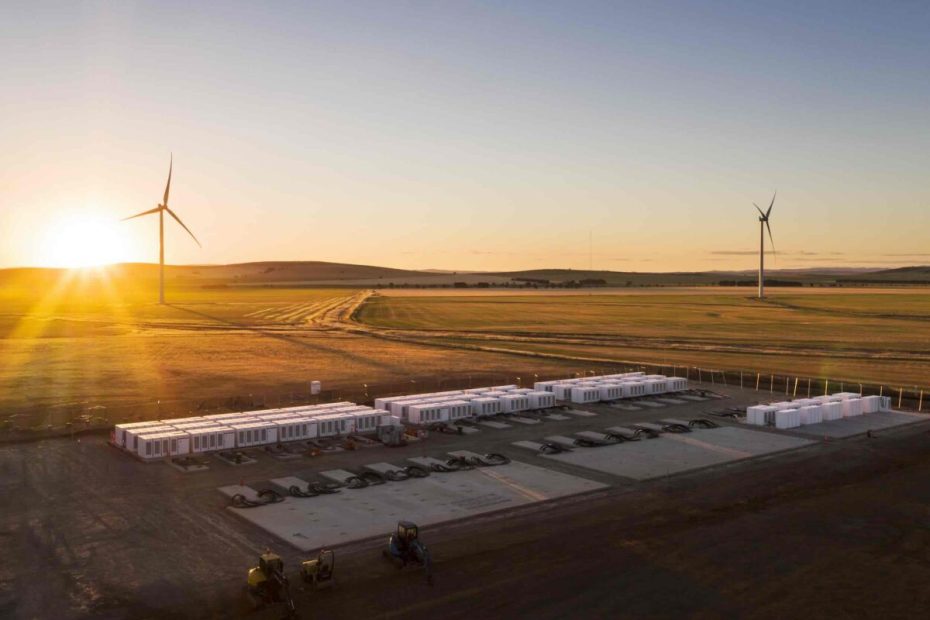
The following week, the SA Government Energy Plan, released in response to the blackout, called for a tender for a big battery three to four times bigger than any battery in the world at the time. The French company Neoen won that tender, and commissioned Tesla to build the 100 MW, 129MWh Hornsdale battery within 100 days, as promised.
And the rest, as they say, is history.
Twidell says there is no doubt that the blackout served as a catalyst for the uptake of battery storage both in Australia and around the world.
In 2016, the Australian Energy Market Operator in its statement of opportunities had forecast that just 4 megawatts of battery storage would be in place in Australia by 2026/27. There is already 12,000 MW of battery storage operating or being commissioned across the country, and double that again in the “committed” category.
Twidell notes that South Australia’s main grid is now often running with just one synchronous generator, often dialled down to a minimum. Soon – with the completion of the new transmission line to NSW – it will be operating at times with none at all.
“In 2016 we were told that the renewables transition was insanity,” Twidell told Renew Economy. “That sounds stupid now, the industry has proved all the naysayer’s wrong.”
Josef Tadich, the current head of Tesla Energy in Australia, agrees. He had joined Tesla in 2015, and worked on the design of the Hornsdale battery.
“I remember there was fear in the industry that maybe we had gone too far, and that maybe it was not possible to run a power system like this,” he says. But he says the lessons learned from the S.A. blackout might have been a “good thing”, but not for reasons that Clegg might suggest.
Rather than being the end for the renewable transition, it “brought everything into focus”, Tadich says. “It galvanised the industry to show what was possible, and we wouldn’t be here today in 2026 without going through the trials and tribulations of 2016.”
Battery storage is often thought of as the device that does little more than store excess solar from households for times when it is needed most, such as the evening peaks, and that it does the same with large scale wind and solar on the grid.
But it is the smarts that it brings to the system that have delivered most change. The Hornsdale battery quickly demolished one profitable gas cartel in the provision of frequency control and ancillary services, and quickly illustrated its ability to provide “virtual inertia”, one of the key properties of spinning machines.
Now, through the agency of grid forming inverters, it is proving the case for system strength, the catch-all description for all the critical services needed to keep a grid stable, particularly in the case of major disruptions.
Engines off
Once the final hurdle – the provision of protection quality fault current – is established, a major grid will be able to operate without thermal generators, or “engines off” as the providers of some off-grid mines describe it when they achieve this at smaller scale.
See: “Significant milestone:” Off-grid mine runs 155 consecutive hours on 100 pct renewables and engines off
Similar lessons to South Australia were learned in Spain last year. Surprisingly, despite their high levels of renewables, Spain had largely ignored the need for battery storage. And like South Australia in 2016, their protection systems were designed to take wind farms out of the system rather than use their inverters to help stabilise them.
As Tadich notes, market operators are now focusing on an increased reliance on wind farms and the wind farm voltage control strategies, which came into force post the 2016 blackout.
“These really provided a lot of confidence to AEMO in operating a high-renewable-penetration market,” he says. “Today AEMO operates the entire SA region on a single synchronous thermal generator, and relies on grid forming batteries. With the new syncons the entire grid will be operated with no thermal and allow 100% renewable generation.”
A global template for the grid
Tom Koutsantonis, the South Australia energy minister, says the state’s energy plan has become a “global template” for energy security, although it is still unhappy with the management of the grid at the time, and particularly the lack of contingency measures taken ahead of that devastating storm.
“The South Australian Government had alerted AEMO to the potential risks posed by the weather on this day in 2016,” Koutstantonis said in a statement emailed to Renew Economy.
“Unfortunately, appropriate contingencies were not undertaken, but governance of the national energy market has improved considerably since that time, in large part because of the lessons learnt that day.
“Fundamentally, if you take out transmission lines, you’re going to have a shock to the system. Unfortunately the then-Commonwealth Government turned a natural disaster into a war on renewables and we were not going to let them do that.
“The measures put in place as part of the former (state) Labor Government’s energy plan, particularly the Hornsdale battery, were ridiculed by the Canberra Coalition at the time, but it’s clear the subsequent decade has vindicated these decisions, as large-scale battery storage has become a global template for energy security.”
It’s interesting to note that in South Australia, Labor was voted out in the 2018 state election after 16 years in power. But the state Liberal party did not change course, it actually set the 100 per cent “net” renewable target, which it wanted to reach by 2030.
Labor, with Koutsantonis back in the energy portfolio, then fast-tracked that target to 2027 when it was returned to government in 2022. Sadly, that era of bipartisan policy is long gone. And despite the technology leaps that have been achieved since then, it makes you wonder if we will ever see it back again.
To join more than 29,000 others and get the latest clean energy news delivered straight to your inbox, for free, click here to subscribe to our free daily newsletter.
To support independent media, and help combat the spread of deliberate misinformation and disinformation about the energy transition, you can click here to make a one off donation or become a regular supporter of Renew Economy.
Giles Parkinson
Giles Parkinson is founder and editor-in-chief of Renew Economy, and founder and editor of its EV-focused sister site The Driven. He is the co-host of the weekly Energy Insiders Podcast. Giles has been a journalist for more than 40 years and is a former deputy editor of the Australian Financial Review. You can find him on LinkedIn and on Twitter.
Share this:
Facebook
X
LinkedIn
Reddit
Email
Print