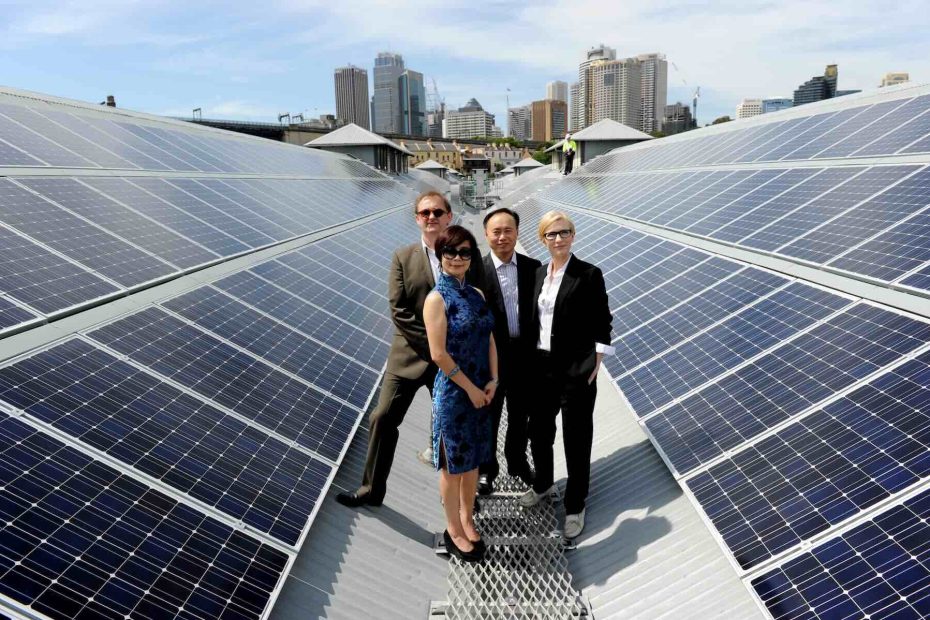
A company headed up by one of the legends of Australian solar research and development has won more than $150 million in federal Solar Sunshot funding to build a commercial-scale PV panel manufacturing plant in one of the nation’s biggest coal hubs – the New South Wales Hunter Valley.
The federal and NSW Labor governments on Tuesday announced a $171 million co-investment in the Hunter Valley Solar Foundry project, an initiative of the Sunman Group, to build a factory that will produce Australian-made PV modules for local and export markets.
Sunman’s founder, Zhengrong Shi, is a graduate of Australia’s University of New South Wales and was once dubbed the “Sun King” for his key role in PV innovation as well as in founding Suntech – once one of the world’s biggest solar companies before its collapse.
For the past decade, Shi has been working on the commercialisation of his new company’s flexible solar panels, a lightweight and bendy form of solar PV using a polymer-based “skin”, sold by Sunman under the brand of “eArc” panels.
Sunman already has two large manufacturing facilities – a 1 GW facility in China unveiled in 2022, and a smaller 500 MW facility that is under construction in Indiana in the US. But last year, Shi revealed his company’s plans to build a big manufacturing centre in Australia.
“We went to China to build first company Suntech, and there were many comments about why Australia didn’t support Dr Shi and let him go to China,” Dr Shi told Renew Economy in an interview almost exactly one year ago.
“Perhaps it was too early to do it here. But I think now it is time to come back and build this.”
This time around, support is forthcoming, with $151 million in conditional funding under the federal government’s $1 billion Solar Sunshot program and $20 million from the New South Wales government’s Net Zero Manufacturing program.
Arena, which administers Solar Sunshot grants, says the money will go towards building a 500 megawatt (MW) per annum manufacturing facility that will produce Sunman’s lightweight solar panels, as well as glass solar modules, using local materials and suppliers.
The Hunter Valley Solar Foundary, as the facility is being called, will also provide production capability to other manufacturers and is expected to produce a total of 800,000 solar modules a year.
It will also create around 200 jobs during construction and more than 100 ongoing positions once the plant is at full capacity. An advanced manufacturing training program is also being explored in collaboration with TAFE NSW, alongside a First Nations recruitment strategy and scholarship program.
Image supplied, Hunter Valley Solar Foundry
“It’s right and proper that the Hunter, which has powered Australia for so long, will be centre of our Future Made in Australia,” federal energy minister Chrid Bowen said on Tuesday at the site where the new facility will be built as part of the Hunter Business Park at Black Hill.
“We invented the modern solar panel. We store solar panels. We’ve been missing, by and large, the middle part of manufacturing solar panels.”
Arena CEO Darren Miller said the project is a “clear demonstration” of Solar Sunshot’s mission, but also marks a homecoming for Dr Shi who began his solar journey in Australia.
“Solar Sunshot is about building on Australia’s world-leading solar research to expand manufacturing capacity, strengthen supply-chain resilience and grow local jobs and skills,” Miller said on Tuesday.
“The Hunter Valley Solar Foundry project reflects these goals, bringing together advanced technology, local workforce development and long-term economic benefits for regional communities.
“Building our manufacturing capabilities will help ensure that our supply chains are resilient and Australian innovations are supported as we accelerate the rollout of solar PV.”
Dr Shi said he was “proud” to bring commercial-scale renewable manufacturing to Australia.
“Once established, the Hunter Valley Solar Foundry will be the largest manufacturer of solar photovoltaic modules in Australia, and the only one in NSW, delivering world-leading products to residential, commercial and utility customers around the country,” he said on Tuesday.
“As a proud Australian and a solar expert trained at the University of NSW, it has been my long-held ambition to establish solar module manufacturing in Australia, and it is my hope that over time the Foundry supports the foundation of a vertically-integrated solar supply chain in Australia.
“This is an important milestone in Australia’s energy transition,” Shi said.
Image supplied, Hunter Valley Solar Foundry
Federal Labor first announced its Solar Sunshot policy in March 2024, promising $1 billion in production subsidies and grants to build a solar supply chain on Australian soil.
Australia “should not be the last link in a global supply chain built on an Australian invention,” prime minister Anthony Albanese said in a speech delivered from the then recently closed Liddell coal-fired power station in the New South Wales Hunter region.
Round 1A – launched in September 2024 and now closed – dedicated up to $500 million to support module manufacturing, while Round 1B set aside $50 million for feasibility and engineering studies, and remains open until November 2026.
A second round, is offering a share in $150 million to manufacturers of module frames, glass, junction boxes and deployment technologies, after opening to submissions in September.
Currently in Australia, domestic solar panel manufacturing is limited to one company: South Australia-based Tindo Solar, which in August won $34.5 million in the first round of Solar Sunshot funding to help deliver a huge scale-up in production – from 20 megawatts (MW) a year to 180 MW.
The funds, delivered via a Manufacturing Production Credit (MPC) and a capital grant, are being used to renovate and ramp up production at Tindo’s Mawson Lakes factory and expand its product range to include premium N-type modules. They will also support a feasibility study for the development of a future Gigafactory, capable of producing up to 1 gigawatt (GW) of modules a year.
The money for Tindo was part of a $45.5 million tranche of funding from the Sunshot Program, with a further $11 million awarded to support feasibility studies for upstream solar manufacturing.
Of the $11 million, $4.7 million was awarded to Stellar PV to test the waters on building a 2 GW low-emissions polysilicon ingot pulling and wafering facility close to Townsville in Queensland.
Another $5 million was granted to Solquartz for its Townsville Green Polysilicon Feasibility Study into a 100,000 tpa low-emission, solar-grade polysilicon production facility, also close to Townsville.
Another of Australia’s biggest domestic solar manufacturing hopes, SunDrive, is yet to get a share in the Sunshot funds, but last month won another $25 million in separate Arena funding to scale and commercialise its copper-based PV technology and edge closer to the goal of ultra-low cost solar.
SunDrive in 2024 applied for a share in the first round of Sunshot funding in partnership with Chinese PV giant Trina Solar, putting forward a proposal to set up a module manufacturing plant in Western Sydney, with an initial production capacity of 1.2 gigawatts (GW).
Bowen told reporters on Tuesday that said Arena was still in discussions with SunDrive on the companies’ Sunshot application.
“We’ll have more detailed announcements when they’re ready. Quite separate to today’s announcement,” the minister said.
If you would like to join more than 28,000 others and get the latest clean energy news delivered straight to your inbox, for free, please click here to subscribe to our free daily newsletter.
Sophie Vorrath
Sophie is editor of Renew Economy and editor of its sister site, One Step Off The Grid . She is the co-host of the Solar Insiders Podcast. Sophie has been writing about clean energy for more than a decade.
Share this:
Facebook
X
LinkedIn
Reddit
Email
Print