The pursuit of ultra-low cost solar is making “good progress” at the panel and cell level, according to the Australian Renewable Energy Agency, but there’s a “long way to go” when it comes to driving down construction costs for utility-scale PV.
This week, just days after announcing the latest two recipients from its second round of funding, Arena has launched round three of its Solar Sunshot scheme, with $250 million up for grabs in the form of production subsidies and grants – this time targeting technologies that can make large-scale solar cheaper and faster to build.
Dan Sturrock, Arena’s general manager of solar investment, says a key goal this time around is to build on the foundations established in round two, which focused its support on cheaper construction methods and system integration, rather than reductions in the price of cells and modules.
The shift in funding focus has been informed by an update on Arena’s 30-30-30 vision – a target originally set in 2023 to deliver 30 per cent module efficiency and a module cost of 30c/watt by 2030, to slash the levelised cost of electricity from solar PV to below $20/MWh, one-third of current prices.
In a report updating progress on 30-30-30, published in July, Arena found that while solar technology costs and efficiencies continue to improve, the cost of deploying large-scale solar in Australia has not fallen at the same pace.
“We’re sort of halfway towards that 2030 [target] date and it was a really ambitious target to significantly drive down the capex construction cost,” Sturrock told Renew Economy’s Solar Insiders Podcast this week.
“We’re making progress, but there’s a long way to go to hit that target in terms of driving down construction costs. And, obviously, we all know that, in the meantime, there’s been … counteracting factors that are probably increasing costs across the sector as well.
“So we’re sort of fighting some of those upward forces, you know, the general inflation and, and shortages of labor.”
This is where Solar Sunshot comes in. First announced in March of 2024, the $850 million funding scheme is dedicated to giving Australia a foothold in the global PV supply chain while also driving down the levelised cost of energy from large-scale solar generation.
Solar Sunshot drew on the findings of the landmark Silicon to Solar Study, which found that establishing manufacturing capability of 10GW of poly-silicon – a key raw material for making PV – and 5GW across the other links of the value chain (ingots/wafers, solar cells and panels) was “credible and feasible” with the right government policy support.
“Historically, Australia has been good at going from the mining pit to port, and long may this continue,” said prime minister Anthony Albanese, in a rousing speech delivered at the time of the policy’s launch.
“But the Australian government will also invest in the path from pit to panels and capture more value for our economy and workforce.”
The first company to win funding was Adelaide-based innovator 5B, awarded $46 million to scale up the manufacture of its prefabricated, pre-wired, accordion-like Maverick solar units that are unfolded on site using a forklift, making installation around 10 times faster than a run-of-the mill large-scale solar farm.
Since then, over two rounds of funding, Arena has thrown its support behind companies at both ends of the solar supply chain, including Australia’s only domestic PV module manufacturer, Tindo Solar ($34.5m).
Grants have also been extended to a green polysilicon feasibility study by a company called Solquartz and another company called Stellar PV, to test the waters on building a 2 GW low-emissions polysilicon ingot pulling and wafering facility close to Townsville in Queensland.
This time around, the focus is on the huge range of opportunities to improve costs in the across the many stages of construction and operation of a solar farm that either have been plateauing or, in some cases, going up.
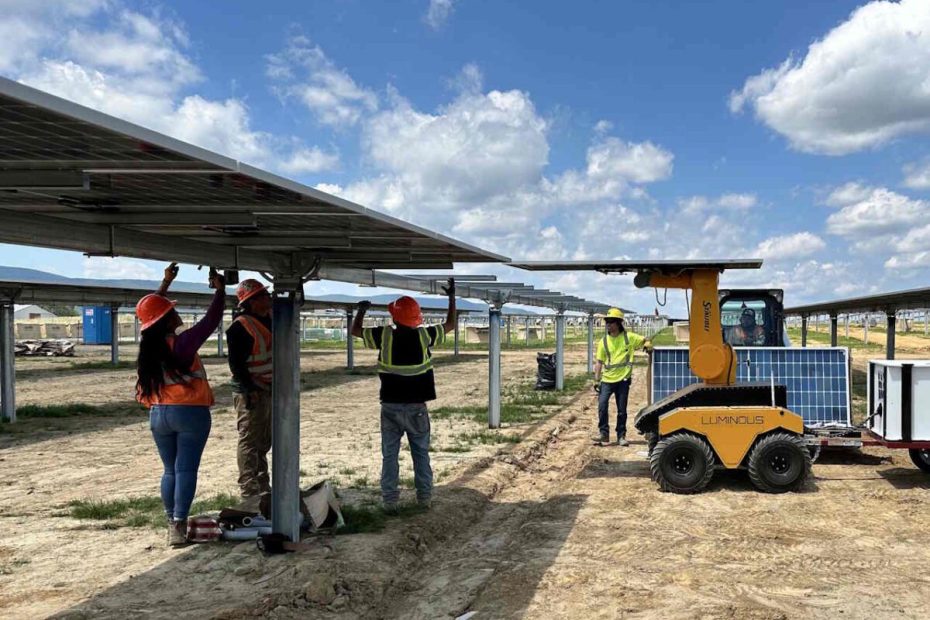
Arena says eligible technologies could include racking and tracking systems, robotics, advanced automation, prefabrication and others that can help reduce the cost of constructing and operating large-scale solar farms.
“The work that’s done in the R&D space and commercialising more advanced solar cells and modules to drive up efficiencies, that’s broadly going according to plan,” says Sturrock.
“Cell efficiencies and module efficiencies have been increasing, and the cost of those devices have been going down, but we really need to focus on that construction cost.
“We really need the balance-of-systems to actually play catch up and bring the best technologies that are sort of springing up around the world, bring them to scale,” Sturrock tells Renew Economy.
“I guess in all parts of the transition … we need to really keep an eye on costs and find a way to drive them down, rather than having them drifting up.
“Are there better ways to do things? [We] need to really look at the lifetime costs and building as cheaply as you can, but also building to a really high quality so that you’re ultimately lowering the lifetime cost of the generation, which is obviously what it’s all about – delivering lower cost to energy users.”
The latest two recipients of Sunshot funding exemplify this new focus on cutting balance-of-plant costs, with US-based firm Luminous Robotics awared up to $17.8 million to establish a Melbourne manufacturing facility that will produce 100 of its solar panel installing Lumi robots by 2029.
The other winner, a local subsidiary of California-based Built Robotics, will get up to $13.3 million to establish a Brisbane manufacturing hub and operations centre for its autonomous piling systems used in utility-scale solar construction.
Sturrock says that alongside some homegrown technologies, there’s a “huge depth of talent” in the US solar market that’s interested in coming to Australia.
“We welcome the competition of the best international technologies coming here and showing what they can do and … rapidly improving their technologies,” he tells Solar Insiders.
“That is the opportunity that we have, with AI and robotics, is that … people can make very rapid progress. They’ve obviously got to source the capital from their investors and then, with a bit of Arena support, hiring the talent, locally, that can really accelerate those technologies into the market.”
Expressions of interest for round three of Solar Sunshot open on November 02 and Sturrock says the maximum funding that the agency is offering this time around is up to $40 million.
“So it’s a pretty big amount capital, but we know that that is required. …You’re trying to create a disruptive technology, and there is… there’s barriers to sort of breaking into a sector where a lot of the components are proven and already operating at scale.
“So that’s the challenge that those sort of companies have: you’ve got to have a great product, you’ve got to continually develop that product, and you’ve got to be able to manufacture it at a commercial scale – and you have to have all those things… working together to drive down those unit costs.
“And ultimately, that will deliver high quality jobs, economic opportunity for …diversifying the economy and ultimately lower-cost constructed solar farms over the next… critical decade as we really look to decarbonise the electricity system, but also… beyond that, moving into decarbonising heavy industry,” Sturrock says.
“So there’s a huge opportunity for solar and, I think, a huge opportunity to bring new technologies to the market.”
Listen to Solar Insiders interview with Arena’s Dan Sturrock.
To join more than 29,000 others and get the latest clean energy news delivered straight to your inbox, for free, click here to subscribe to our free daily newsletter.
To support independent media, and combat AI slop, you can click here to make a one off donation or become a regular supporter of Renew Economy.
Sophie Vorrath
Sophie is editor of Renew Economy and editor of its sister site, One Step Off The Grid . She is the co-host of the Solar Insiders Podcast. Sophie has been writing about clean energy for more than a decade.
Share this:
Facebook
X
LinkedIn
Reddit
Email
Print