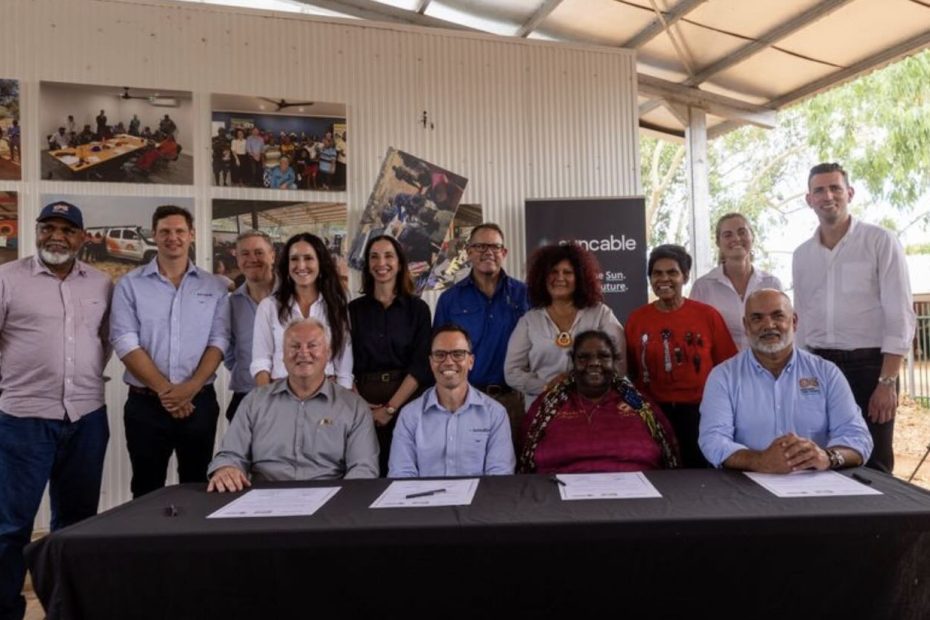
SunCable says it has reached a “landmark” 70-year deal with traditional owners for the development of what will be Australia’s biggest solar project – to be built on a cattle station in the heart of the Northern Territory.
The announcement was made on Monday and involves agreement with traditional owners and the Northern Land Council for the construction of the multi-gigawatt solar facility on 12,000 hectares at the Powell Creek station.
SunCable says the agreements are the result of talks that were initiated in 2019 for a vast tract of land that it wants to use to build huge solar and battery storage facilities to help power new industrial facilities in and around Darwin, and later Singapore via a sub-sea cable.
It says it is the final agreement it needs – having already secured approvals from the federal and territory governments – before it can go about finalising contracts with customers and setting out to build the facility.
The scale of the project – originally for up to 20 gigawatts of solar – has been modified several times since, and is still not settled.
However, SunCable COE Ryan Willemsen-Bell says the aim is to generate around 3 gigawatts of “firmed” renewables, which would require some 12 GW of solar and 45 GWh of battery storage to continue through the night. The first project stage might aim for 200 MW of firmed solar, he told Renew Economy.
See also: SunCable aims to deliver its first “firmed” power from Australia biggest solar project by end of decade
SunCable, majority owned by software billionaire Mike Cannon-Brookes, announced just a few months ago that the strategy has changed, and will now focus on incremental growth to meet new industry power needs near Darwin, including for major data centres.
It has also started the process for planning approvals for another major solar facility at the nearby Muckaty station.
SunCable says there has been a lengthy process of negotiations between SunCable and more than 200 traditional owners – from Janigirulu, Bamayu and Walanypirri – over the last three years, since the company identified the land that it hoped to use at Powell Creek station
“This is a significant deal that NLC, Traditional Owners and SunCable were able to negotiate, and an example of how large-scale energy projects can be developed in partnership with Aboriginal communities who want to shape their economic future while continuing to live and work on country,” the company said in a statement.
“The ILUA is the result of years of dialogue, negotiation and trust-building,” Willemsen-Bell said in a statement.
“It ensures that the voices of Native Title Holders are not only heard but are central to the development of this project. Throughout the years, SunCable has listened carefully to shape a comprehensive agreement that recognises the importance of Native Title rights and interest that will deliver long term benefits.”
The Agreement includes employment and local capacity building for long-term careers, training and vocational support to build skills that endure well beyond construction, and protection of cultural heritage and sacred sites, guided by Traditional Owner knowledge and NT laws.
It also includes economic participation through business development, procurement, and shared investment, environmental stewardship, and long-term community benefits that extend well beyond the life of the project.
“With some of the best solar in the world, it can give Northern Australia a unique advantage to attract investment in energy-intensive sectors such as artificial intelligence and hyperscale data centres, green fuels manufacturing, sustainable aviation fuels, and critical minerals processing,” Willemsen-Bell said.
If you would like to join more than 28,000 others and get the latest clean energy news delivered straight to your inbox, for free, please click here to subscribe to our free daily newsletter.
Giles Parkinson
Giles Parkinson is founder and editor-in-chief of Renew Economy, and founder and editor of its EV-focused sister site The Driven. He is the co-host of the weekly Energy Insiders Podcast. Giles has been a journalist for more than 40 years and is a former deputy editor of the Australian Financial Review. You can find him on LinkedIn and on Twitter.
Share this:
Facebook
X
LinkedIn
Reddit
Email
Print