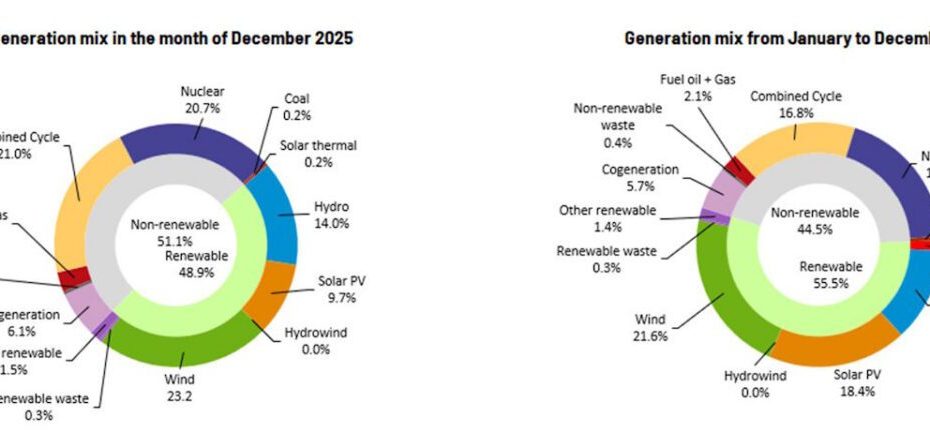
Renewable energy accounted for over half of the total energy mix in Spain during 2025, with the trend continuing immediately into the first month of 2026, despite being the heart of winter.
Figures published by Red Eléctrica, Spain’s national electricity grid operator, show that renewables accounted for 55.5 per cent of the country’s total energy mix in 2025.
Of this,wind energy leading the way with 21.6 per cent, making it not only the largest contributing renewable energy source, but the largest source of all, ahead of nuclear and combined cycle gas.
Solar PV was the second leading renewable energy source, accounting for 18.4 per cent of Spain’s total energy mix, though it was the third overall source behind nuclear, which provided 19.1 per cent.
With renewables accounting for a 55.5 per cent market share – increasing to 56.6 per cent when including self-consumption, which presumably refers to individual systems like rooftop solar – renewable production exceeded 150.8-terawatt-hours (TWh) for the whole of 2025, an all-time high.
This, even as electricity demand increased by 2.7 per cent during the year, topping out at 255,759-gigawatt-hours (GWh) – and came despite restrictions imposed after the dramatic blackout in April.
The high share of renewables has continued directly into 2026, with renewables accounting for 55.7 per cent of the country’s energy mix in January, rising to 56.1 per cent if self-consumption estimates are taken into account.
National electricity demand also rose in January, up 3.7 per cent on January 2025, totalling 23,778 GWh. Of this, self-consumption installations generated over 700 GWh throughout January, or around 2.94 per cent.
Wind power remained the leading source of electricity generation in January, accounting for 31.9 per cent, with production increasing by 7 per cent to reach 8,087 GWh. Solar PV only accounted for a 9.2 per cent share, coming in fifth behind nuclear (20.7 per cent), combined cycle gas turbines (16 per cent), and hydropower (12.9 per cent).
A total of 797 GWh from energy storage technologies were also integrated into the grid in January, facilitating greater utilisation of the country’s massive renewable generation.
If you would like to join more than 29,000 others and get the latest clean energy news delivered straight to your inbox, for free, please click here to subscribe to our free daily newsletter.
Joshua S Hill
Joshua S. Hill is a Melbourne-based journalist who has been writing about climate change, clean technology, and electric vehicles for over 15 years. He has been reporting on electric vehicles and clean technologies for Renew Economy and The Driven since 2012. His preferred mode of transport is his feet.
Share this:
Facebook
X
LinkedIn
Reddit
Email
Print