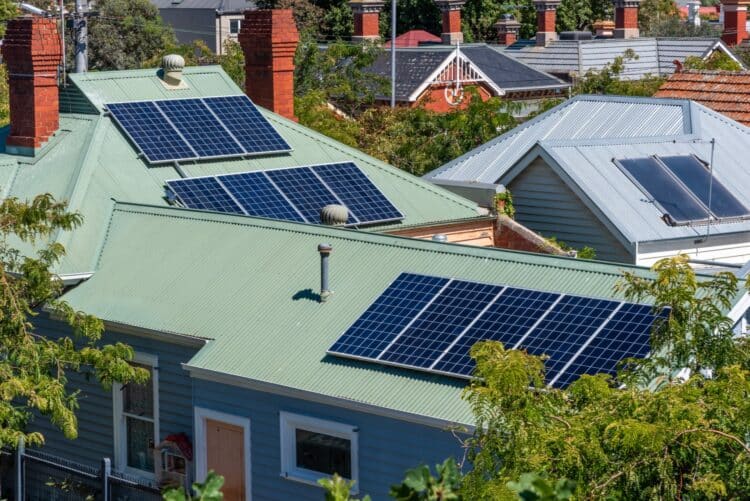
For a period on Sunday March 8, South Australia was solely powered by one source of energy.
Rooftop solar occupied the entirety of the grid for stretches, pushing demand contributions over 100 per cent on multiple occasions. At 1:35pm, renewables contributed to 114 per cent of demand, with rooftop comprising 108.5 per cent and wind making up 5.5 per cent.
At this time, 500-megawatts (MW) or 29.7 per cent of potential utility-scale solar generation was curtailed, and 295MW or 17.5 per cent of wind capacity was curtailed, painting a picture of both a self-sufficient but unbalanced grid, with wastage offsetting the rooftop highs.
Either way, it marked the 18th day where rooftop PV has provided 100 per cent of South Australia’s electricity demand. The first day was on Saturday September 16, 2023.
This demonstrates the state’s significant investment in its distributed energy resources (DER) capability, something that dates back to 2004 when, after winning the 2002 state election, Labor Premier Mike Rann aspired for 15 per cent of South Australia’s electricity to come from renewable sources by 2014 and 26 per cent by 2020 (against a federal goal at the time of 2 per cent by 2020).
This was formally legislated as a 20 per cent target by 2014 through the Climate Change and Greenhouse Emissions Reduction Act established in 2007.
In 2008, South Australia was the first Australian state or territory to introduce solar feed-in tariffs, spurring households to financially benefit from excess rooftop solar they generated throughout the day.
A year later, the City of Victor Harbor leveraged the tariffs to introduce the first council-driven rooftop solar bulk buy scheme, providing even further incentive for residents to adopt rooftop PV. By buying in bulk, a combined group of residents could access more affordable PV systems through suppliers than buying alone.
Later initiatives that spurred DER in South Australia included Liberal Premier Steven Marshall introducing, in 2019, a goal to achieve 100 per cent net renewable energy generation (DVRES) by 2030. This was brought forward to 2027 by Labor Premier Peter Malinauskas in 2024.
South Australia would hit 100 per cent net renewable energy generation for a whole week in December 2025, much of which was driven by rooftop solar.
Subscribe to Energy and discover all you need to know about the energy transition.