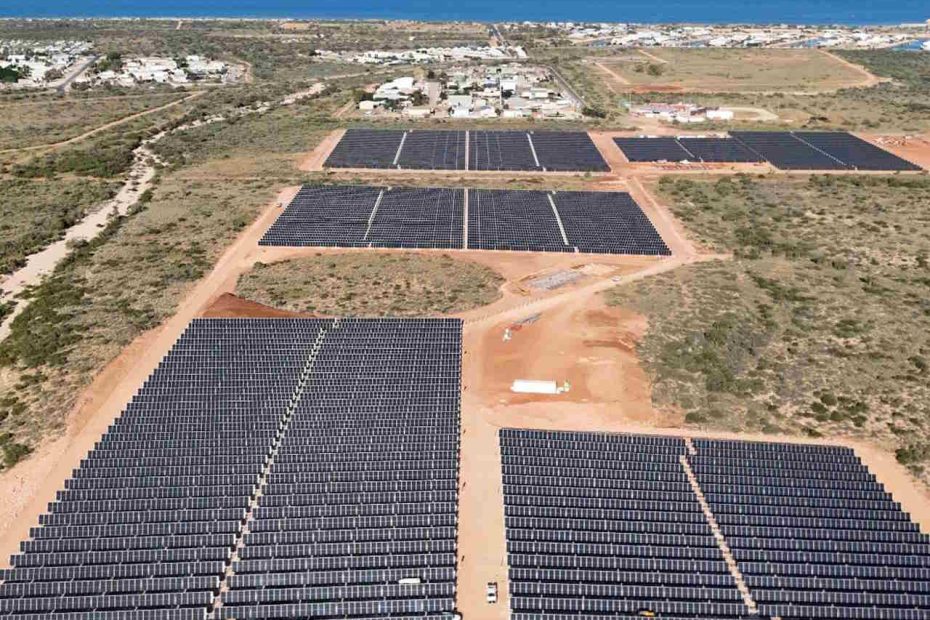
A newly completed small solar farm built in Australia’s mosts destructive wind area “didn’t miss a beat” when the area was struck by Tropical cyclone Mitchell in February, maintaining full operations and incurring no structural damage, its builders say.
The 9.6-megawatt (MW) Exmouth solar farm, completed just months ago by Pacific Energy, is located on Western Australia’s North West Cape and is part of a major hybrid project designed to dramatically reduce the region’s dependence on gas and diesel.
The small resort town is also located within Australia’s only region to have a wind speed rating of ‘D’, reflecting potential wind speeds that commonly exceed 288 km/h and reach up to 317 km/h.
Cyclone Mitchell started out as a severe tropical cyclone, but by the time it reached Exmouth on February 8 it had weakened to a Category 2 strength, but still battered the region with strong winds and drenching rainfall.
James Butcher, director of project engineering at California based solar technology company Nextpower, says it still provided a good test of its technology, given that Wind Region D “has long been considered too extreme for solar trackers.”
Solar trackers, as the name suggests, are a mechanical device which angles solar panels to track the sun’s path across the sky, therefore maximising energy production. In a region with such potentially extreme wind conditions, it’s little wonder that solar trackers have never been used.
“When Cyclone Mitchell passed near Exmouth on 8 February 2026, the site experienced destructive wind conditions, heavy rainfall, and regional grid outages,” Butcher said in a LinkedIn post.
“Post-event inspections confirmed no structural damage, no foundation movement, and no mechanical failures, with the system remaining fully operational.
Butcher noted that it was important real-world proof that tracker systems can operate reliably in extreme conditions, particularly given the multiple gigawatts of large scale solar planned and under construction to support the huge iron ore mines, regional towns and low carbon industries.
If you would like to join more than 29,000 others and get the latest clean energy news delivered straight to your inbox, for free, please click here to subscribe to our free daily newsletter.
Joshua S Hill
Joshua S. Hill is a Melbourne-based journalist who has been writing about climate change, clean technology, and electric vehicles for over 15 years. He has been reporting on electric vehicles and clean technologies for Renew Economy and The Driven since 2012. His preferred mode of transport is his feet.
Share this:
Facebook
X
LinkedIn
Reddit
Email
Print