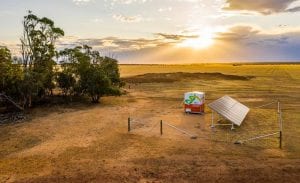
When public money installs solar panels and batteries on a farm, the person who lives and works on that farm should end up better off – lower bills, real ownership, genuine control – and for most, energy sovereignty.
That is the basic promise of the energy transition.
Western Power’s stand-alone power systems program breaks that promise systematically. It uses the technology of decentralisation to reinforce the economics of centralised utility control.
The grid disappears from the paddock. The tariff, the ownership, the control, and the financial benefit stay with the incumbent.
That is not an energy transition. It is a network asset management strategy dressed in solar panels.
Original purpose: solving the network’s problem
The program was conceived to solve a real problem. More than half of Western Power’s network serves less than 3% of customers across long, exposed rural spur lines — costly to maintain, chronically unreliable, and a proven bushfire ignition risk. Replacing them with on-site solar-battery-diesel systems is cheaper than refurbishment. Western Power estimated $400 million in avoided maintenance costs.
That financial logic drove every design choice.
Western Power owns the asset. Western Power selects which properties are eligible and when they are transitioned. Once the poles come down, the grid connection is gone permanently.
The farmer pays nothing upfront and receives nothing ongoing: the Synergy retail tariff is unchanged after installation, federal battery rebates flow to Western Power as asset owner, and the farmer – as non-owner – has no entitlement to either.
The regulatory architecture, built out between 2020 and 2021, confirmed the program as a network replacement service and allowed cost recovery through regulated tariffs.
The underlying commercial logic – that this primarily serves the utility’s balance sheet – was never challenged.
Experience gained: lessons not learned
The 2016 Ravensthorpe pilot was genuinely promising: six properties avoided more than 200 hours of outages over three years, satisfaction jumped from below 6/10 to above 9/10. The case for the program was real.
But the 2018 internal review of that same pilot explicitly flagged under-sizing as a failure mode. Those lessons were not applied. The technical standard remains 63A single-phase — adequate for a suburban home, structurally inadequate for a working farm.
Three-phase irrigation, grain handling, shearing, and workshop loads cannot be served without costly phase converters. Early models suffered thermal management failures in ambient temperatures routinely exceeding 40°C. When a system trips on overload, only an authorised Western Power contractor can reset it — a wait measured in hours.
Western Power flagged auto-reset as a priority in 2024. It has not delivered it.
The rollout has also fallen well short: 321 systems deployed against a target of at least 850 by 2025, and a long-term target of 4,000 by 2031 that looks increasingly implausible. The ERA imposed $14.3 million in service standard penalties for 2024/25, with rural long feeder performance the worst category.
Review required: the ABC lit the fire
This month’s ABC investigation documents the accumulated result: systems that overheat, fail in full sunlight, and rack up dozens of outages – with farmers unable to reset their own breakers. Western Power says 96% of customers report improved reliability. That means 13 customers have not, and the ones with the oldest systems are faring worst.
The cost arithmetic compounds the problem. A 14 kW solar, 42 kWh battery urban residential system runs around $14,000 after rebates today. Apply a ten-fold regional escalation “bugger factor” to double the size a full off-grid farm system lands at $140,000. The reported cost to Western Power of $150,000–$200,000 sits above even that generous range – and delivers a single-phase, utility-owned asset in return.
The solution: redesign for 2026, not 2016
The technology has moved on. The economics have moved on. The policy framework has not.
The Farmers for Climate Action Energy Sovereignty for Regional Australia report, released last month, frames the opportunity: a 6,000 ha broadacre farm’s five-year diesel bill could equal the capital cost of an integrated on-farm solar-battery-electric system the farmer would own, with near-zero marginal cost energy thereafter.
Western Power’s SPS delivers none of that.
My approach would redesign the program for the public good:
Follow the customer, not the asset — capital subsidy funds customer-owned self-supply as a genuine alternative to utility ownership
Size for the farm — three-phase capable, expandable, designed for full farm electrification, not suburban load standards
Pass through rebates — federal incentives to the farmer who hosts the system, not the utility that owns it
Cut the bill — near-zero marginal cost solar and battery should produce a real reduction in what farmers pay; if it doesn’t, it isn’t an energy transition
Build microgrids, not just silos — community-scale systems capture efficiencies that individual SPS cannot
The program was designed in 2016 to solve a network maintenance problem. Ten years on, with battery costs collapsed, federal rebates available, and farm electrification accelerating, it is time to redesign it around the interests of the people at the end of the line.
The recent ABC story is about maintenance failures. The policy story is about whose interests the program was built to serve – and whether we are willing to change the answer.
Ray Wills is managing director, Future Smart Strategies, and Adjunct Professor at the University of Western Australia. Ray is an energy futurist who has noticed that “network replacement service” and “energy sovereignty” are not the same thing, and keeps saying so.
Ray Wills
Ray Wills is managing director of Future Smart Strategies, and claims to be world’s least wrong futurist.
Share this:
Facebook
X
LinkedIn
Reddit
Email
Print