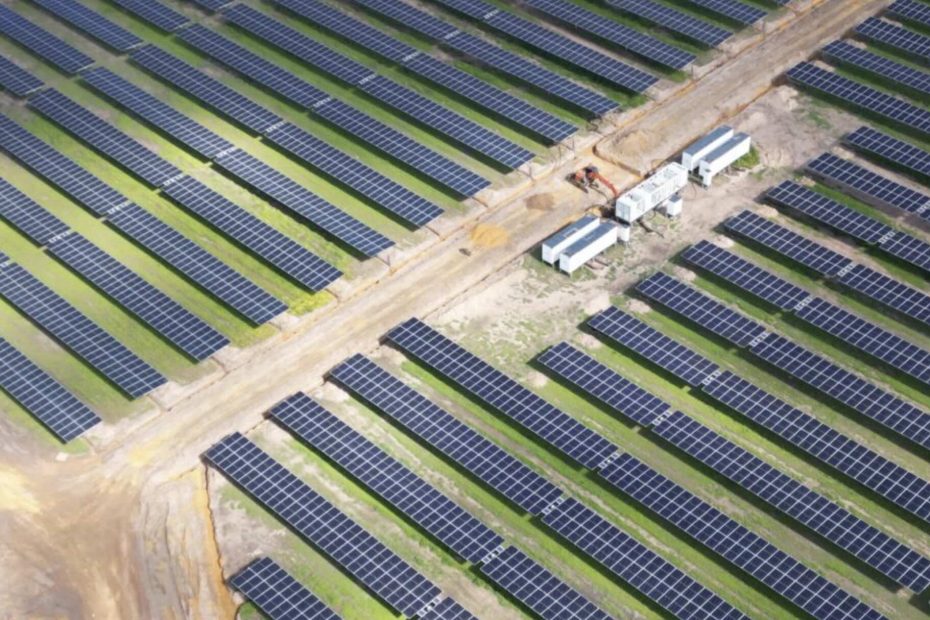
Late last week, the biggest solar-battery hybrid project by capacity in Australia was waived through the federal government’s EPBC process.
The Tallawang solar-battery hybrid, located near Gulgong in the Central-West Orana renewable zone in NSW, is rated at 500 megawatts of solar, with a 500 MW, 1,000 MWh battery.
Its the biggest, in terms of outright capacity if not storage, of any solar-battery hybrid project presented to the market to date, but it’s just one of more than two dozens solar-battery hybrids that are about to change the shape of the electricity grid – again.
The last decade has seen the gradual emergence of the so-called “solar duck”, representing the demand curve that has been crushed in the middle of the day by the impact of the near 30 gigawatts of rooftop solar installed on households and businesses across Australia.
That has had a significant impact on Australia’s ageing fleet of coal generators, because it means they can no longer operate in their preferred mode of “baseload”, or always on.
They now have to dance around the solar duck, either by ramping up and down to levels not believed possible hitherto, or switching the units off altogether for a shift or two.
That duck curve has also had an impact on large scale solar, which is suffering increasing levels of heavy curtailment because of the impact of rooftop solar.
The coal fired generators that cannot dance, or which have run out of steps, are bidding wholesale prices well below zero to ensure they are dispatched, reasoning that it is cheaper to pay someone to use their power than having to shut down and start up again.
These coal fired generators also want to be ready to cash in on the evening peak.
But now, or at least very soon, there is going to be an added problem.
New solar farms are no longer being built to target the middle of the day when their output is highest – they are adding behind the meter big batteries to transform themselves into “solar-battery hybrids” that can focus on the lucrative evening peaks.
This new development has been helped along by a few different factors: Unlike wind, solar has not suffered an increase in costs, battery storage costs have actually fallen significantly, and new connection rules and protocols are making the task of grid agreements for such hybrids a lot easier. They are also quicker and easier to build.
As the Cunderdin solar-hybrid in Western Australian has already shown, these facilities can now target the evening peaks, after dusk, and – depending on how the battery is used and cycled – can even feed power into the grid for much of the night.
Of course, this means that they are now targeting the dinner and the dessert of the fossil fuel generators, who depend so heavily on the high prices achieved in the evening peaks to boost their quarterly and annual revenues.
Remarkably, there are currently no solar-battery hybrid installations on the country’s main grid, with the first, a relatively small one at Quorn Park in the NSW west, likely to be commissioned early next year by Potentia Energy, which is also developing the Tallawang facility.
But it will be followed by a stream of new solar-hybrid projects. The last Capacity Investment Scheme tender alone awarded underwriting agreements to 3.4 gigawatts of solar-battery hybrid capacity with more than 11 GWh of storage.
See: Solar battery hybrids lead the charge as Chris Bowen names 20 winners of 6.5 gigawatt CIS tender
The previous CIS generation tender awarded selected another 1.1 GW of solar-battery hybrid capacity with some 2.7 GWh of storage capacity, and other projects (such as Fulham, Horsham, Kiamal 2, and Maryvale) have been successful in state-based tenders, and others still are forging ahead without government underwriting.
These solar-battery hybrid projects come in all shapes and sizes, with a mixture of two hour battery storage to four hours, with some now proposing battery storage of up to eight hours.
The buyers of this output are expected to be big industry – Rio Tinto has contracted two neighbouring solar hybrids near Gladstone to help power its aluminium smelter and refineries once the city’s ageing coal generator is shut down – and manufacturing companies and data centres.
In Western Australia, which will soon follow South Australia and close the last of its coal fired generators, big batteries and solar-battery hybrids are considered key in soaking up the excess solar in the middle of the day and storing it for the evening peaks.
The Cunderdin battery, for instance, has developed a pattern of behaviour that sees it inject power into the grid in the morning, focus on storing excess power in the late morning before responding to market movements during the day. Around one third of its output is sent to the grid after sunset.
How this impacts prices in the evening peaks will be interesting to see, particularly in a few years when the full 5 GW or so of already flagged solar battery hybrid capacity, and nearly 20 GWh of storage, is operating on the grid.
One sector not out there contracting or building solar battery hybrids are the big retailers who also own many of the remaining coal-fired generators. That is no surprise.
If you wish to support independent media, and accurate information, please consider making a one off donation or becoming a regular supporter of Renew Economy. Please click here. Your support is invaluable.
Giles Parkinson
Giles Parkinson is founder and editor-in-chief of Renew Economy, and founder and editor of its EV-focused sister site The Driven. He is the co-host of the weekly Energy Insiders Podcast. Giles has been a journalist for more than 40 years and is a former deputy editor of the Australian Financial Review. You can find him on LinkedIn and on Twitter.
Share this:
Facebook
X
LinkedIn
Reddit
Email
Print