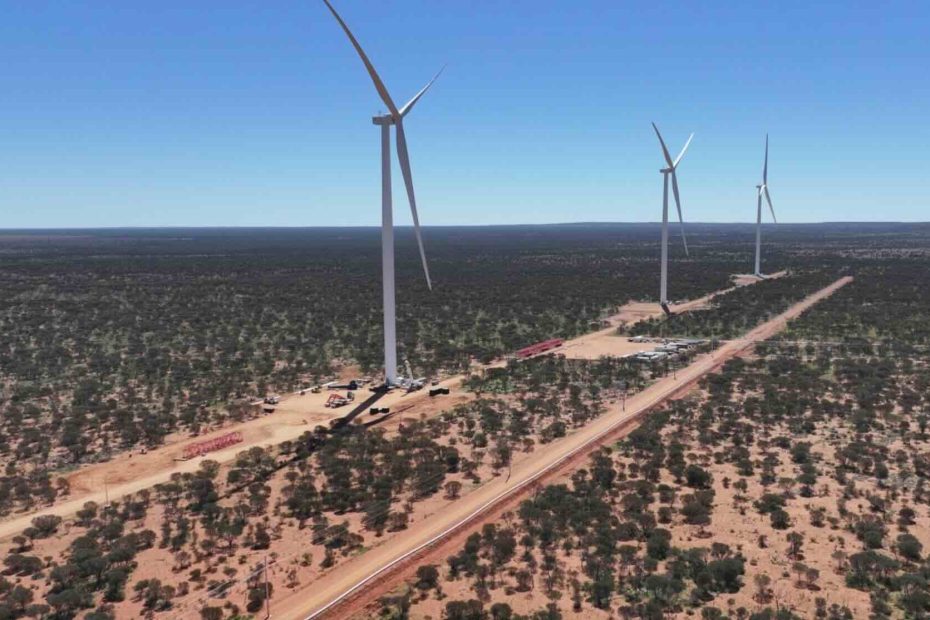
A major lithium mine supplying the electric vehicle and grid storage industries, yet backed by Australia’s richest person and anti-net zero campaigner, has achieved an 80 per cent share of renewables at its operations for the second year in a row.
“It is doing what we built it to do,” Ryan Hair, the chief operating officer at Liontown Resources, which operates the remote and off-grid Kathleen Valley mine in Western Australia, told an analysts briefing on Monday.
The mine features a hybrid power station – built by Zenith Energy -that includes 30 megawatts (MW) of wind capacity, 17 MW of solar and a 17 MW, 19 MWh battery.
It was commissioned in 2024 and was expected to achieve around a 70 per cent share of renewables, but has consistently done better than that, running at an average penetration of 81 per cent renewables over the 2025 fiscal year, and 80 per cent in the latest 2026 fiscal year ending June 30.
The biggest shareholder in Liontown Resources is Gina Rinehart, the backer of One Nation and a strong advocate for that party’s policies of scrapping net zero and ripping up renewable energy targets.
The party’s leaders on the weekend were shown on social media “blowing up” and burning effigies of renewable energy infrastructure at an anti-renewable rally in Victoria.
Liontown, like another Rinehart portfolio company Lynas Rare Earths, is heavily dependent on the switch to renewables and green energy as it supplies the EV and grid battery market, and aims to reach “net zero” in its own operations by 2034.
The Mt Weld rare earths mine owned by Lynas has achieved an even higher share of renewables so far in 2026, an average of 93 per cent over the past six months. The minerals it extracts are used to help make EVs and wind turbines, among other industries.
Liontown has also produced its first climate report and, like Lynas Rare Earths, warns that global demand for its minerals will slump and prices fall if the world goes slow on climate action, and dumps net zero policies – as its biggest shareholder advocates.
Liontown models two climate scenarios, one modelled on the Paris target of limiting global warming to 1.5°C, which delivers the best commercial opportunity for its business case.
The other higher-warming scenario (SSP3-7.0), which models temperatures rising by between 2.6 and 4.6° by the end of the century makes for grim reading, with severe impacts on its own operations within the next few years.
Liontown says it “represents a pathway in which physical climate risks, including extreme heat, water scarcity, bushfire, and flooding, intensify progressively and dominate the risk profile, particularly in the medium to long term.
It says its own operations are particularly vulnerable to extreme heat in the second climate scenario, including equipment failure, the loss of workforce productivity over the four month summer period.
“Extended heatwave events could result in unplanned processing stoppages following sustained extreme heat, with longer stoppages correlating with longer heatwave durations.”
“The onset of material impact is anticipated in the medium term, between 2029 and 2040, with peak impact in the long term, between 2041 and 2070,” it writes.
It says uncertainty in the pace, nature and stringency of climate policy responses in Australia and in key export markets, including the trajectory of carbon pricing mechanisms represents a significant risk to its operations.
To support independent media, and help combat the spread of deliberate misinformation and disinformation about the energy transition, you can click here to make a one off donation or become a regular supporter of Renew Economy.
Giles Parkinson
Giles Parkinson is founder and editor-in-chief of Renew Economy, and founder and editor of its EV-focused sister site The Driven. He is the co-host of the weekly Energy Insiders Podcast. Giles has been a journalist for more than 40 years and is a former deputy editor of the Australian Financial Review. You can find him on LinkedIn and on Twitter.
Share this:
Facebook
X
LinkedIn
Reddit
Email
Print