A prominent rare earths miner backed by Australia’s richest person, Gina Rinehart, says it has achieved a renewable share of 90 per cent over the last quarter, and is considering taking its processing plant off grid too because of reliability issues with the main grid.
Rinehart, one of the country’s loudest opponents of Net Zero and renewables, and a supporter of Pauline Hanson’s One Nation which is echoing those views, has a significant share in Lynas Rare Earths, the world’s only significant producer of separated rare earth materials outside of China.
The company, with a market value of around $15 billion, recently signed a major deal to supply a Malaysia magnet factory that is supplying the wind turbine and EV industries.
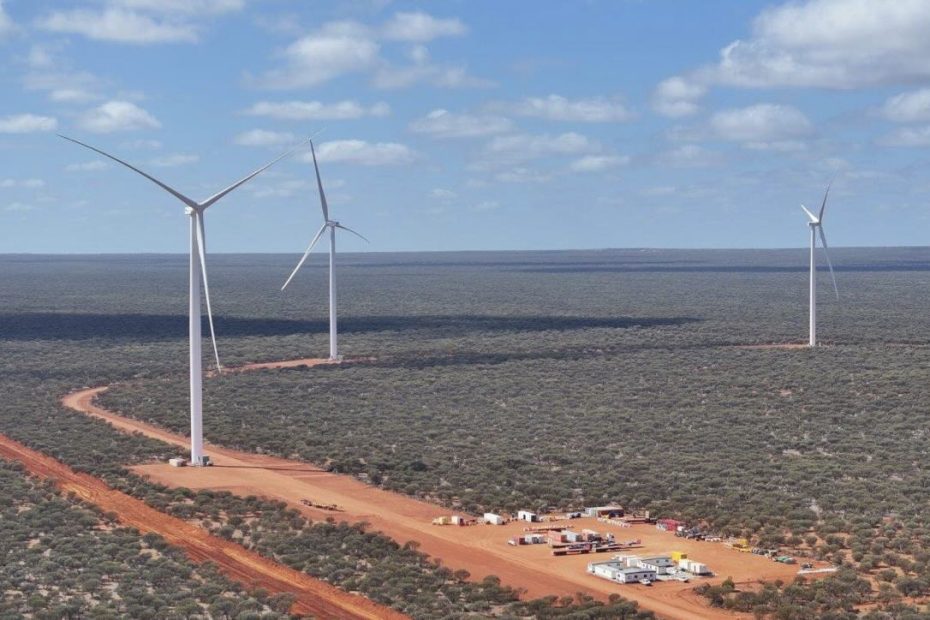
Its major mine, the Mt Weld facility in Western Australia, boasts one of the highest share of renewables from its off-grid hybrid power plant that was completed last year.
It combines 24 megawatts (MW) of wind, 7 MW of solar, and a 12 MW/12 MWh battery. It expected to achieve around 70 per cent share renewables but has done much better than that – achieving a remarkable 95.7 per cent renewables share in the first quarter of 2026 and 90 per cent in the less renewables-favourable June quarter.
“The Mt Weld hybrid renewable power station continued to achieve renewable electricity content above the targeted 70%, with average renewable content of 90% in the June quarter FY26,” the company said in a quarterly statement published on Wednesday.
It has previously said that the high share of renewables means it burns very little diesel, apart from that used in the trucks that take its ore to its major processing plant in Kalgoorlie.
It made no further mention of the hybrid plant in its statement to shareholders and no questions were asked about it in the following call with investment analysts, but there were questions about the reliability of power supplies in Kalgoorlie, where Lynas has its rare earths processing facility.
Pol Le Roux, the company’s interim CEO, said its operations in Kalgoorlie were still experiencing regular outages, despite some improvements, and the company is still considering taking the facilities off-grid to avoid disruptions.
“It’s true that the power supply is not up to where we want it to be,” Le Roux said.
“We had a very difficult situation back in October to 25 until January or February this year. Since then, the situation has improved. There were some modifications made on the Western Power side.
“Okay, it’s not as good as we wish. Let’s say we are staying within one power failure per month, which is not what we wish to have. That’s what we have. It’s, I would say, manageable.
“We’re still weighing whether we should go for off-grid solution or not. At the moment, it’s not the real emergency, I think. Power has improved. Not to where you could dream of, but enough.
“I hope I won’t be made wrong in a few hours or next week. Keep just one power failure per month. That would be nice.”
Kalgoorlie has suffered a series of blackouts in recent years, the most notable being caused by a storm that tore down transmission lines and the failure of gas-fired back up generators to start up.
The W.A. government is seeking to address the power supply situation in Kalgoorlie and surrounding areas, and is currently looking at submissions to a tender for a 50 MW, 500 MWh vanadium flow battery that it hopes will boost grid supply and reliability to the local grid.
Kalgoorlie is connected by a single transmission line to the state’s main grid, but this is regularly affected by outages caused by storms, dust or lightning, and Western Power, the state network company, is looking to boost local resilience with storage and more renewables.
To join more than 29,000 others and get the latest clean energy news delivered straight to your inbox, for free, click here to subscribe to our free daily newsletter.
To support independent media, and combat AI slop, you can click here to make a one off donation or become a regular supporter of Renew Economy.
Giles Parkinson
Giles Parkinson is founder and editor-in-chief of Renew Economy, and founder and editor of its EV-focused sister site The Driven. He is the co-host of the weekly Energy Insiders Podcast. Giles has been a journalist for more than 40 years and is a former deputy editor of the Australian Financial Review. You can find him on LinkedIn and on Twitter.
Share this:
Facebook
X
LinkedIn
Reddit
Email
Print