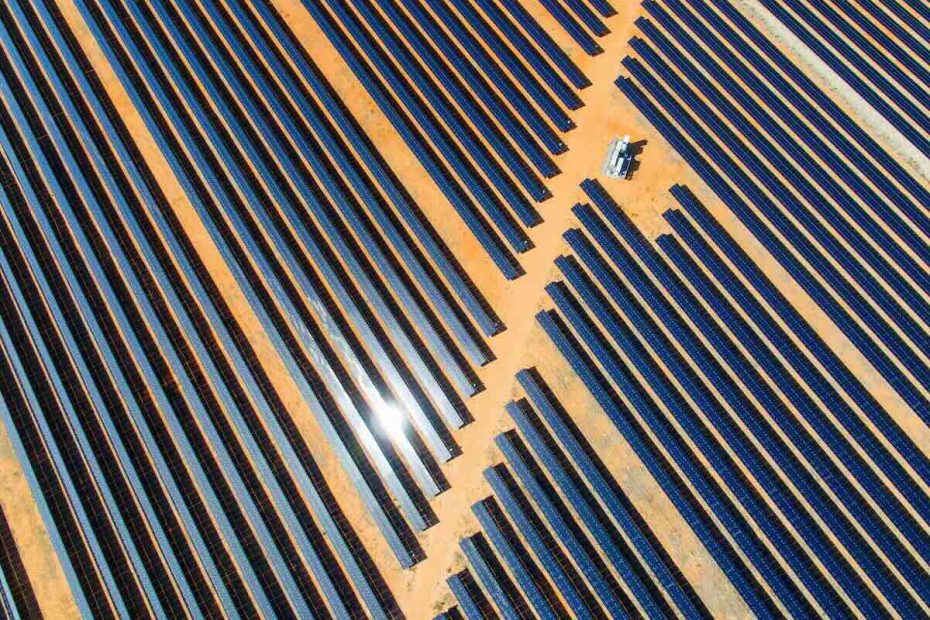
A proposal to develop a series of huge, gigawatt-scale renewable energy zones in remote, inland New South Wales – where wind and solar resources are abundant but the population sparse – has resurfaced, this time backed by a quiver of heavy-hitting global and local renewables developers.
A consortium of six companies including Tilt Renewables, Squadron Energy, Iberdrola, Acciona Energía, Ark Energy and Voyager Renewables, has pitched the “Inland Renewable Energy Region” in a submission to the Australian Energy Market Operator’s Draft 2026 Integrated System Plan.
The joint submission to the market operator’s draft blueprint for NEM – a version of which was shared with Renew Economy on Tuesday – calls for additional transmission capacity in Far, North West and Western NSW, to unlock “a major inland renewable region with strong resource fundamentals, low development constraints and supportive local communities.”
The consortium of companies says the outback zone could support more than 10 gigawatts (GW) of new renewable power at full scale, with a stage one capacity of between 2 and 4 GW achievable by 2035, and 6 GW by 2040.
“The Inland Renewable Energy Region represents a nationally significant opportunity to unlock a large inland renewable corridor in far north-west and western NSW,” the submission says.
“It offers a dependable and scalable source of renewable energy capable of materially contributing to NSW’s future supply as coal retires.
“Existing [zones] are constrained by social licence, land use and hosting capacity limitations, while offshore wind faces high costs and long lead times. These factors underscore the need to unlock new inland regions with strong fundamentals and lower development barriers.”
The pitch mirrors that of NSW network company Transgrid, put forward in its 2024 Transition annual planning report (TAPR) and again in 2025, which argued that tapping “excellent solar and wind resources on under-utilised, low-density land” was a much better way to usher out coal and meet future energy demand than building offshore wind.
As Renew Economy reported in 2024, Transgrid identified three potential “remote” REZs in NSW – around Broken Hill, Noona, and the north-west – which it proposed to connect with new HVDC transmission lines.
“These regions have some of the best solar and wind resources available anywhere in the NEM (National Electricity Market),” the Transgrid report said. “The high capacity factors and favourable solar-wind correlations, present an opportunity to diversify generation supply in NSW.”
As Renew Economy editor Giles Parkinson noted back then, Transgrid’s push to create big inland renewable zones is perhaps not surprising, given they would need to be connected back to the state’s population centres by lengthy new transmission lines – which Transgrid would naturally build.
“But the idea is favoured by many in the renewable energy development industry, who have been quietly looking at options, arguing that the better wind and solar resources and smaller populations will outweigh the added costs of transmission,” Parkinson added.
To this end, the consortium of companies behind the submission in December signed a memorandum of understanding on the project, which agrees to jointly assess the feasibility of building a major new transmission link to the Cobar region, around 300km north-west of Dubbo.
The submission is urging AEMO to declare the new transmission line a priority project in the final version of its 2026 ISP, which is due to be published in June. The consortium says a the Inland REZ could deliver 2-4 GW of power by 2035 and 6 GW by 2040.
“With appropriate transmission the region has long-term potential to exceed 10 GW, establishing a major inland corridor supporting potential future interconnection with South Australia, Queensland and Victoria,” it says.
The group says technical assessments undertaken by its members have identified potential connection points for “multiple HVAC and HVDC configurations” that include Broken Hill, Mt Piper, Bannaby and Wollar: “all of which offer credible integration pathways into the existing network.”
“As the corridor expands, further stages could align with future interconnection opportunities identified in AEMO’s planning processes,” the submission says.
Transgrid is not named in the consortium of companies pushing for the Inland Renewable Energy Region and has confirmed with Renew Economy that it has had no formal role in putting together the new proposal.
Elsewhere, the network company is working in partnership with the infrastructure arm of Acciona to deliver the eastern portion of the $1.4 billion HumeLink transmission project in New South Wales.
Iberdrola, too, has a hand in Australia’s transmission market, having last November won the contract to develop the Victorian section of the Victoria to New South Wales Interconnector West.
In NSW, a consortium of companies led by Iberdrola and another involving Acciona are among six contenders pitching for selection as the network operator for the proposed New England Renewable Energy Zone (REZ).
The submission also calls on AEMO to include the Inland Renewable Energy Region transmission project in the Optimal Development Path (ODP) and to ensure the regulatory and planning framework facilitates timely delivery, with clear guidance on sequencing, cost‐benefit assessment and integration with existing and future ISP projects.
“These recommendations are intended to assist AEMO in identifying a credible, least‐regret pathway that strengthens NSW and NEM resilience while accommodating emerging demand and accelerating the energy transition,” the submission says.
“With strong resource fundamentals, advanced preparatory work and committed industry partners, the Inland Renewable Energy Region represents a timely, scalable and nationally significant opportunity to help meet Australia’s reliability, affordability and decarbonisation objectives.”
If you would like to join more than 28,000 others and get the latest clean energy news delivered straight to your inbox, for free, please click here to subscribe to our free daily newsletter.
Sophie Vorrath
Sophie is editor of Renew Economy and editor of its sister site, One Step Off The Grid . She is the co-host of the Solar Insiders Podcast. Sophie has been writing about clean energy for more than a decade.
Share this:
Facebook
X
LinkedIn
Reddit
Email
Print