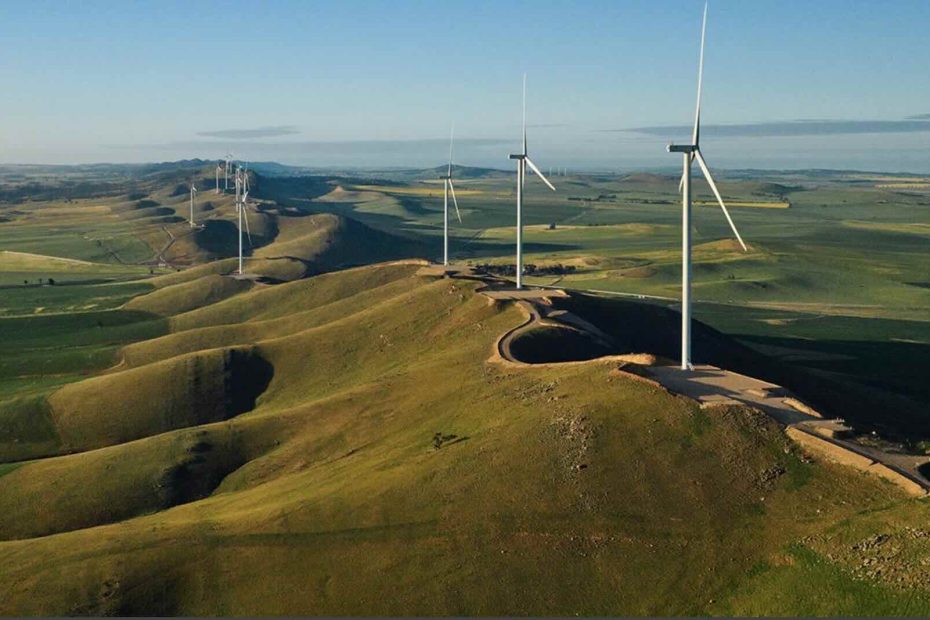
A record-breaking month of renewable energy generation has been set in three different states across Australia in May, new data reveals, as solar and wind continue to push down spot prices on the electricity market and batteries continue to smooth price volatility.
Rystad Energy reports that Australia’s large-scale solar and wind assets generated a total of 4.6 terawatt-hours (TWh) over the month of May, up 10 per cent from 4.2 TWh in May 2025.
And despite May 2026 featuring the worst wind and solar drought on Australia’s main grid since 2022, four new records were set: Wind generation for the month of May in Victoria of 1,079 gigawatt-hours (GWh) and Queensland (625 GWh), and utility PV generation for the month of May in NSW (549 GWh) and Queensland (538 GWh).
At a state level, Victoria took out top spot for utility solar and wind generation combined, at 1,218 GWh combined, including 139 GWh from utility PV and 1,079 GWh from wind.
Rystad’s top-performing wind assets for the month were mostly in Queensland and Western Australia, although the project in number one spot for capacity factor (CF) was the 175 megawatt (MW) White Rock Wind Farm in Glen Innes, NSW, at 45.6% CF.
Also in the mix of top performing wind assets was the Synergy co-owned 55 MW Mumbida wind farm (44.6% CF) and APA Group’s Badgingarra wind farm (43.6% CF) – both in WA.
For large-scale solar, the best performing assets for the month were almost all in Queensland, including Pacific Blue’s 100 MW Haughton Stage 1 project in the Burdekin Shire in the state’s north (24.3% AC CF), the 110 MW Moura solar farm in the Banana Shire (24.0 % AC CF) and Genex Power’s 50 MW Kidston solar farm, also in the north (23.0 % AC CF).
Wind and solar, aside, Rystad Energy senior analyst David Dixon says May was also notable for the effect that large-scale battery storage continues to have on smoothing out market volatility.
“NEM intraday spreads have collapsed as batteries continue to ramp up,” Dixon says on LinkedIn. “The average two-hour intraday spread was less than $A106 per megawatt-hour (MWh) across all states (NEM & WEM).
“Spot prices remain relatively low, the spot price in all NEM [National Electricity Market] states was below $100/MWh. The last time this occurred for the month of May was May-2020 during Covid.”
If you would like to join more than 29,000 others and get the latest clean energy news delivered straight to your inbox, for free, please click here to subscribe to our free daily newsletter.
If you wish to support independent media, and accurate information, please consider making a one off donation or becoming a regular supporter of Renew Economy. Please click here. Your support is invaluable.
Sophie Vorrath
Sophie is editor of Renew Economy and editor of its sister site, One Step Off The Grid . She is the co-host of the Solar Insiders Podcast. Sophie has been writing about clean energy for more than a decade.
Share this:
Facebook
X
LinkedIn
Reddit
Email
Print