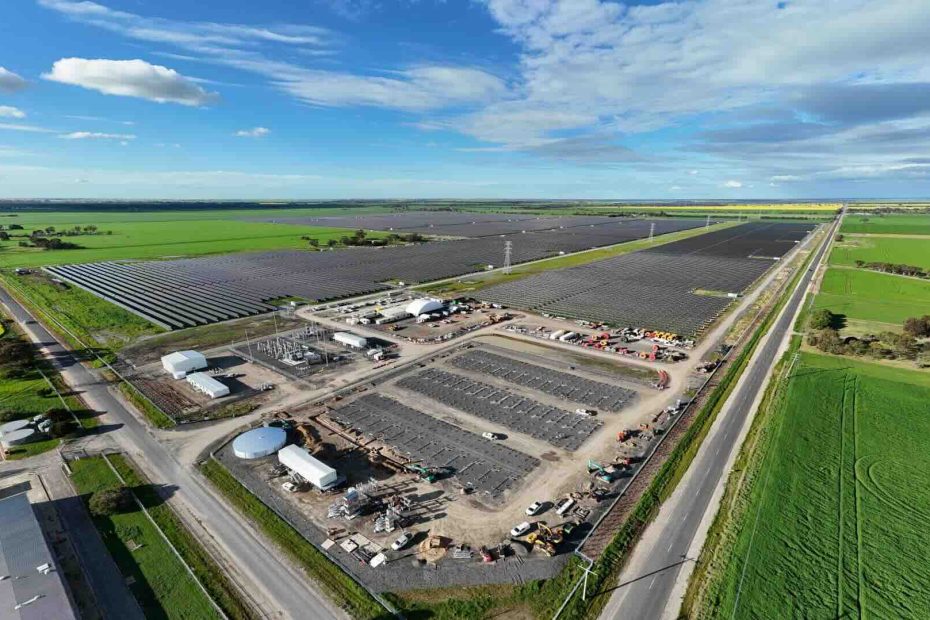
A record level of large-scale renewable energy construction commitments in the September quarter – most notably from wind and battery projects – has made “significant headway” on closing the capacity gap for the Albanese government’s target of 82% renewables by 2030, a major new report has found.
The Australian Renewable Energy Scorecard, compiled by the Institute for Energy Economics and Financial Analysis (IEEFA) and Green Energy Markets (GEM), shows big gains for wind and battery storage commitments, particularly in Queensland and South Australia, and outside of the NEM in Western Australia.
Cuts to the government’s Cheaper Home Battery scheme, though, resulted in a drop for small-scale storage.
“This quarter represents an all-time record for renewable energy projects being committed to construction, at 2.4 gigawatts,” the scorecard noted. “This is 20% up on the previous record (in Q1 2022), and a step change from the low volumes recorded in Q1 and Q2” of this year, it said.
“Overall, battery projects under construction represent 28% of new capacity required, wind projects 21% of new capacity required, and solar projects 16% of new capacity required” to hit the 2030 goal, according to the scorecard.
Commitments for wind farm construction were notably large in the July-September period, reaching the second highest for any quarter in data going back to 2015. In the six previous quarters, only one of them had featured new construction commitments for that energy source.
Record setting quarter for commitments. (Via IEEFA)
“The Queensland gap to their 2030 [Integrated System Plan by the Australian Energy Market Operator] requirements is now 90% bridged with projects in construction,” said Tristan Edis, GEM’s chief executive.
“Queensland and WA’s rapid renewable progress is largely due to these state governments stepping in to support power purchase agreements,” said Edis, a co-author of the scorecard.
“They did this either directly via their state-owned utilities, or also in Queensland’s case by providing support for Rio Tinto’s Gladstone Smelter to contract renewable energy.”
Commitments in WA and SA have reached more than 60% of the progress needed.
Renewables supplied about 44.3% of electricity in the NEM and 36.4% of the main WA grid in the September quarter, according to AEMO’s latest market report.
Climate change and energy minister Chris Bowen has maintained his optimism the 2030 goal can be reached, despite most analysts viewing it as a long shot.
“I would say 82 per cent renewables by 2030 is also ambitious, but I believe achievable … yes hard work, but not inevitable, but I believe doable,” he told Renew Economy in April. (You can hear the full interview here).
Bowen, who is President of Negotiations at the COP31 climate summit being held in Türkiye, told a media conference this week that Australia was “transitioning” off fossil fuels in the grid.
“We had 33% renewable energy in 2022,” he said. “Now we’re at 50%, and we are driving towards 82% by 2030.”
That optimism, though, may prove unfounded. Bloomberg New Energy Finance’s 2026 outlook report for Australia, released on Wednesday, has the nation falling well short of the 82% renewables share by 2030.
For two scenarios, BNEF has Australia reaching either 61% or 64% of renewables by decade’s end. One of those scenarios has the 82% mark being reached in 2035, or five years late.
The IEEFA/GEM scorecard noted developers of renewable energy and battery projects are already pursuing capacity far greater than the amount required to meet the 2030 goal.
“However, the amount of capacity currently under construction is significantly lower than the new capacity that needs to be operational by 2030 to meet the target,” it said.
The pipeline tallies look good, but more needs to be under construction. (Via IEEFA)
Wind made up the lion’s share of new capacity construction commitments in the September quarter, reaching 1.5 GW in total.
Queensland’s expansion of new wind farm commitments was the standout result among the states, thanks largely to the previous Labor government under premiers Annastacia Palaszczuk and Steven Miles, according to Edis.
“A substantial share of the credit for Queensland’s progress this quarter is actually down to actions taken by the previous state government,” he said.
“It serves to illustrate that government policies to drive transformation of the electricity system can take time to bear fruit, after which progress can be quite rapid.”
Rapid wind advance in some states but NSW lags. (Via IEEFA)
The IEEFA-GEM scorecard estimated that large-scale renewable and battery projects already in construction were providing about $8 billion in investment and 21,600 job years of employment.
“If the remaining, fully approved renewable and large-scale battery projects proceed to construction, it would result in around $51 billion in investment and 142,500 job years of employment,” it said.
Removing the pipeline of possible projects to compare just capacity presently under construction, though, reveals how much work is still to be done.
Still a long way to go, construction-wise, to hit the 2030 target. (Via IEEFA)
The scorecard noted that in all states other than SA, the wind pipeline is larger in capacity than the solar equivalent when considering the full range of projects, such as “in development” and “early-stage feasibility”.
Taking wind and solar projects under construction together, each state falls shy of the new capacity required to hit the 2030 target.
The gap, though, is particularly large in NSW, where some 17.5 GW of new wind and solar generation capacity is needed, the scorecard showed.
The construction gap is widest for wind and solar in NSW. (Via IEEFA)
What’s holding up construction, actual or committed?
Approvals don’t seem to be the problem, suggesting that developers’ main problem is to secure financial terms for their projects that are attractive enough for them to start construction.
Only about 6% of projects that have been fully approved have also been contracted, across Australia’s main grids.
“Across Australia’s main grids, the capacity of fully approved wind, solar and battery projects noticeably exceeds the aggregate operational capacity required by 2030,” the scorecard noted.
Queensland, SA and WA have more fully approved solar and wind capacity than required, while Victoria has more fully approved solar than needed.
Approvals aren’t in short supply. (Via IEEFA)
The storage story is generally more positive than wind and solar.
“In the [June] quarter we were only 21% of the way to covering the gap between what battery capacity was needed by 2030 versus what was operational,” Edis said.
“This quarter we’re now 34% of the way there thanks to significant utility scale battery commitments,” he said.
Batteries continue to draw in investment. (Via IEFFA)
“If the rate of progress experienced this quarter was maintained then the remaining utility scale battery capacity gap to 2030 could be covered by projects in construction within 1.5 years,” Edis said.
The one main negative result in the September was the retreat from record levels of installations for small-scale storage and solar systems after the government pared back its subsidy scheme. Households that tapped the subsidy for batteries often included a new or large solar system, boosting demand for both storage and photovoltaics.
Rooftop solar, though, remained materially above recent years in terms of installations.
“Battery installations falling below recent averages, however, shows government support is still needed to help people invest in the long-term savings and security that renewables and battery systems provide,” Edis said.
Government subsidy reduction takes its toll on home battery installations. (Via Ieefa)
The September quarter saw a 44% drop in small-scale battery system installations, and a 20% cut to installation sizes, the scorecard noted.
Still, the size of storage going in remains more than double the average prior to July 2025 when the Cheap Home Battery scheme began.
If you would like to join more than 29,000 others and get the latest clean energy news delivered straight to your inbox, for free, you can click here to subscribe to our free daily newsletter.
If you wish to support independent media, and accurate information, please consider making a one off donation or becoming a regular supporter of Renew Economy. Please click here. Your support is invaluable.
Peter Hannam
Peter Hannam is a veteran journalist whose work spans almost four decades and includes stints outside Australia, including time in China, Japan, Singapore and Mongolia. He has lately reported extensively on energy, climate and environmental issues in Australia, and also worked for the federal Climate Change Authority as a special media advisor.
Share this:
Facebook
X
LinkedIn
Reddit
Email
Print