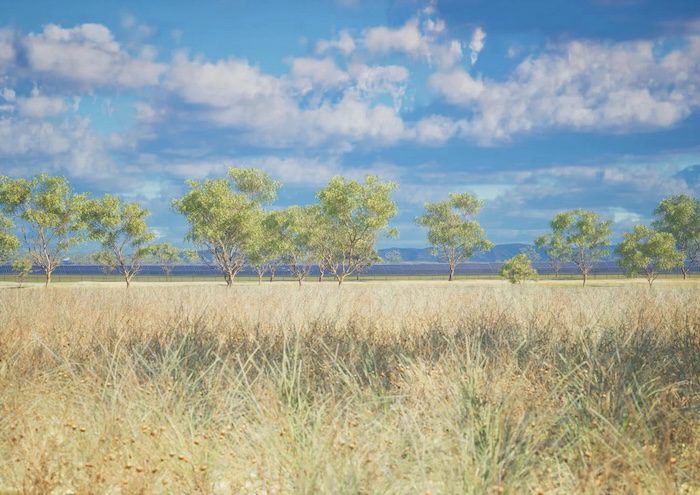
Res Australia has signed what it says is Queensland’s first solar community benefits agreement (CBA) with a council, under the stringent new rules put in place last year.
The 450 megawatt (MW) Wooderson solar project can now move forward with its development application which was lodged last year before the strict new rules were unveiled.
The agreement with the UK renewable energy giant’s Queensland development arm, Central Queensland Power, is the Gladstone regional council’s second under the new rules, and shows where the local government is able to flex – and where it is not.
The first CBA that Gladstone council signed was for Ampyr’s Rutherglen battery, a 400 MW, four hour project, in February.
The Wooderson CBA will see the enormous project pay out $850/MW into the council-run fund, or up to $382,500 a year, and a separate community benefits sharing program run by the developer of $1000/MW during construction phase and $150/MW over the operational life of the facility to be directed at seven communities.
These rates are indexed to inflation.
The ultimate owner of the project will also need to pay an “operating contribution” of 5 per cent of the funds being paid in – nearly $20,000 a year – to cover the council’s costs of administering the fund.
Somewhat flexible
The two Gladstone CBAs show what developers can likely expect from now on: a non-negotiable council fund and a social impact assessment-informed benefits sharing program.
The council adopted a community benefits policy in October last year which says it will only sign a CBA that includes minimum payments for each technology, the 5 per cent admin fee, and a community benefits sharing program.
Council minutes from April 7 show Central Queensland Power originally proposed alternative options for Wooderson, but the council rejected these as they “did not sufficiently align with policy”.
In the end, the Wooderson and Rutherglen CBAs precisely match the council’s stipulations.
The Rutherglen battery CBA will see the ultimate owner pay out a Consumer Price Index-linked $150/MW over the life of the battery into the council run fund – the minimum payment in the council’s policy – plus the 5 per cent admin fee.
Where there is some flexibility is in the benefits sharing program may have some flexibility – although it must still involve council “to avoid duplication”, according to the October policy.
The draft agreement for the Wooderson project agrees on percentages to be shared among communities, and includes a local content commitment to try to have 15 per cent of labour hours to be done by apprentices or learning workers, and a third to be done by locals.
The Rutherglen agreement, on the other hand, is more specific about how the community benefits sharing program should be managed.
It includes a one-off payment of $40,000 followed by annual payments of $50 per megawatt-hour (MWh) into the general pot, $15/MWh for neighbour payments, and $160,000 over five years for fire services.
New rules
Queensland unveiled strict new rules last year for wind and solar projects, and later for batteries as well, that require proponents to sign binding CBAs with councils before lodging planning applications.
Social impact assessments must now be done beforehand to inform a portion of those agreements.
The new rules were cautiously welcomed by some community advocates who say they give people more of an opportunity to weigh in on projects near them before a planning application is lodged.
But others cautioned that signing a deal before a project has gone into the planning process, a system designed to temper and test plans against government policies and protocols, will result in cookie-cutter funds that don’t reflect the reality of a project.
Central Queensland Power’s Mike Whitbread said in a statement sent to Renew Economy they were doing a social impact assessment anyway, but the new mandate meant they simply brought this forward.
If you would like to join more than 29,000 others and get the latest clean energy news delivered straight to your inbox, for free, please click here to subscribe to our free daily newsletter.
If you wish to support independent media, and accurate information, please consider making a one off donation or becoming a regular supporter of Renew Economy. Please click here. Your support is invaluable.
Rachel Williamson
Rachel Williamson is a science and business journalist, who focuses on climate change-related health and environmental issues.
Share this:
Facebook
X
LinkedIn
Reddit
Email
Print