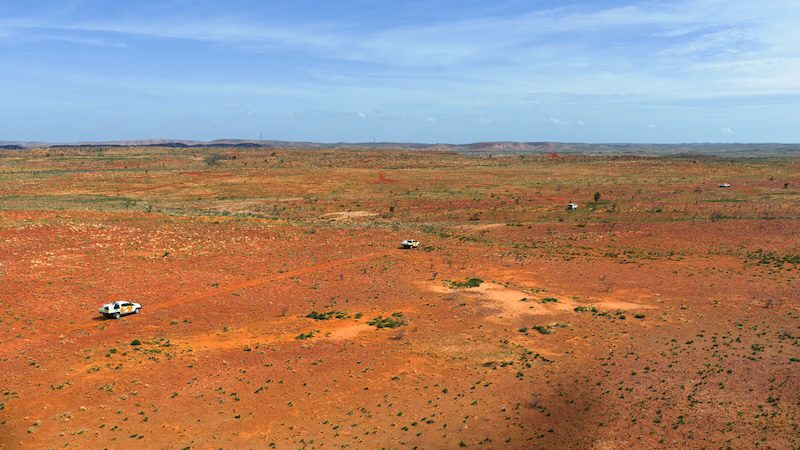
A 1.5 gigawatt (GW) wind, solar and battery project in the Pilbara has lobbed its final planning application, adding another giga-scale proposal to the emerging class of giant wind ventures.
First Nations group Yindjibarndi Energy Corporation (YEC) says it lodged the application for Baru Marnda, a site some 55km south of Karratha and the organisation’s biggest project to date.
The project is for up to 1000 megawatts (MW) of wind capacity from 143 turbines, and up to 500 MW of solar capacity across four arrays, and a big battery, according to the EPBC referral lodged last year.
The organisation’s first project, which reached financial close earlier this year, is the 75 MW Jinbi solar farm, which is located in part of the same Chichester Range transmission project area as Baru Marnda.
The Pilbara is one of Australia’s richest economic zones, thanks to the massive iron ore mines run by BHP, Rio Tinto, Gina Rinehart’s Hancock and Fortescue. But it is also the most fossil fuel intensive, although this is rapidly changing as Fortescue leads the charge towards its target of “real zero emissions” by 2030.
Fortescue is currently building more than 2 gigawatts of wind and solar capacity, and more than 4,000 MWh of battery storage to power its mines and the electric equipment it will use, while the Yindjibarndi revealed in May they have also been holding discussions with BHP about providing green power to its operations.
“The (Baru Manda) Development Application brings together work across planning, environment, cultural heritage, water, transport, bushfire, noise, visual impact, aviation and land tenure,” a note on the YEC LinkedIn page says.
“YEC has been awarded Priority Project status for the [70km] Chichester Range Corridor, one of four priority common-use transmission corridors identified for the Pilbara.
“The proposed corridor would connect the Maitland Strategic Industrial Area with [up to 1 GW of] renewable energy generation to its south, potentially including Baru Marnda.”
The Yindjibarndi Aboriginal Corporation partnered with Philippine-based Acen Renewables to set up YEC and develop the range of projects planned for lands where the First Nation groups holds a mix of exclusive, non‑exclusive and extinguished Native Title rights.
The aim is to reach a financial investment decision next year, start building in 2028 and see first power in 2031.
The Baru Marnda project was until recently still two projects, according to planning documents for the Jinbi proposal lodged in September last year with the local council.
According to those documents, Project Baru was to host up to 450 MW of wind while Project Marnda was to host up to 600MW wind, with both including unspecified solar and battery options.
The EPBC referral, however, wrapped the two together as a project spanning more than 42,000 hectares. It was confirmed as a controlled action in August last year.
YEC also filed paperwork with the state Environmental Protection Authority (EPA) at the same time as the federal referral, but that process hasn’t moved past an extensive request for more information issued in September last year.
YEC is also developing the Eastern Development Zone, also in the Pilbara and similarly sized as the Baru Marnda project.
It is about 50 km from the proposed Hamersley Range transmission corridor and 80 kilometres from major mining operations, YEC says on its website.
The schedule for this project is one to two years behind Baru Marnda.
To join more than 29,000 others and get the latest clean energy news delivered straight to your inbox, for free, click here to subscribe to our free daily newsletter.
To support independent media, and help combat the spread of deliberate misinformation and disinformation about the energy transition, you can click here to make a one off donation or become a regular supporter of Renew Economy.
Rachel Williamson
Rachel Williamson is a science and business journalist, who focuses on climate change-related health and environmental issues.
Share this:
Facebook
X
LinkedIn
Reddit
Email
Print