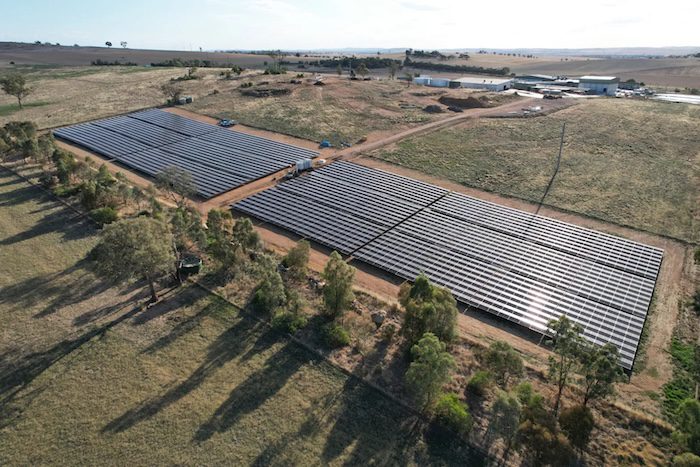
A sheep abattoir in New South Wales’ (NSW) Riverina is doubling the size of its solar farm and adding a battery as it seeks to dramatically reduce its dependence on the grid.
Climate Capital built the original 2.32 megawatt (MW) solar farm for Junee Prime Lamb in 2023, and now the abattoir is going back for seconds to ensure that it can supply more of its own power needs.
It wants to add another 2.6 MW to the array and a 2.75 MW, two hour battery.
The abattoir’s biggest energy drawdown period is in the afternoon when butchered meat is chilled after processing, the development application for the extension says.
“Electricity generated by the solar farm will offset mains power consumption during daylight hours and this will extend into the evening,” it says.
“This period of prime electrical use extends into the evening. The proposed BESS will provide some of the electrical power during the evening period where no solar energy is being generated.
“This will reduce costs for operation of the abattoir and therefore stabilise its viable future in a time where energy costs are causing cost overruns for many industries.”
Commercial-scale solar specialist Climate Capital owns the original $3 million project, which was designed so it could be easily expanded, and sells power back to the abattoir under a 25-year behind-the-meter power purchase agreement (PPA).
It will own the new assets as well.
Junee Prime Lamb isn’t the only abattoir to supplement its electricity needs with solar and a battery.
In 2022 Hardwick Meat Works in Kyneton, Victoria, finished its 2.5 MW solar farm, 2 MWh battery and industrial-sized heat pump to offset some of the electricity needed for water heating.
It expected to save about $508,000 a year from the $2.57 million project.
Local project for a local problem
The new solar farm, which will be to the east of the abattoir and the existing array, will be designed a little differently to a large-scale project.
For a start, it plans to use 12 blocks of panels in a fixed east-west configuration to capture sunlight in the morning and afternoon, instead of using trackers.
Single and multi-exis trackers tilt panels towards the sun over the course of the day, but can have higher running costs and noise emissions, the planning application notes.
In fertile rural areas like the Riverina, one of the main objections to solar in particular is that without excellent and early design planning to allow sheep grazing underneath, the land can be lost to production.
The land that Junee Prime Lamb wants to generate more power was being used for crops and grazing.
But as the development application points out, the dominant land use in that area is a lamb abattoir and the extension will directly support a rural industry directly relating to primary production. Furthermore, it says cleaning up the area of stored and forgotten bits and pieces is likely to improve the local environment.
If the loss of prime agricultural land is bothersome, so is the heightened traffic movement and noise that comes with building large-scale renewables in the countryside.
Once again, the Junee Prime Lamb site has an advantage given 20-30 large trucks deliver sheep to the abattoir each day.
“During construction, deliveries to the solar farm is [sic] expected to involve approximately 20-shipping containers of equipment,” the planning application says.
“On occasion, more than one truck movement may occur on the same day. This will represent less than a 5-percent increase in daily traffic movement to and from the site.”
If you would like to join more than 28,000 others and get the latest clean energy news delivered straight to your inbox, for free, please click here to subscribe to our free daily newsletter.
Rachel Williamson
Rachel Williamson is a science and business journalist, who focuses on climate change-related health and environmental issues.
Share this:
Facebook
X
LinkedIn
Reddit
Email
Print