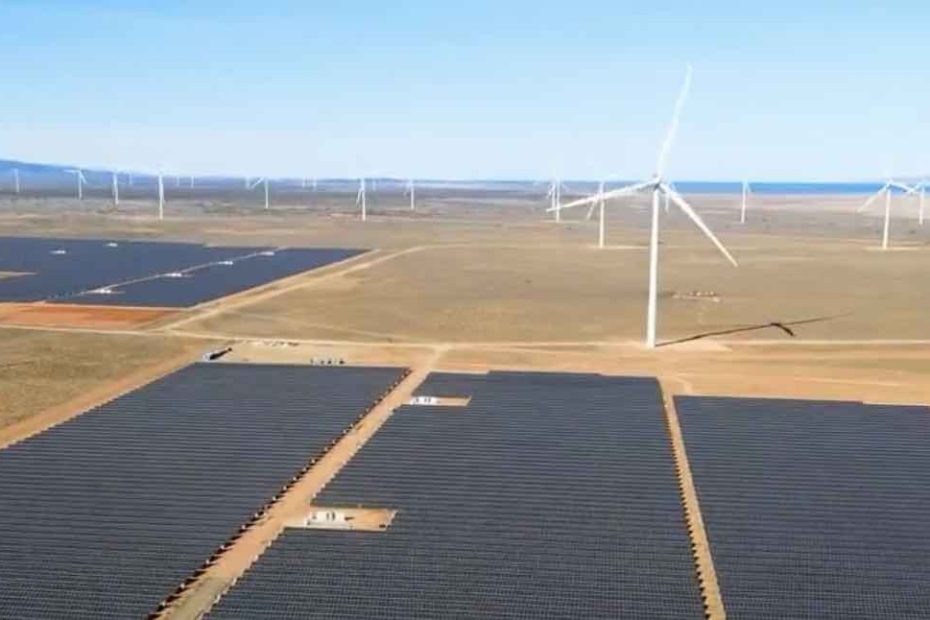
If the new leader of the opposition, Angus Taylor, thought there was “too much wind and solar” on Australia’s grid back when he was federal energy minister in 2018, have we got news for him in 2026.
In just the last three months of 2025, nine wind and solar projects added 2.1 gigawatts (GW) of new electricity generating capacity to the grid, and 1 GW, 2.3 gigawatt hours (GWh) of battery storage, according to the latest data from the Clean Energy Council (CEC).
The CEC’s latest quarterly report shows just how far Australia has come since 2018, when renewables surged to 7.5 GW of total installed capacity and wind broke out of its investment drought.
According to the report, more renewables were “switched on” in the dying months of 2025 than in any other quarter on record, leaving the previous record – 1.3 GW added in third quarter of 2021 – well behind.
By the end of 2025, some 12.18 GW of renewable generation was either being built, or had reached financial commitment, the CEC data shows. For batteries, that rises to a whopping 13 GW and 34.7 GWh.
Battery installations surged in 2025 with the total capacity installed across the year – 1.9 GW and 4.9 GWh – outpacing the combined figure for the previous eight years.
“The final quarter of last year saw many new renewables records broken, CEC chief Jackie Trad said in a statement on Wednesday.
“Sixty-three per cent of total renewable generation capacity that was switched on in 2025 was delivered in Q4 (2.1 GW). That scale of projects being commissioned in a single quarter is an Aussie first.
“In addition, renewable energy supplied over half (51%) of all electricity in the NEM for the first time during Q4 2025, and reached up to 77 per cent of peak demand when the grid was pushed to its limits during January’s extreme heatwaves, according to the Australian Energy Market Operator.
“As more renewable projects come online, we’re seeing them do exactly what they’re designed to do: stabilise the energy system as coal-fired generators retire. It’s more evidence that Australia’s transition to renewables is well underway,” Trad said.
The future looks set as well.
The CEC count puts the number of under construction or financially committed renewable energy projects at 81, or nearly 13 GW. For battery projects that figure is 75, promising 13 GW and 34.7 GWh.
So how does Trad think Angus & Co will take the news that, in addition to renewables supplying half the grid’s needs over summer, the industry is romping forward?
“To my mind, the political parties in Australia have made their views on the energy transition very clear, and those views were tested at the last election,” Trad told Renew Economy.
“Australians made their positions very clear around different energy policies, and I think that is what needs to be focused on.
“The fact that here we are in 2026 with almost half of our energy being from clean energy, we know that one in three households have solar on their roof, and hundreds of thousands of Australians are adopting the Albanese government’s Cheaper Home Battery scheme.
“The 2024-25 data is important, but the most important signal in this conversation is the signal that was sent at the 2025 election.”
For industry, the biggest factor slowing down the transition now is not planning, but transmission.
Trad was quick to point to the difficulty in network access as a key hurdle, because federal changes to the EPBC Act are making people optimistic about planning reforms.
“There is a lot of optimism from industry around EPBC Act reforms,” she says.
“People are really wanting to engage with government around those reforms and how they can ensure their projects can receive a fast decision, whether that is a yes or a no.”
Recovering after white-knuckle election
But while the quarter made records, 2025 was not the greatest year in Australia’s history of renewables, a detail Trad partly puts down to the federal election in May.
That event was a battle between whether Australia continues forward with renewable energy, or abruptly switches to nuclear, a technology the Coalition appears still to be clinging to.
The rmap-up in activity in the final quarter of 2025, however, is an indicator of what 2026 may look like, as investors and developers get back up to speed after some wobbles of uncertainty.
Five generation projects worth $3.5 billion reached financial close in the quarter, of which four were the cluster of wind projects that broke the investment vacuum in that technology last year.
New South Wales (NSW) pipped rival Queensland for most projects having reached financial close or under construction, with 39 in the blue state to the maroon’s 25.
Victoria has 29, and Western Australia has 24, a state that has gone from not doing much at all to becoming a case study for how to run a main grid on majority renewables.
In total, there were 143 wind, solar and battery projects underway by the end of 2025 worth $38 billion in capital spending.
Where things are built, fastest
The report also shows where, according to the data, it’s easiest to get things built.
Once a project has been nursed through planning processes and a developer makes a financial investment decision (FID), the point at which they make a call on whether to build the concept, data from projects between 2017 to 2025 shows the time it takes for the project to be fully operational is measured in around two to three years.
South Australia is the fastest place to get anything built, from solar (21 months), to wind (an astonishingly quick 23 months), to batteries (20 months).
Western Australia is the only state with enough data on solar-battery hybrids, which they’re pushing through at an average rate of 17 months.
This is despite projects now flying through the planning process before FID – the 2 GW Tathra wind, solar and battery project was shoved through in just four months, for example.
Queensland, once the superstar of Australia’s energy transition ambitions, has stepped out of the limelight since the Liberal Crisafulli government put up new planning barriers.
But even before the planning changes, eight years of data shows that building things in the state has long been challenging. It takes an average of 37 months to shepherd a wind project through construction and commissioning in the Sunshine State, and 28 months for a battery.
Batteries win 2025
Australia’s big battery story began in 2024 and continued to wind headlines through 2025.
Across the year, 11 projects with 1.9 GW of capacity and 4.9 GWh of energy reached final commissioning but 1 GW, 2.3 GWh of that came in the final quarter.
However, the number of projects to reach financial close, the point where finance is locked in to start building, appeared to moderate in 2025.
There were 20 battery projects to reach that milestone last year, and at 4.2 GW, 13.4 GWh they were bigger than in previous years.
Rachel Williamson
Rachel Williamson is a science and business journalist, who focuses on climate change-related health and environmental issues.
Share this:
Facebook
X
LinkedIn
Reddit
Email
Print